
The Records, in the Open
Government tracks the public in secret. We document the government in the open. This is a growing North Carolina repository of public-records requests and the responses they get — with a scorecard that names the agencies disclosing the truth and the ones stonewalling. File a request, send us the response, and we’ll add it.
Last updated July 22, 2026
Every request we’ve filed and where each one stands, plus a free template to file your own. Looking for the actual documents we’ve already received? Those live on the Local Records page.
Transparency is the whole point. An agency that won’t show you its surveillance contract is telling you something.
The NC Records-Request Template
Anyone can file. Copy the text below, fill in the agency and your name, and email it to the agency’s public-records officer or town/county clerk. North Carolina’s Public Records Law (N.C. Gen. Stat. § 132-1) requires public records be produced “as promptly as possible.”
Re: Public Records Request — Automated License Plate Reader (ALPR) Program
Pursuant to the North Carolina Public Records Law (N.C. Gen. Stat. § 132-1 et seq.), I request copies of the following records concerning your agency’s use of automated license-plate-reader (ALPR) cameras, including any provided by Flock Safety, Genetec, Motorola, or any other vendor:
1. All current contracts, quotes, purchase orders, and renewals with any ALPR vendor.
2. Any policy, directive, or standard operating procedure governing ALPR use, access, data retention, and auditing.
3. The number of ALPR cameras operated by or accessible to your agency (fixed and mobile), and the locations or areas they cover.
4. The retention period for captured plate data, and the schedule on which it is deleted.
5. Any memoranda of understanding or data-sharing agreements with other agencies — local, state, or federal (e.g., the county sheriff, the N.C. SBI, ICE, CBP) — and any participation in a statewide or nationwide lookup network.
6. If your agency operates or accesses a Flock Safety network, the following reports generated from the Flock “Insights” tab, for the most recent three complete calendar months, in native CSV or Excel format: (a) the Organization Audit — searches performed within your agency’s own Flock organization; (b) the Network Audit — searches of your agency’s Flock network by any agency in the Flock system; and (c) the Event Log. Each is generated on demand within the Flock platform and is not burdensome to produce.
7. Your agency’s Flock network/sharing configuration — the organization sharing settings showing State Network, Nationwide Network, and Community Network participation, and any custom sharing arrangements.
8. The names of agencies and organizations with which your agency shares ALPR data; from which it receives ALPR data; with which it shares “hot list” information; and from which it receives “hot list” information.
9. Any records of misuse, policy violations, or disciplinary action related to ALPR use.
Please provide records electronically where available. If any portion is withheld, please cite the specific statutory exemption and produce all reasonably segregable non-exempt portions, and advise of any fees before incurring them.
This template is general information, not legal advice. Captured plate data itself is confidential under N.C. Gen. Stat. § 20-183.32, so an agency may withhold the raw data — but contracts, policies, camera counts, retention schedules, data-sharing agreements, and audit summaries are generally public. Consult a licensed NC attorney about any specific dispute.
Statewide records we’ve mirrored
Primary ALPR records from beyond the Cape Fear — agency policies and North Carolina legislative records — that we’ve pulled and preserved on the Internet Archive so they can’t quietly disappear. Browse the full set →
‘Not a public record.’
Raleigh’s ALPR & IP-camera directive declares plate data “not a public record” under § 132-1.4, with a 90-day purge — the cleanest challenge target in the state.
A Rekor deployment
Kinston runs its ALPR through Rekor — install, maintenance, and cloud storage — with a 90-day purge and § 20-183.32 sharing. Rekor is on our Chapter 74D unlicensed-vendor complaint.
The disclosure that didn’t pass
The committee substitute to H206 would have created § 20-183.34 for SBI/DOT plate readers; the enacted bill dropped the ALPR section.
The pilot made permanent
The 2026 budget act converted the SBI/NCDOT ALPR right-of-way pilot into a permanent program — in budget text, while Article 3D still stops at § 20-183.33.
The Complete NC Surveillance Records Archive
Every record we’ve preserved on the Internet Archive — 60-plus items and growing — the government’s own contracts, policies, audits, and communications on license plate readers, drones, facial recognition, and real-time crime centers across North Carolina. Free to read, cite, and download; mirrored so they survive whatever happens to any agency portal.
New Hanover County & Wilmington (7)
- New Hanover County — Flock ALPR public records (2026)
- NCDOT ALPR/Flock records — New Hanover encroachments & Condor MOU
- NHC Sheriff — ALPR searches labeled ‘Protest’ (Nov. 2025)
- Wilmington PD — Fusus / STING Center real-time crime center
- Wilmington PD — drone / UAS records
- City of Wilmington — ShotSpotter (SoundThinking)
- City of Wilmington — Verra/ATS red-light photo enforcement
Cape Fear beach towns & counties (18)
- Carolina Beach PD — Flock ALPR production
- Carolina Beach — Flock vendor payment history (#26-76)
- Carolina Beach PD — policy manual (2024)
- Kure Beach — Flock ALPR public records
- Kure Beach PD — complete Flock Network Audit (Mar–Jul 2026)
- Wrightsville Beach — ALPR records
- Atlantic Beach — Verkada ALPR program
- Brunswick County SO — ALPR/Flock records
- Brunswick County SO — ALPR records request (follow-up)
- Town of Belville — ALPR/Flock response
- Town of Leland — Flock/ALPR records
- Pender County — Flock ALPR public records
- Pender County SO — Flock ALPR audit production (#26-306)
- Pender County SO — Flock/ALPR records (#26-297)
- Columbus County SO — ALPR records
- Onslow County SO — SoundThinking PlateRanger
- Town of Surf City — ALPR program records (Pender/Onslow)
- Town of Oak Island — drone / UAS program
North Carolina universities (17)
- Appalachian State University — Flock/ALPR records (#26-154)
- UNC Asheville — ALPR records
- UNC Charlotte — Flock/ALPR (#26-206)
- UNC-Chapel Hill — ALPR/Flock records (#26-564)
- UNC Pembroke — Flock ALPR production
- UNC Wilmington — ALPR public-records request
- UNC System — UNCW response & UNCP LPR policy
- UNC Greensboro — ALPR records (FY26-167)
- NC State University — transportation LPR production
- East Carolina University — ALPR / parking-LPR records
- Elizabeth City State University — ALPR records
- Fayetteville State University — ALPR records
- NC Central University — ALPR records (mediation)
- Winston-Salem State University — Flock ALPR contract
- Western Carolina University — ALPR production
- UNC School of the Arts PD — Axon/Fusus RTCC (2022–2024)
- NC A&T State University Police — Flock network audits, devices & invoice
Other NC agencies & cities (13)
- Asheville — resolution to terminate Flock contract
- Durham — police ALPR & real-time crime center records
- Durham PD — ALPR standard operating procedure (2016)
- Charlotte-Mecklenburg — CMPD Flock MOU & CATS audit
- Madison County SO — Flock ALPR records
- Davidson County — Flock/ALPR records
- Town of Angier PD — Flock/ALPR (#26-52)
- Town of Cary PD — Axon/TASER (CEW) records
- Whiteville PD — ALPR records
- Town of Duck — Flock home-camera program
- Southern Shores PD — ALPR policy
- Buncombe County SO — Axon/Fusus ‘Connect Buncombe’ RTIC (#26-1233)
- Rockingham County — ALPR oversight ordinance & public records (item 7.A)
Drones, facial recognition & other tech (6)
- North Carolina drones & drone-as-first-responder (DFR)
- NC SBI — unmanned aircraft (drone) procurement (2025)
- Fayetteville PD — drone / UAS / DFR records
- Mooresville PD — Flock Aerodome drone-as-first-responder
- Fayetteville PD — Clearview AI facial recognition
- NC Fusus / real-time crime center contracts (Raleigh, Greensboro, Elizabeth City, A&T)
State law, licensing & oversight (7)
- NC SBI — ALPR pilot report to the General Assembly (Apr 2026)
- NC statewide — agency policies & ALPR law (Raleigh, Kinston, H206, S.L. 2026-41)
- NC Alarm/Security Systems Board — Flock licensing file (2021–2024)
- NC Security Systems Licensing Board — Flock licensing file
- U.S. Senate — Hawley investigative letter to Flock (Aug 2026)
- U.S. Senate — Hawley letter opening the Flock investigation
- NC Flock transparency-portal audits — statewide
Vendor materials & source data (5)
- Flock Safety vendor materials — terms, Flock+Axon LPR pilot deck & U.S. Patent 11,416,545 (Flock’s own vehicle/person-tracking patent)
- Flock Safety NC overview presentation deck (Dare County BOC)
- Flock/ALPR source-data preservation archive (NC + national)
- North Carolina Flock/ALPR source-data archive
- NC Flock aggregate — who is searching (data, code, methodology)
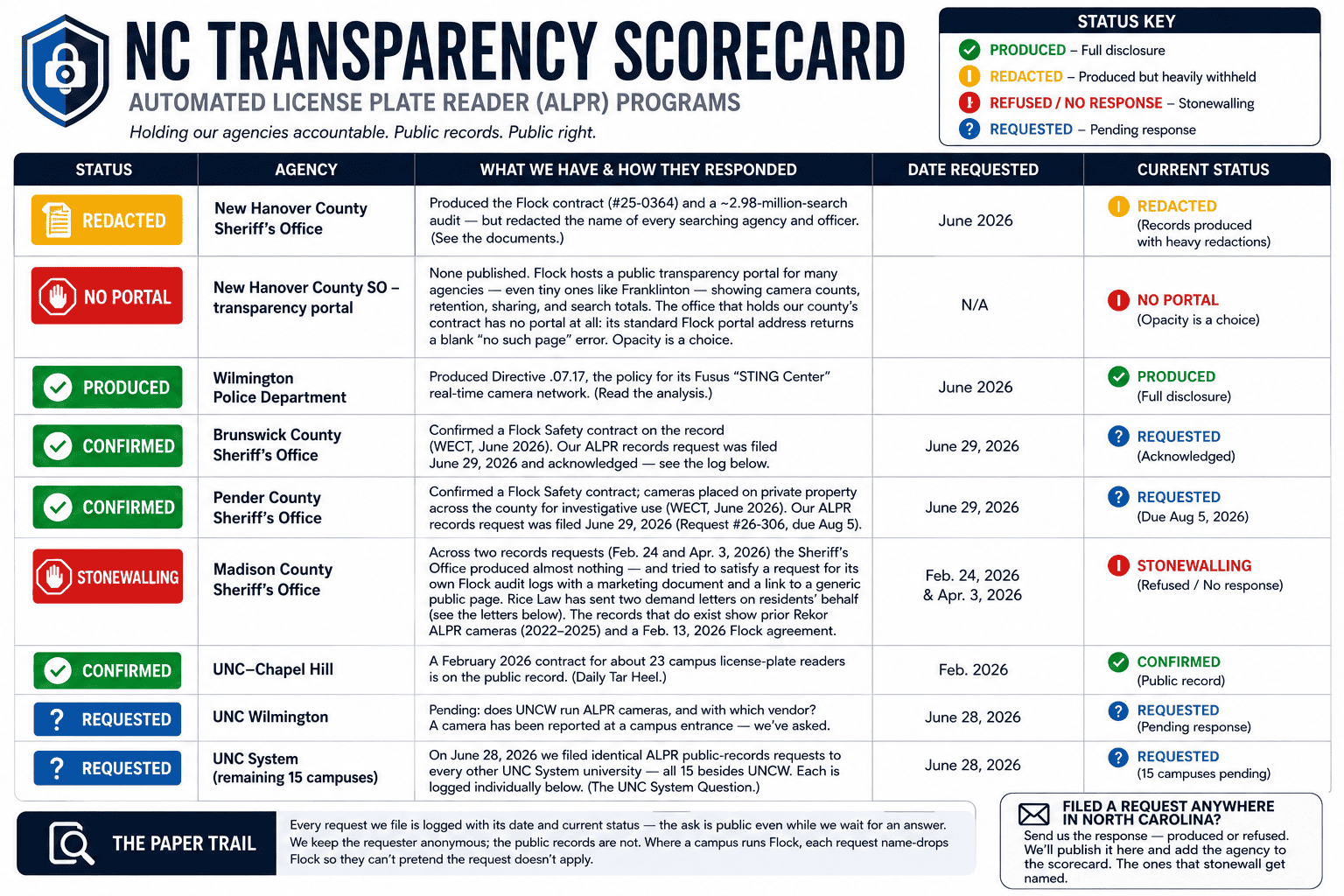
Every Request, Every Agency — One List
One running list of every public-records request in this campaign — each agency on its own line, with the date we filed and where it stands. Status key: Produced = full disclosure; Redacted = produced but heavily withheld; Stonewalling = refused or non-responsive; Pending = filed, awaiting a response. We keep the requester anonymous; the public records are not. Where an agency runs Flock, each request names Flock’s own Organization Audit, Network Audit, and Event Log — the same records that exposed nearly three million searches of New Hanover County’s network. Not every request is about Flock. Some target other surveillance systems — like the Wilmington Police Department’s Fusus “STING Center” real-time crime center — and ask for that system’s contracts, funding, policies, and camera-integration records instead of ALPR search logs. Each row says exactly what we asked for.
Key ALPR documents from across North Carolina and Washington, indexed and mirrored on the Internet Archive:
- NC State Bureau of Investigation & NC ISAAC — the SBI’s Initial Report to the General Assembly on the pilot authorizing ALPRs in state rights-of-way (154 pp.; Apr. 7, 2026; S.L. 2023-151 § 5(b) / 2024-43 § 3(b)), plus the 2017 NC Information Sharing & Analysis Center (NCISAAC) fusion-center presentation to the legislature.
- Davidson County — the Sheriff’s Office Flock contract, Sheriff Simmons’s memo, the Aug. 24 commissioners’ agenda item, and the Sheriff’s Office ALPR policy 4.5 (the county voted to remove its cameras Aug. 24).
- Asheville — the City Council resolution directing the City Manager to terminate the city’s Flock contract (adopted Aug. 25).
- Federal oversight — Sen. Josh Hawley’s Aug. 26 letter to Flock’s CEO opening a Senate Judiciary subcommittee investigation.
- Durham — Durham PD’s License Plate Reader General Order (No. 4089), the Real-Time Crime Center / Peregrine town-hall FAQ, and Rep. Valerie Foushee’s FY26 federal funding disclosure for the Durham PD RTCC.
- Charlotte-Mecklenburg — CMPD’s redacted Flock data-sharing MOU, and the NC State Auditor’s Rapid Response review of Charlotte Area Transit System (CATS) safety and security.
- NC drones & Drone-as-First-Responder (DFR) — the EFF FOIA of the FAA’s DFR/BVLOS waiver roster (nine NC agencies, incl. New Hanover County SO), the NC drone statute (G.S. 15A, Art. 16B) and the NC Sheriffs’ Association UAS legal guide, plus drone policies and records from Durham, Raleigh, Winston-Salem, and Charlotte-Mecklenburg — the ALPR-to-drone fusion that dispatches a drone to a Flock alert.
- Southern Shores — the Southern Shores Police Department ALPR policy (Dare County).
- Fayetteville PD — Clearview AI facial recognition — the full record obtained by public-records request: the purchase order, the Clearview account emails, and a usage report showing 3,013 facial-recognition searches (Dec. 2019–Apr. 2021), 1,739 (57%) returning a matching face.
| Filed | Agency | Status | The request |
|---|---|---|---|
| Feb 24, 2026 | New Hanover County Sheriff’s Office (contract & policies) | Produced | Our first ALPR/Flock request, for the contract, the policies, and the data-sharing agreements. Produced in March 2026: the Flock contract (#25-0364, about $219,000) and the Sheriff’s Office ALPR standard operating procedure. This request is complete and is not the one in dispute. Separately, the office that operates it published no Flock transparency portal for months — then launched one on Aug 10, 2026, a week before the county meeting. It lists 36 cameras and the office’s own search count, but not the network audit of who else has searched the system. (See the documents.) |
| Apr 28, 2026 | New Hanover County — the search audit (Contract #25-0364) | Mediation requested | The request that produced the search log, and the one still in dispute. We asked for the Flock Organization Audit, Network Audit and Event Log — the County’s own record of who searched its cameras. The County produced on June 11 (received June 18, after an email filter blocked it): 2,980,082 records, with the Organization Name field — the identity of the agency that ran each search — redacted to “***” in every single row, along with officer names, plates and case numbers. We do not contest the plate reads. We contest one field. Our June 18 demand letter (read it) asked the County to cure that one field, set out why Article 3D does not make agency identity confidential, and expressly withdrew any request for officer identities. It also noted that Buncombe County released the same field intact, under the same statute and the same vendor. Update (July 13, 2026): the County still has not released the searching-agency / entity information; that demand is being handled by Deputy County Attorney Karen Richards, whom we followed up with directly. The County’s stated position, in writing (June 29, 2026). Responding to our June 18 demand letter, Ms. Richards gave two grounds. First, on the searching agencies: “It would be my stance that a PRR to NHC does not grant you information about another entity or pulled by another entity … Please feel free to contact each agency you believe uses FLOCK & request that information from them.” Second, on the officers: deputies use an anonymous entry code that “may not remain anonymous” if released — and she noted the County was still seeking clarification on that second point. She committed to an update “next Monday,” which was July 6. It did not arrive. Update — July 20, 2026: we wrote again, and narrowed what we are asking for. Our letter accepts the officer-anonymity concern at face value and drops, for now, any request for individual officer identities. We ask only for the searching agencies — entity-level information — and we say plainly that producing the audit with agency names restored and entry codes still withheld resolves the dispute. That is not a line we invented. NC A&T State University Police — sworn law enforcement under § 116-40.5, on the same vendor platform, given a materially identical request — produced in eleven days, naming every searching organization (Texas DPS, Houston PD, Dallas PD, the NC SBI, the U.S. Postal Inspection Service) while redacting individual searcher names and plate numbers. The peer agency protected the officer and disclosed the agency. On the County’s first ground we disagree, and said so: the audit log is New Hanover County’s own record — generated by the system the County pays for, documenting queries against a network the County operates. Whose name appears inside a record has never determined whose record it is. And the alternative suggested cannot work: to ask each searching agency directly, we would first have to know which agencies searched, which is the very information being withheld. We also asked to meet and confer — in person, by phone, or by video, at the County’s convenience, including outside business hours, and with the Sheriff’s Office or the vendor present if that helps establish what the platform can export. Response requested by Friday, July 24, 2026. A correction of our own, the same afternoon. Our July 20 letter dated the disputed request to February 24. That was the earlier request, which the County answered in March. The request at issue is April 28, 2026, and we wrote to Ms. Richards to correct it ourselves rather than leave it in the record. In the same note we pointed out that the County’s second ground — the anonymous entry code — answers a request we had withdrawn eleven days before she raised it, and we listed six items from the June 18 letter that the June 29 response never reached, including the field-by-field statutory basis, the § 20-183.31(a) written policy, the § 20-183.31(a)(7) audit records, the sharing lists, and the data dictionary. One field remains in dispute: Organization Name. Update — August 3, 2026: we filed for mediation. With that one field still withheld, we filed a Request for Pre-Litigation Mediation of a Public Records Dispute under N.C. Gen. Stat. § 7A-38.3E, naming New Hanover County and the New Hanover County Sheriff’s Office, on the single remaining field — Organization Name. Filed August 3, 2026 in New Hanover County (No. 26M000599-640). (Read the file-stamped request.) Deadline — August 27, 2026: pre-litigation mediation under § 7A-38.3E(a) is consensual, so we asked New Hanover County and the Sheriff’s Office, through Deputy County Attorney Karen Richards, to confirm in writing whether they will agree to voluntary mediation, with a response requested by August 27, 2026. If the County and Sheriff do not agree, the next step is a Chapter 132 civil action (G.S. § 132-9), after which mediation becomes mandatory under § 7A-38.3E(b). Update — August 6, 2026: mediation is under discussion between the parties. The August 27, 2026 date for the County’s and Sheriff’s written answer stands. The files we have received are now archived. Every record New Hanover County and the City of Wilmington have released on ALPR — the contract, the policies, the full audit production, the Fusus directive — together with this correspondence, is mirrored permanently at the Internet Archive. The README there states every redaction we made and why. Download the full audit directly — all 2,980,082 rows (19 CSV files, 52 MB ZIP). |
| Jun 19, 2026 | New Hanover County — the accountability records (SOP 222 · #26-910) | Escalated | A narrow, one-month follow-up to the New Hanover file — and a test of whether the oversight the Sheriff points to actually exists on paper. For May 1–31, 2026 we asked for the records the Sheriff’s Office’s own ALPR policy, SOP 222, requires it to create and keep: the written outside-agency access requests and the ALPR Manager’s approvals before any disclosure (SOP 222.3.F.1; § 20-183.32(e)); any ALPR audit conducted during May (222.4.A.9); the access logs identifying every user or agency and the date and time of each access (222.5.D.2.c); the authorized-user list and operator training records (222.3.A; 222.4.A.7); maintenance and calibration records (§ 20-183.31(c)); the non-investigative hot-list configuration (222.3.E); the network/sharing configuration in effect that month; and any third-party disclosures, the Fusus API data flow, and data-sharing MOUs (§ 20-183.32(e); Agreement § 5.3). Filed via the County’s NextRequest portal; point of contact Alex Riley. Filed June 19, 2026 — Request #26-910; acknowledged June 22 with the County’s standard ‘researching responsive records’ message. Thirty-three days later, nothing has been produced and no completion date given. Follow-up sent July 22, 2026 asking for rolling production — or written confirmation, item by item, where no records exist — by August 5, 2026. The point is simple: these are records the Sheriff’s Office is required to keep. A written statement that the access logs or audits do not exist would not close the question — it would answer it. Update — August 5, 2026: third notice sent. The August 5 deadline arrived with no production, no completion date, and no further correspondence — forty-seven days after filing. We sent a third notice through the County’s portal asking, by Friday, August 14, 2026, for either (a) rolling production beginning with the access logs and the May audit, or (b) an item-by-item written confirmation of any category for which no record exists, and why. Absent one of the two, we will evaluate the remedy under Chapter 132 — § 132-9, including an action to compel and to recover costs and reasonable attorneys’ fees under § 132-9(c). The through-line has not changed: a written statement that the Office does not keep the access logs or audits its own SOP 222 requires would itself be a finding about whether that oversight exists on paper. |
| Aug 12, 2026 | New Hanover County Sheriff’s Office (facial recognition · #26-1244) | Pending | The facial-recognition companion to our ALPR work. No public record we have found shows the Sheriff’s Office owning or buying facial-recognition software — the Flock system is not it, and the Sheriff has said so. But owning it is not the only way to use it, so we asked for the paper on every route: contracts, quotes, trials, and demonstration agreements with any facial-recognition vendor (Clearview AI, DataWorks Plus, NEC, IDEMIA, Amazon Rekognition, PimEyes, Cognitec, Rank One, Paravision, Marinus, Vigilant/Motorola); any free trial or demo; facial-recognition policies and SOPs; whether Flock ALPR images or data have been exported — through Flock’s API or otherwise — to any system capable of facial recognition, plus the current list of third-party integrations and API consumers; any request for a facial-recognition search through the NC DMV, SBI, or FBI NGI, and any MOU or access credential; audit logs; and vendor communications — with a written no-records confirmation if the Office holds none, so a “no” is on the record rather than left to silence. Filed via the County’s NextRequest portal; point of contact Alex Riley. Filed August 12, 2026 — Request #26-1244. |
| Aug 30, 2026 | New Hanover County Sheriff’s Office (Clearview usage & audit · #26-1354) | Pending | The usage follow-up — and the one the earlier requests were building toward. When #26-1244 went in, no public record we had found showed the Sheriff’s Office owning facial-recognition software. It does. The County’s own records show a purchase of Clearview AI “Search PRO,” on a purchase order the County itself titled “NHCSO Facial Recognition Software” (Contract #24-0236, P.O. #20241713, procured through Carahsoft; $12,995/yr, 25 users, term dated Sept. 25, 2023). So this request stops asking whether and starts asking how it has been used. We asked for: the Clearview audit, usage, and search logs — each query’s timestamp, the user who ran it, any case-number/justification field, and the result count, in native CSV; the authorized-user roster (the 25 seats); the facial-recognition use policies (including any CJIS-required policy); training and certification records; usage metrics and match rates; any integration or export path between the Sheriff’s camera systems — Condor, Fusus, body/in-car — and Clearview (the route by which a captured image could be run through facial recognition); the full contract file; and Clearview and Carahsoft communications. The letter also demands a withholding log for anything claimed exempt, argues up front that audit metadata, rosters, policies, and contracts are administrative records and not § 132-1.4 criminal-investigation records, and asks the Office to preserve the logs and give a cost estimate first. Filed via the County’s NextRequest portal by Rice Law o/b/o DeFlockILM; point of contact Alex Riley. Filed August 30, 2026 — Request #26-1354; received the same day via web. |
| Feb 24, 2026 | Wilmington Police Department | Produced | Produced Directive .07.17, the policy governing its Fusus “STING Center” real-time camera network. (Read the analysis.) |
| Feb 24, 2026 | Madison County Sheriff’s Office | Stonewalling | Across three requests (Feb. 24, Apr. 3 and June 29, 2026) the Sheriff’s Office has produced almost nothing — and tried to satisfy a request for its own Flock audit logs with a marketing document and a link to a generic public page. The records that do exist show prior Rekor ALPR cameras (2022–2025) and a Feb. 13, 2026 Flock agreement. We have served three demand letters on residents’ behalf — published in full below. Update — July 14, 2026. On a single day the Sheriff’s Office answered two outstanding demands with two separate productions. Both are deficient, and each one refutes an objection the Office had been making. The first produced a single spreadsheet: an offense-type usage summary. It reports 3,302 searches across 33 offense categories, expressed as percentages. It does not say who ran them, when, why, or which networks they reached — and it does not state what period it covers, describing the data only as running “since we started using the system.” That is not the Organization Audit. The Organization Audit is a per-search log, and it is what was asked for. The second production contained exactly one new document, and copies of records already sent: the signature page of a Flock amendment, signed by Sheriff Harwood on June 22, 2026. Not the amendment — its signature page. Flock has not countersigned it. But directly above the Sheriff’s signature, the page warrants that by signing, the customer “has read and agrees to all of the terms and conditions contained in the previously executed Agreement.” The previously executed Agreement is the February 13, 2026 contract — the record this Office has maintained since February that it does not hold, and that Flock possesses. The Sheriff signed a warranty that he had read it. Everything else in that production was paper the requester already had. The summary is the problem with their own objection. Chief Deputy Duncan again invoked N.C. Gen. Stat. § 132-6 — that an agency need not create a record it does not have. But a breakdown of searches by offense type cannot be conjured from nothing. It can only be computed from the per-search audit data, which means the County holds that data, can query it, and exported a report derived from it on request. Exporting an existing report is production, not creation. The document offered to prove the records don’t exist is the document proving they do. Two categories drew no response at all. The Network Audit — every search run by an outside agency against Madison County’s cameras — and the network share settings showing what the County shares in and out. Not produced, not denied, no statement that a search was made and nothing found, and no statutory basis cited for withholding. The demand required one of those three. The County chose none of them. The request for a direct link to the agency’s own transparency page went unanswered as well, and the litigation-hold demand drew no acknowledgment — on a system whose audit logs purge on a schedule. The first of these requests was filed on February 24. The County has now had five months. |
| Jul 4, 2026 | NCDOT — Division 3 (Wilmington) & State Public Records Office (produced in full — resolved) | Produced | A different kind of request — not to a police agency, but to the road authority. Filed with NCDOT Division 3 (Wilmington) and the NCDOT State Public Records Office (Raleigh), this one doesn’t ask what the cameras record — it asks whether they were lawfully permitted and safely installed in the state’s own rights-of-way. It seeks: (A) every encroachment permit or agreement (N.C.G.S. § 136-93) authorizing any ALPR, PTZ, or Flock Condor device in NCDOT right-of-way in New Hanover County; (B) records across a list of state corridors (I-40, I-140, NC-133, US-421, US-74/76, and more); (C) any SBI ALPR pilot (S.L. 2023-151) applications, approvals, or MOUs; (D) roadside-safety and engineering review — breakaway-pole hardware (X2 Redi-Torque / Redi-Soil), MASH / NCHRP 350 crash-worthiness, and clear-zone setback; (E) any denials, deficiency notices, stop-work or removal orders, or complaints (Jan. 2018–present); and (F) vendor and installer records (Flock Safety and any licensed installers, per the Oct. 2023 Wake County order in the N.C. Alarm Systems Licensing Board matter). Fee waiver requested; production to info@deflockilm.org. Why it matters: a camera pole placed in a state right-of-way without an encroachment permit, or one that fails crash-safety standards, may be an unlawful or unsafe installation subject to removal — a compliance-and-safety angle that is entirely independent of the privacy debate. Read the full request (PDF) — free to copy and adapt for your own county or agency. Filed July 4, 2026; acknowledged July 6, 2026 (NCDOT Request #783351104621). NCDOT reports it has assigned the request to the proper records custodian to gather documents, which will then go through legal review under N.C.G.S. Chapter 132 before release. Update — August 3, 2026: with NCDOT’s ten-business-day window closed (on or about July 20) and no custodian named or production date given, we sent a status follow-up to the NCDOT Public Records Office — copying the Encroachments Office, Division 3 Engineer Trevor Carroll, and NCDOT records staff — asking who the assigned custodian is, for an estimated production date, and whether responsive records sit at the Division 3 (Wilmington) level. Update — August 5, 2026: with still no custodian named or production estimate, we sent a second follow-up on the same thread, again pressing for the assigned custodian, an estimated production date, and the Division 3 records status. Update — August 8, 2026: with the request now more than a month old and still no custodian, production date, or documents, we escalated to NCDOT leadership and counsel — a written status demand to Secretary of Transportation Daniel H. Johnson and General Counsel Ebony J. Pittman, copying the Public Records Office and the Encroachments Office. The demand asks NCDOT to name the assigned custodian, produce the encroachment and roadside-safety records “as promptly as possible” under N.C.G.S. § 132-6(a), and treat continued silence as a constructive denial that we may take to Superior Court to compel production and recover fees under § 132-9. Update — August 8, 2026: they had already answered. Our escalation crossed with a response we had not seen: on July 30, 2026, NCDOT public-records analyst Amira Ishak produced a substantive answer, which Meredith Vick re-sent when we pressed. We correct the record — NCDOT produced, and what it shows is larger than the request asked. (A) Encroachments: NCDOT has issued five ALPR encroachments in New Hanover County right-of-way — four to the New Hanover County Sheriff’s Office (approved July 7, Sept. 12, Oct. 6, and Dec. 29, 2025) and one to the State Highway Patrol (March 17, 2026); no HOA or municipality holds one. Unlike Pender, the Sheriff did place plate readers in state right-of-way — with permits. Condors: NCDOT treats Flock “Condor” live-view cameras as distinct from plate readers, and disclosed that NCDOT itself holds a signed data-sharing MOU with Flock Safety — executed March 31, 2026 by State Traffic Systems Operations Engineer Dom Ciaramitaro and Flock’s chief legal officer — giving NCDOT live-video access for “traffic monitoring, traffic operations, and emergency management,” and access to law-enforcement agencies’ Flock video when those agencies elect to share. NCDOT says it asked Flock to submit encroachment agreements for the live-view cameras, and Flock has not done so in New Hanover County — warning that a device placed in the right-of-way without approval “may be in violation of GS 136-18(10).” (C) SBI pilot: an SBI email dated March 4, 2025 confirms the New Hanover County Sheriff’s Office was accepted into the statewide ALPR pilot (S.L. 2023-151); no other county agency was. (D) Roadside safety: NCDOT produced the MASH breakaway-pole and structural analyses for one encroachment. The five full encroachment files are following by secure file transfer. Resolved — full production received. The five encroachment files followed by secure file transfer, completing the response: the encroachment agreement, the SBI memorandum, the MASH breakaway-pole and structural records, the traffic-control plans, and the location plan sheets all came through on a rolling basis. We have thanked the NCDOT Public Records Office — analyst Ms. Ishak, with credit to Ms. Vick and Mr. Harding — for a thorough and cooperative response, and consider our records file complete. The substantive thread the records opened — NCDOT’s own March 31, 2026 data-sharing MOU with Flock and its treatment of ‘Condor’ live-view cameras as distinct from plate readers — we continue to pursue on the merits with Traffic Systems Operations. We have published everything NCDOT produced. |
| Jun 28, 2026 | UNC Wilmington — Office of General Counsel (responded — no Flock) | Responded | Full ALPR / Flock public-records request (the standard template above): all vendor contracts; ALPR policies and SOPs; camera counts and the areas they cover; the data-retention schedule; all data-sharing agreements and MOUs — including with the New Hanover County Sheriff’s Office, the SBI, ICE, CBP, other UNC System institutions, and any nationwide lookup network; 12 months of search audit logs; misuse and discipline records; and vendor communications. Sent to the Office of General Counsel; the original recipient has retired, so it was redirected to Assistant General Counsel Samantha Taylor. A same-day supplement adds the named Flock audit reports — the Organization Audit, Network Audit, and Event Log — plus the network/sharing configuration and ALPR/hot-list sharing lists for March–May 2026, in native CSV/Excel. Acknowledged July 22, 2026 by Assistant General Counsel Samantha Taylor, who candidly apologized for the delay, explained the request had been redirected after the original recipient’s retirement, and committed that the University would fully respond by August 1, 2026; we offered rolling production, prioritizing the Flock Network Audit (Insights tab, most recent three months, native CSV), without withdrawing any item. Update — August 5, 2026: follow-up sent. August 1 — the date the University itself set — passed without a production or a further date. We wrote again, in the same collegial spirit, asking by Friday, August 14, 2026 for the Network Audit now with the remaining items on a rolling basis, or a written completion date. As UNCW is New Hanover County’s own university, we would rather report a prompt, full production than a dispute. (Read the follow-up, staff emails redacted.) Update — Aug 27, 2026: UNCW answered, and the news is straightforward. Through Assistant General Counsel Samantha Taylor, the University confirmed it does not operate any Flock or other ALPR cameras on campus and has never operated a Flock system — so there is no plate data, no retention schedule, no audit logs, no data-sharing MOUs, and no ALPR policy. Two disclosures round it out. First, UNCW parking enforcement runs four human-operated LPR cameras on two vehicles that read plates in campus lots against an internal parking-permit database only — not a networked, Flock-style system. Second, the one responsive record: UNCW ran a no-cost ALPR demonstration from KNC Technologies on the ‘Cloudrunner’ system, December 2025 through June 2026 — a different vendor than Flock — and the demo has ended, with UNCW stating it no longer has access to Cloudrunner or its data. We credit a clear, complete answer and consider this request resolved. |
| Jun 28, 2026 | Appalachian State University — Office of General Counsel | Produced — closed | Standard ALPR/Flock records request (vendor contracts, ALPR policies, camera counts & coverage, retention schedule, data-sharing MOUs incl. campus↔city police, the NC SBI, ICE, CBP & any nationwide lookup network, the Flock Organization & Network Audit (Insights tab, most recent 3 months), misuse/discipline records). Filed via the university’s NextRequest public-records portal; OGC ogc@appstate.edu. Filed June 28, 2026 — Request #26-154. The University confirmed on July 24, 2026 that it would produce responsive records on a rolling basis. Produced (partial) — August 11, 2026. App State released the Flock vendor contract, the App State PD ALPR policy, and three months of Flock Network Audits (March–May 2026). What the audit shows: App State’s cameras were searched 1,511,722 times in three months by 3,487 agencies — 84.3% from outside North Carolina (NC just 15.5%). The single heaviest searcher of this public mountain campus was Houston, TX PD — 177,461 searches; Texas agencies alone ran 335,385. The files are complete (not truncated). The production is mirrored at the Internet Archive. Closed — Aug 28, 2026. We accept the production as delivered. The substance is here — the contract, the ALPR policy, and three months of Network Audits that already name the 3,487 searching agencies — so the who-is-watching record is public. We are not further pursuing the three fields App State withheld under § 132-1.7 (camera count/locations, sharing configuration, and partner names); the audit answers the core question, and our resources are better spent on the agencies still hiding the record entirely. |
| Jun 28, 2026 | East Carolina University — Office of University Counsel | Produced | Standard ALPR/Flock records request (contracts, policies, camera counts, retention, data-sharing MOUs incl. SBI/ICE/CBP, the Flock Organization & Network Audit (Insights tab, most recent 3 months), misuse records). Submitted via ECU’s public-records portal; Public Records Officer Sandra Strickland, General Counsel Meagan Kiser. Filed June 28, 2026 — reference RR-02558; acknowledged. Update: ECU’s records officer asked us to clarify the “policy violations” item; we responded through the portal confirming the request seeks ALPR access and misuse audit records — not parking or student-conduct files. Second follow-up sent July 22, 2026 — the clarification confirmed, we offered rolling production, prioritizing the Flock Network Audit (Insights tab, most recent three months, native CSV), without withdrawing any item; response requested by Aug 1, 2026. Update — July 31, 2026: ECU gave a firm date. Public Records Officer Sandra Strickland replied that the University is “continuing to gather and review records responsive to the request” and committed to a response by Friday, August 7, 2026. Produced — August 7, 2026, on the committed date, in full. Like NC State, ECU does not run Flock. Its parking program operates a Genetec AutoVu / AIMS parking-management LPR system (AIMS software by EDC Corporation) — five mobile, vehicle-mounted ALPR units and two fixed AutoVu SharpV cameras near the parking garage — for campus parking enforcement, not a law-enforcement network. The AIMS license runs July 1, 2025 – June 30, 2030, with a Data Protection Agreement attached; retention is 90 days for non-enforcement plate data (§ 20-183.32(a)); and ECU states it holds no MOUs or data-sharing agreements, no hot-list network, and shares data with no agency, using it “solely for internal administrative parking purposes” and never selling it. With no Flock network there is no Network Audit, and ECU identified no misuse records — a complete, cooperative production. The full file is mirrored at the Internet Archive. Like NC State’s, ECU’s plate-reading is a walled-off parking system — the counterexample to the nationwide Flock networks elsewhere in the System. |
| Jun 28, 2026 | Elizabeth City State University — Legal Affairs | Responded — no program | Standard ALPR/Flock records request (contracts, policies, camera counts, retention, data-sharing MOUs incl. SBI/ICE/CBP, the Flock Organization & Network Audit (Insights tab, most recent 3 months), misuse records). Filed by email to Legal Affairs, legalaffairs@ecsu.edu (General Counsel Regina C. Rudisill). Filed June 28, 2026 — acknowledged. Follow-up sent July 13, 2026. Second follow-up sent July 22, 2026 — we offered rolling production, prioritizing the Flock Network Audit (Insights tab, most recent three months, native CSV), without withdrawing any item; response requested by Aug 1, 2026. Update — August 5, 2026: escalated. August 1 passed with no production, no completion date, and no exemption cited. We sent a firm escalation copying Chancellor S. Keith Hargrove — noting that seven UNC System institutions have already produced or begun rolling production of the identical request (UNC School of the Arts in three days, NC A&T in eleven) while ECSU alone has produced nothing — and setting an August 14, 2026 deadline before we treat the request as constructively denied and evaluate the remedy under § 132-9, costs and reasonable attorneys’ fees included under § 132-9(c). (Read the escalation.) Update — August 5, 2026 (same day): the escalation broke the silence. Hours later, ECSU General Counsel Regina C. Rudisill replied — copying Chancellor Hargrove — that the University “will work to fulfill your request as soon as possible” and would follow up with an anticipated timeline on Monday, August 10. No records or firm production date yet, but after five weeks of silence the office is now engaged. We hold the August 14 deadline. Update — the answer is no program. General Counsel Regina C. Rudisill confirmed that ECSU does not contract with Flock and operates or controls no ALPR system (Flock, Genetec, Motorola, or other) — it holds no responsive records because it runs no such program. She noted roughly two Flock cameras in the city of Elizabeth City, none on campus. Effectively a written ‘no records’ answer. Update — Aug 20: we sent a short closeout clarifying that the request reaches all ALPR, any vendor, operated or accessed — and asked for a one-line confirmation that ECSU neither operates nor accesses any outside plate-reader network, after which we close. Update — Aug 28: nudge sent to GC Rudisill for that one-line confirmation on outside-network access; a ‘confirmed’ reply resolves the request. Update — Sept 9: second nudge sent, requesting the outside-network-access confirmation by Sept 14. Update — Sept 23: final follow-up. With no reply, we sent a closing note giving ECSU until Oct 3, 2026 to confirm that no ECSU officer or account accesses, queries, or receives data from any outside ALPR network (any vendor) via a shared network, MOU, or another agency’s system — and providing that continued silence will be understood as the University having no such outside access to report, on which basis we close the file. A clean no-ALPR / no-campus-program result. Correspondence mirrored at the Internet Archive. |
| Jun 28, 2026 | Fayetteville State University — Office of General Counsel | Responding — rolling (not Flock) | Standard ALPR/Flock records request (contracts, policies, camera counts, retention, data-sharing MOUs incl. SBI/ICE/CBP, the Flock Organization & Network Audit (Insights tab, most recent 3 months), misuse records). Filed via FSU’s public-records portal (HighQ); General Counsel Wanda L. Jenkins. Filed June 28, 2026 — reference Matter:00211; portal-acknowledged. Follow-up sent July 13, 2026. Second follow-up sent July 22, 2026 — we offered rolling production, prioritizing the Flock Network Audit (Insights tab, most recent three months, native CSV), without withdrawing any item; response requested by Aug 1, 2026. Update — August 5, 2026: escalated. August 1 passed with no production, no completion date, and no exemption cited — and beyond the portal’s automatic matter number, no substantive response of any kind. We sent a firm escalation copying Chancellor Darrell T. Allison — noting that seven UNC System institutions have already produced or begun rolling production of the identical request (UNC School of the Arts in three days, NC A&T in eleven) while Fayetteville State alone has produced nothing — and setting an August 14, 2026 deadline before we treat the request as constructively denied and evaluate the remedy under § 132-9, costs and reasonable attorneys’ fees included under § 132-9(c). (Read the escalation, counsel’s email redacted.) Update — August 7, 2026: FSU pushes back on the deadline — but still produces nothing. Deputy General Counsel Benita G. Powell replied that the University “cannot commit to a requester-imposed deadline” and “does not and will not consider an inability to meet” the August 14 date “to constitute a denial, constructive denial, or any other form of denial,” adding that the request “remains active and is being processed.” Six weeks in, that is still zero records, no completion date, and no exemption cited. We narrowed the dispute in reply: North Carolina sets no fixed deadline, and we dropped the “constructive denial” label — but § 132-6(a)‘s “as promptly as possible” is a reasonableness standard a backlog cannot suspend (State Emps. Ass’n, 2010), and nine System peers produced the identical request, several within days. If no records or itemized basis arrive by August 14, the recourse is not a label but an action to compel production under § 132-9, costs and reasonable attorneys’ fees available under § 132-9(c). Fayetteville State is now the lone System institution still at zero.) Update — August 11, 2026: FSU breaks its silence with substance. Deputy General Counsel Benita G. Powell reported that the University has no operational ALPR system yet — it is in the onboarding and testing phase — and that while it has executed contracts for the ALPR system it anticipates using, it has no Flock Safety contract. FSU committed to produce responsive, non-exempt records on a rolling basis (contracts, policies, camera counts, retention, data-sharing, audits). We replied the same day to underscore that the request is vendor-neutral — it covers all ALPR, not only Flock, so the executed non-Flock contracts are squarely responsive and should lead the production; that “onboarding/testing” does not exempt existing records; and that § 20-183.31(a) requires a written ALPR policy before a system goes live. It is the UNC Greensboro pattern again: “we don’t have Flock” is not “we don’t have ALPR.” The full thread is on the Internet Archive. We hold the Aug 14 window and welcome rolling production. Update — Aug 14, 2026: first rolling production. Legal Associate Joseph Bates produced two records — the FSU DPPS ALPR standard operating procedure (ALPR data used for official law-enforcement purposes only; 90-day retention unless a warrant or a sworn preservation request applies; framed to CALEA 41.3.9) and the University’s Surveillance Technology Policy (governing collection, retention, and destruction of images from campus surveillance technology, including body-worn cameras). The request remains active and under rolling review. Still to come: the executed (non-Flock) ALPR vendor contract, the camera count and locations, retention practices in operation, data-sharing agreements, and audit records — to the extent they exist, given the system is still in onboarding/testing. Both policies are mirrored at the Internet Archive. Update — Aug 29, 2026: we replied to Legal Associate Bates. We credited the ALPR SOP and Surveillance Technology Policy, then pressed the item that should be readily producible now: the executed (non-Flock) ALPR vendor contract the University has said it holds — a single existing document, responsive whether or not the system is yet operational, with the vendor’s name intact — along with the planned camera count, retention/sharing settings, and any audit records as the system goes live. Rolling production welcome; a ‘no records yet’ note answers anything that doesn’t exist during onboarding. Update — Sept 2, 2026: another record, and a deficiency letter. Legal Associate Joseph Bates produced one more document — a Mutual Aid Agreement between the Fayetteville State University Police and the Fayetteville Police Department, executed April 2026. It is a general mutual-aid agreement under § 160A-288 (temporary loans of officers, equipment, and supplies, and proportional sharing of forfeited assets) — not an ALPR data-sharing agreement, and it does not mention plate readers or say whether FSU will share LPR data with the city police. We sent a deficiency letter the same day: crediting the production, then pressing the item that should lead — the executed (non-Flock) ALPR vendor contract Deputy GC Powell confirmed on Aug 11 the University holds, with the vendor’s name intact, by September 16, 2026 — along with the camera count and areas, the retention and data-sharing settings, and any audit records as the system goes live. The letter reserves the § 132-9 remedy (costs and fees under § 132-9(c)) and adds a § 132-3 preservation demand: preserve all responsive records and suspend the SOP’s 90-day auto-purge as to any plate-read or audit data once the system is operational, so the audit trail is not lost while the request is pending. The thread and the produced records are mirrored at the Internet Archive. Update — Sept 23, 2026: hard-deadline follow-up on the overdue contract. September 16 passed with no vendor contract produced, so we sent a firmer demand to Legal Associate Bates (cc Deputy GC Powell) on the one admitted-to-exist item: the executed ALPR vendor contract, with the vendor’s name intact, plus any order form, quote, or amendment, by 5:00 p.m. Friday, Oct 3, 2026. It answers the two usual objections — “onboarding/testing” does not exempt a contract the University already holds under § 132-6(a), and any claimed-exempt portion must be identified with a statutory basis and the segregable non-exempt terms produced (the vendor’s identity and commercial terms are not exempt) — and states that absent production or an itemized basis we will treat the item as constructively denied and evaluate the § 132-9 remedy (costs and fees under § 132-9(c)). Camera count, retention/sharing settings, any ALPR-specific data-sharing agreement, and audit records remain welcome on a rolling schedule, with the § 132-3 preservation ask renewed. |
| Jun 28, 2026 | North Carolina A&T State University Police — Legal Affairs & Compliance | Produced | Standard ALPR/Flock records request (contracts, policies, camera counts, retention, data-sharing MOUs incl. SBI/ICE/CBP, the Flock Organization & Network Audit for the most recent 3 months, misuse records). Filed by email to public_records@ncat.edu; General Counsel Melissa J. Holloway. Filed June 28, 2026 — produced July 9, 2026 via NC A&T’s ‘Aggies SecureShare’ portal. A complete disclosure — and a revealing one. NC A&T Police run 16 Flock LPR cameras ringing their Greensboro campus, at $51,240 per year (invoice INV-90184; $3,000 per camera plus tax, a 12-month renewal term). But the story is the audit. The Flock Network Audit for March–May 2026 records 1,390,776 searches that touched A&T’s shared network, run by 3,487 different organizations — overwhelmingly out of state (Texas DPS 36,242; Houston PD 35,264; Dallas PD 20,993; Fort Worth PD; Kansas Highway Patrol; plus Florida, Georgia, Oklahoma & Indiana agencies), alongside the NC SBI (10,702) and a federal agency — the U.S. Postal Inspection Service (11,781 searches). Searcher names and plate numbers are redacted (‘***’) in the network audit; the searching agency is not — and 974 of those searches cite immigration reasons (‘Immigration (civil/administrative),’ ‘Immigration (criminal),’ HSI). By contrast, A&T’s own officers ran just 261 searches in the same window, and 77.8% were traffic infractions — not violent crime. The sharing web spans 363 organizations, including out-of-state departments, that federal agency, and even private apartment-complex networks across a dozen states. Run the numbers yourself. We’re publishing the full production — every audit CSV, the camera list with GPS, the network-sharing config, and the invoice — as one download: the complete NC A&T Flock dataset (.zip). (Figures are DeFlockILM’s own tally of the produced audit files, parsed for accurate record counts.) |
| Jun 28, 2026 | North Carolina Central University — Office of Legal Affairs | Producing (partial) — mediation held | Standard ALPR/Flock records request (contracts, policies, camera counts, retention, data-sharing MOUs incl. SBI/ICE/CBP, the Flock Organization & Network Audit (Insights tab, most recent 3 months), misuse records). Filed via NCCU’s NextRequest portal; General Counsel Matthew Tulchin. Filed June 28, 2026 — Request #26-174. Follow-ups July 13 and July 22. Response (July 23, 2026): General Counsel Tulchin declined to give any timeframe — citing a ‘first come, first served’ practice and a “significant backlog,” noting the Act sets no fixed deadline, and dismissing the peer-institution comparison as irrelevant — while producing no records, setting no completion date, and identifying no exemption. We replied the same day with a formal demand letter laying out the governing law: production “as promptly as possible” and the ‘liberal access’ standard that rejected a first-come-first-served justification (State Emps. Ass’n v. Dep’t of State Treasurer, 2010); no duty to create records but a duty to produce those that exist (Ochsner, 2019); vendor-held data still reachable where the University’s contract gives it a right to that data (Gray Media Grp. v. City of Charlotte, 2023); and that § 132-1.4 does not convert a vendor contract or administrative audit into a non-public record (Gannett v. SBI, 2004). The letter asks for the contract now, the remainder on a rolling basis, and an itemized statutory basis for any withholding, by Monday, August 3, 2026 — failing which we will evaluate the remedies available under Chapter 132 (§ 132-9). Update — August 5, 2026: we invited NCCU to mediation. With August 3 past and no production and no further word, we sent the University an invitation to pre-litigation mediation under N.C. Gen. Stat. § 7A-38.3E(a), which is consensual. We noted that seven UNC System institutions have already produced or begun rolling production of the identical request, and that NCCU stands out as the one that declined to commit to any timeframe at all. We asked the University to confirm in writing by Friday, August 14, 2026 whether it will agree to voluntary mediation; if it declines, § 7A-38.3E makes mediation mandatory once a Chapter 132 action (§ 132-9) is filed — the same table, after a filing rather than before. (Read the invitation, counsel emails redacted.) Update — August 14, 2026: the University is now receptive — it agreed to voluntary mediation under § 7A-38.3E and committed to begin producing, starting with its ALPR vendor contract. The same day we proposed two NCDRC-certified Superior Court mediators — retired Resident Superior Court Judge William H. Freeman and former U.S. Magistrate Judge Charles K. ‘Ken’ McCotter, Jr., either of whom would serve remotely and statewide — and offered to prepare and circulate the AOC § 7A-38.3E form for filing in Durham Superior Court, with the contract leading a rolling production. Update — Aug 27, 2026: check-in sent. With no reply on the mediator and no contract produced in the two weeks since, we wrote General Counsel Tulchin again, asking by Wednesday, Sept 3, 2026 that he (1) confirm Freeman or McCotter or name an alternate, and (2) produce the Flock/ALPR vendor contract he committed to review first. The tone stays collaborative — NCCU agreed to mediate — but the file needed a date to keep it moving.) Update — Sept 2, 2026: NCCU produced — and the vendor is not Flock. General Counsel Tulchin released four records and asserted they “obviate the need for mediation.” They do not — the record that names who searched the cameras was not among them — but the production is a real break, and it answers the vendor question. NCCU runs Leonardo/ELSAG ‘Street Sentry’ license-plate readers — not Flock: a 2025 purchase order (P0141220, Dec 12, 2025) and a 2026 renewal quote (#33422) both cover nine LPR units from Leonardo US Cyber & Security Solutions, LLC of Greensboro, the maker of the ELSAG ALPR line, at $550 per camera per year ($4,950). The University also produced its ALPR Policy 430 (Lexipol; 90-day retention; bars ALPR use for traffic-violation enforcement per § 20-183.31; and directs an annual audit report to the Chief of Police) and — the significant one — a data-sharing MOU with the Atlanta-Carolinas High Intensity Drug Trafficking Area (AC-HIDTA). That MOU makes NCCU Police a member of a multi-state (Georgia, South Carolina, North Carolina) LPR database governed by an executive board of 120+ law-enforcement executives; the University’s plate reads flow over a VPN to the AC-HIDTA Operations Center, are retained up to two years, and are shared with member agencies across three states on a “need to know” basis. So a public HBCU campus’s nine plate readers feed a regional, federally-organized drug-intelligence network. What is still missing: the search/access audit (who queried NCCU’s cameras, when, and for what stated reason — the Leonardo/ELSAG equivalent of the Flock Network Audit, and the item of greatest public interest); the annual audit report to the Chief that Policy 430.6.1 requires; the underlying acquisition contract and any Leonardo master or software-license agreement (the University produced only a warranty PO and renewal quote); the camera-location list; the AC-HIDTA user roster and hot-lists; and any per-item ‘no responsive records’ certification or exemption log. Because those core items are unproduced, the production does not moot the dispute, and the § 7A-38.3E mediation stands — the next step is a deficiency letter identifying the audit and the contract as the records that lead. (General Counsel Tulchin departs the University Sept 11; correspondence after that date goes to Tiara Nicholson. The produced records are being mirrored at the Internet Archive.) Update — Sept 2, 2026 (same day): resolution letter sent. We replied with a short deficiency-and-resolution letter offering to close the entire request — and skip mediation — in exchange for two written items: (1) a statement of who installed and who services the nine Street Sentry units, and (2) the user-access / query audit log the AC-HIDTA MOU (§ 6.3) and Policy 430.6.1 require, for the most recent three months in native format. Everything else is waived on receipt. We asked for a response by September 16, 2026, failing which the agreed § 7A-38.3E mediation proceeds. |
| Jun 28, 2026 | North Carolina State University — Office of General Counsel | Produced | Standard ALPR/Flock records request (contracts, policies, camera counts, retention, data-sharing MOUs incl. SBI/ICE/CBP, the Flock Organization & Network Audit, misuse records). Filed via NC State’s NextRequest portal; Records Officer Charlotte Clevenger, General Counsel Allison Newhart. Filed June 28, 2026 — Request #26-423. Follow-ups July 13 and July 22. Produced in full on July 23, 2026 — a complete, transparent response, and a clarifying one: NC State does not run Flock. Its Department of Transportation operates a Genetec AutoVu / AIMS parking-management LPR system — 14 fixed cameras at parking-lot and deck entrances, plus roughly nine mobile enforcement units — for parking-space utilization, enforcement, and gate access, not a nationwide law-enforcement network. With no Flock, there is no Network Audit to produce. What the records do show: a written LPR Data Collection & Privacy Operating Procedure (effective July 1, 2018, reviewed annually by the Director of Transportation), a 7-day video-retention line in the AIMS support quote, and a July 2025 MOU giving University Police access to the AIMS parking database (Shibboleth accounts; a single user before 5 PM, multiple after). The full production — the AIMS support quote, purchase order, the LPR procedure, the fixed/mobile camera list, and the Transportation–Police MOU — is mirrored at the Internet Archive. A reminder that the surveillance question reaches beyond Flock, to the Genetec, Rekor, and parking-LPR systems already on North Carolina campuses. |
| Jun 28, 2026 | UNC Asheville — Office of General Counsel | Audits produced — rolling | Standard ALPR/Flock records request (contracts, policies, camera counts, retention, data-sharing MOUs incl. SBI/ICE/CBP, the Flock Organization & Network Audit (Insights tab, most recent 3 months), misuse records). Filed by email to the Office of General Counsel under Policy 910; the office redirected us to its new permanent General Counsel Caroline McLean, and the request was forwarded there. Filed June 28, 2026. On June 29, GC McLean asked us to re-submit through UNCA’s intake form; done the same day and acknowledged — with notice that the office is “an office of one” and responses may be delayed. Follow-up sent July 13, 2026. Second follow-up sent July 22, 2026 — we offered rolling production, prioritizing the Flock Network Audit (Insights tab, most recent three months, native CSV), without withdrawing any item; response requested by Aug 1, 2026. Update — August 5, 2026: with Aug 1 lapsed and no production, completion date, or cited exemption, we sent a third notice (escalation) to General Counsel, copying Chancellor Kimberly van Noort. It credits the office’s early cooperation, then cites § 132-6(a) (“as promptly as possible”), State Emps. Ass’n (2010), Ochsner (2019), Gray Media (2023), and Gannett v. SBI (2004); sets an August 14, 2026 deadline to produce the vendor contract and Flock Network Audit (native CSV); and offers pre-litigation mediation under § 7A-38.3E before any § 132-9 action to compel and recover fees under § 132-9(c). Update — August 10, 2026: GC McLean produced UNC Asheville PD’s Flock Safety “Law Enforcement Agreement” (the vendor contract), apologized for the delay (high public-records volume), and said she is working to obtain the remainder (Network Audit and policy). The contract is archived on the Internet Archive. The same day, we confirmed receipt of the contract and itemized the four items still outstanding — the Flock Network Audit (Insights export, three months, native CSV), the written ALPR/Flock policy and retention setting, any data-sharing agreements or MOUs (SBI, and any ICE/CBP or other outside agency), and any misuse, audit-flag, or discipline records — and asked for the audit and policy by August 14, 2026, with rolling production welcome. Update — Aug 28, 2026: GC McLean advised she will be in touch next week with the remaining items; we thanked her and are holding. The Network Audit, written policy/retention, any data-sharing MOUs, and misuse records remain the open items, expected in that next production. A cooperative custodian working a genuine one-person backlog — no escalation needed while she’s producing. Update — September 8, 2026: the audits are in — and they are staggering. GC McLean produced the second batch: the Flock Organization Audit, Network Audit, and Event Log for March 1–May 31, 2026, in native Excel. The Network Audit — who searched UNC Asheville PD’s campus cameras — records 1,280,229 searches in three months by 3,472 different agencies, overwhelmingly out of state. The heaviest searchers are Texas: Texas DPS (34,715), Houston PD (33,087), Dallas PD (20,171), Fort Worth PD (14,541) — with Coweta County GA, Kansas Highway Patrol, Florida and Oklahoma agencies, and the NC SBI (10,033) close behind. 69% of searches carried no case number, and the median search reached 6,127 networks at once (max 7,079) — the one-search-reaches-everywhere design. Officer names and search reasons were not populated or were redacted. UNC Asheville’s own use is small by contrast (a few hundred searches), but its offense codes include categories North Carolina law questions for ALPR — “Traffic Infraction” (39) and “City Planning/Traffic Analysis” (66), against § 20-183.31(b)’s bar on traffic-enforcement use. The context that makes it sting: this is the same city whose City Council voted 5–2 to cancel Flock on Aug. 25 — while the University’s separate campus network kept being searched more than a million times a quarter. Written policy/retention, data-sharing MOUs, and misuse records remain on rolling production. The audit files will be preserved at the Internet Archive. Update — Sept 9, 2026: we thanked GC McLean, confirmed receipt, and itemized the four categories still outstanding — the written ALPR policy and retention setting, the network sharing/discoverability configuration and any SBI/ICE/CBP MOUs, the camera count and locations, and any misuse or discipline records — with rolling production welcome. Update — Sept 23, 2026: with the four items silent since Sept 9, we sent a follow-up push restating them and asking for the remainder — or a specific completion date — by October 3, 2026, with rolling production and a “no records held” statement for any empty category both welcome. Cooperative one-person office; no escalation while she’s producing. |
| Jun 28, 2026 | UNC–Chapel Hill — Public Records Office | Disputed — audit refused (§ 132-1.4) | ALPR/Flock records request targeting the February 2026 Flock contract and the reported ~23-camera campus deployment: full contract, camera counts & coverage, retention, all data-sharing MOUs (incl. ICE/CBP/SBI), and the Flock Organization & Network Audit (Insights tab, most recent 3 months). Filed via UNC’s NextRequest portal / publicrecords@unc.edu. Filed June 28, 2026 — Request #26-564. Follow-up sent July 13, 2026. Second follow-up sent July 22, 2026 — we offered rolling production, prioritizing the Flock Network Audit (Insights tab, most recent three months, native CSV), without withdrawing any item; response requested by Aug 1, 2026. Update — July 30, 2026: UNC–Chapel Hill released a first set of documents and stated the request is still being processed. The release includes the Flock Master Services Agreement and a signed Amendment (the vendor contract), plus two Flock “Insights” vehicle-volume dashboards — one showing 2,204,154 total reads and 998,456 unique vehicles captured on the campus network. Still outstanding: the Network Audit in native CSV (which outside agencies searched the campus cameras, and why), the ALPR policy/SOP, the retention schedule, all data-sharing MOUs, the sharing configuration, the agency share/receive and hot-list lists, and any misuse records — along with any 2026 renewal. Partial production credited; the balance remains open. Update — August 5, 2026: we sent a deficiency-and-thanks letter through the portal — crediting the contract and dashboards, then itemizing the seven records still outstanding, led by the Network Audit in native CSV (which outside agencies searched the campus cameras, and why), and citing § 132-6(a) and the native-format right under § 132-6.2(a). Rolling production offered; awaiting the balance. Update — August 7, 2026: UNC–Chapel Hill produced two more records. The first is the department’s written ALPR policy (effective June 7, 2024; Chief Brian James) — which cures the policy item and sets a 30-day auto-purge, stricter than the 90-day statutory ceiling, with preservation up to one year on a sworn law-enforcement request. The second is usage data: a daily vehicle-read dashboard totaling 2,022,828 reads from June 30 to July 29 and 17,189,148 year to date, plus a search-reason breakdown showing 33 searches in the window — led by burglary/breaking-and-entering (17), missing or endangered persons (6), and hit-and-run (4). The scale is the point: millions of plates scanned, a few dozen ever searched. Still open: the Network Audit in native CSV naming which outside agencies searched the campus cameras and why, the data-sharing MOUs, the sharing configuration, the agency share/receive and hot-list lists, any misuse records, and any 2026 renewal. We credit the policy and usage data and continue to press the balance. Update — Aug 11–20, 2026: the University produced its own usage data but refuses the audit as a “criminal investigation.” On Aug 11 the Public Records Office tried to close #26-564, withholding “any other records” under N.C. Gen. Stat. § 132-1.4 (records of criminal investigations) and § 132-1.7, and deferring the rest to a future Flock website. We reopened the same day: § 132-1.4(f) provides that a record’s use in an investigation “shall not affect its status as a public record”; the Network Audit is administrative access metadata (which agency searched, when, across how many networks), not an investigative record (News & Observer v. Poole; Gannett v. SBI); § 132-1.7 does not reach an access log, a sharing setting, or a camera count; and five NC agencies on the same vendor — Carolina Beach, Kure Beach, NC A&T, UNC Pembroke, and UNC Charlotte (a sister UNC-System campus) — produced the Network Audit while protecting individual officers. A Flock portal shows only the Organization Audit, not the inbound Network Audit at issue. Update — Aug 20: University Counsel confirmed in writing there are no data-sharing MOUs and no misuse/discipline records, that the University runs 23 Flock cameras, and that the sharing configuration is “State.” That narrows the dispute to a single category: the Organization Audit, Network Audit, and Event Log, which the University refuses on § 132-1.4 criminal-investigation grounds. The full correspondence and the produced records are mirrored at the Internet Archive. |
| Jun 28, 2026 | UNC Charlotte — Office of Legal Affairs | Produced — closed | Standard ALPR/Flock records request (contracts, policies, camera counts, retention, data-sharing MOUs incl. SBI/ICE/CBP, the Flock Organization & Network Audit (Insights tab, most recent 3 months), misuse records). Filed via UNC Charlotte’s NextRequest portal; General Counsel Jesh Humphrey. Filed June 28, 2026 — Request #26-206. Follow-up sent July 13, 2026. Response (July 13, 2026): Public Records Officer Tina Dadio replied that she is working through requests as received and is the sole staff member assigned to public records, which “may further impact response time.” Second follow-up sent July 22, 2026 — we offered rolling production, prioritizing the Flock Network Audit (Insights tab, most recent three months, native CSV), without withdrawing any item; response requested by Aug 1, 2026. Produced (July 30, 2026) — a full production, delivered in a zip. The University produced its fully executed Flock contract, three months of Flock Network Audits (March–May 2026), the Event Log and Organization Audit, an MOU with the N.C. SBI, the police LPR Directive 900-023, its ALPR policies (Security Cameras Policy 715; PaTS LPR Privacy Policy), the parking-LPR contracts, and the Flock budget. Non-enforcement LPR data is held 90 days (compliant). What the audit shows: UNC Charlotte’s cameras were searched at least 1,048,575 times every month — each monthly file is capped at Excel’s row limit, so the true totals are higher — overwhelmingly by out-of-state agencies (Houston, TX PD alone ran roughly 57,000 searches a month), while the University’s own police ran only a couple hundred. And Charlotte-Mecklenburg PD — the department whose officer the SBI criminally charged on July 29 for misusing Flock — searched this public campus’s cameras 13,733 times in three months. Credit where due: we called this a complete and well-organized production — and we corrected a note of our own, having first missed the responsive zip linked at the foot of the message. Two items remain, and we raised both with Public Records Officer Tina Dadio on July 30: (1) the audits in native CSV — the Network Audits came as Excel, truncated at the ~1,048,575-row limit, so the monthly totals are cut off, whereas native CSV (§ 132-6.2(a)) has no such cap; and (2) reconsideration of the camera count (item 3) and the sharing configuration and partners (items 7–8), which the University withheld under N.C. Gen. Stat. § 132-1.7 — a narrow, enumerated exemption — even though the Network Audit it produced already names the searching agencies. We asked the University to produce those (a screenshot of the sharing config suffices) or confirm its position in writing, and followed up on August 5 for a status. The whole production is mirrored at the Internet Archive. Update — August 7, 2026: the two open items reach the General Counsel. On the truncated audits, Vice Chancellor and General Counsel Jesh Humphrey agreed to have OneIT review whether the complete Network Audit, Organization Audit search log, and Event Log can be retrieved — but flagged a possible § 132-6.2(b) “special service” charge if that takes extensive IT resources. On the camera count and sharing configuration (items 3, 7–8), the University maintained its refusal — now resting not on § 132-1.7 but on the ground that producing them would “create a new record.” We replied, item by item: a CSV export of an existing Flock report is a format election under § 132-6.2(a), not record creation; the truncated Excel files the University already produced are, on its own logic, incomplete copies of a record § 132-6(a) requires in full; a one-click export is not the “extensive” IT use a fee requires; and a camera count and a settings screen reflect existing information the University holds (§ 132-6(c)) — underscored by the fact that the University’s own Network Audit already names the searching agencies. We also noted the obvious peer comparison: UNC Charlotte’s own System siblings — UNC Pembroke and NC A&T among them — produced these same native-CSV exports with a few keystrokes, several in under ten days, and Flock’s own documentation describes the CSV export as simple. A “burdensome” or “new record” position is hard to square with what much of the System has already done routinely. Closed — Aug 28, 2026. We accept UNC Charlotte’s production as substantially complete. It delivered the executed contract, three months of audits (which named the searching agencies — including 13,733 searches by Charlotte-Mecklenburg PD, whose officer the SBI charged for Flock misuse), the SBI MOU, and its policies. We are not further pursuing the two remaining items — a native-CSV re-export of the truncated audits and the § 132-1.7 camera-count/sharing fields; the record already answers who searches this campus’s cameras. Update — Sept 4, 2026: the University produced the complete native CSVs anyway — and the full numbers are bigger than the cap let us see. Public Records Officer Tina Dadio re-exported the Network Audit split into half-month batches so Excel’s ~1,048,576-row limit never truncates it — the fix we had asked for. The complete three-month total is 3,775,134 searches of UNC Charlotte’s cameras (March–May 2026), run by 3,806 distinct agencies. The University’s own campus police account for just 229 of them. The single largest searcher is Houston, TX PD — 185,752; Charlotte-Mecklenburg PD (whose officer the SBI charged for Flock misuse) ran 14,677; and roughly 94% of all searches came from outside North Carolina. With this, the request is fully satisfied. (the complete audit) |
| Jun 28, 2026 | UNC Greensboro — Institutional Integrity & General Counsel (resolved) | Produced — resolved | A deliberately vendor-neutral ALPR records request — contracts with any ALPR vendor (Flock, Genetec, Motorola “or any other”); policy/SOP; camera counts & locations; retention; data-sharing MOUs (incl. SBI/ICE/CBP and other UNC System schools); the Flock Organization & Network Audits and Event Log if UNCG “operates or accesses” a Flock network; the sharing configuration; the agencies it shares with; and misuse records. Filed via UNCG’s public-records portal, request FY26-167; public-records counsel Murphie Chappell. Filed June 28, 2026. Nothing arrived for two weeks, so we followed up July 13 (read it). On July 14 a paralegal produced three records and wrote that “UNC Greensboro does not have any agreements with Flock specifically … and as such we do not have records responsive to several sections of your request,” adding that he would “consider your request closed at this time” — in the same message reporting he was still awaiting records from campus partners. (the response, staff emails redacted · the complete production, ZIP). The catch: the request was never about Flock — and UNCG’s own records show it runs ALPR. The three documents produced establish that the university has used Rekor (not Flock) since a Master Subscription Agreement dated December 29, 2020, and renewed it for FY27 with 16 ‘Rekor Scout’ licenses at $855 each — $13,680 a year (Quote 00006651, signed by Chief of Police Chris Jasso on May 13, 2026; PO P0089418, shipped to UNCG Police). Rekor Scout is software that turns existing cameras into plate readers — so there are no Flock poles to photograph, just sixteen camera feeds reading plates. Only two of the nine items were conditioned on Flock. Not produced: the ALPR policy, the camera count and locations, the retention schedule, any data-sharing agreements, the list of agencies it shares with, and any misuse records — none of which depend on the vendor, and none withheld with a cited statutory basis. N.C. Gen. Stat. § 20-183.31(a) requires a law enforcement agency to adopt a written ALPR policy before the system is operational; on the face of the production, UNCG has run one for more than five years. We wrote back July 15 correcting the premise, renewing the seven vendor-neutral items one by one, demanding the § 20-183.31(a) written policy (or a written statement that none was ever adopted) and the § 20-183.31(c) maintenance records, and asking the question the response never reached: can any UNCG officer access another agency’s ALPR network? We gave the University ten business days. Second follow-up sent July 22, 2026 — UNCG has not acknowledged the July 15 letter; the response window closes July 29, 2026, after which we will treat FY26-167 as constructively denied and evaluate the remedy under § 132-9. Greensboro is also home to NC A&T, whose sixteen Flock cameras were included in 1,390,776 searches in three months. Two campuses, one city, thirty-two plate-reading feeds — and so far no answer on whether they can search each other’s. Escalated — July 29, 2026. With neither the July 15 nor the July 22 letter acknowledged and the ten-business-day window closed, we sent a Notice of Constructive Denial to Vice Chancellor and General Counsel Jerry D. Blakemore — over the office that had purported to “close” the request. The notice treats FY26-167 as constructively denied, renews the six outstanding vendor-neutral items (policy, camera count and locations, retention, data-sharing agreements, sharing partners, and misuse records), and sets an August 5, 2026 deadline before we pursue the remedy under N.C. Gen. Stat. § 132-9 — an action to compel production and recovery of costs and reasonable attorneys’ fees under § 132-9(c). (read the notice, staff emails redacted). Update — August 5, 2026: we invited UNCG to mediation. Rather than proceed straight to a Chapter 132 filing on the August 5 deadline, we sent the University an invitation to pre-litigation mediation under N.C. Gen. Stat. § 7A-38.3E(a), which is consensual. We noted that seven UNC System institutions have already produced or begun rolling production of the identical request, and that UNCG is the outlier in its own way — it produced three documents, declared it has “no agreements with Flock,” and purported to close a request that was never Flock-specific, leaving six vendor-neutral items unanswered. We asked the University to confirm in writing by Friday, August 14, 2026 whether it will agree to voluntary mediation; if it declines, § 7A-38.3E makes mediation mandatory once a Chapter 132 action (§ 132-9) is filed, with costs and reasonable attorneys’ fees available under § 132-9(c). (Read the invitation, staff names and emails redacted). Update — August 5, 2026: the invitation worked, and UNCG began producing. Within the hour, Associate General Counsel Murphie Chappell replied and started a rolling production — noting she was preparing an additional response and actively gathering the historical invoices from the records custodian, with more records “to be provided promptly.” The first substantive item arrived: the camera locations (item 7). UNCG produced a list of 14 fixed Rekor reader locations — not only campus lots (Walker) but public thoroughfares including Spring Garden, W. Gate City Blvd, and Josephine Boyd. Combined with the sixteen Rekor Scout licenses, it confirms the University runs a real plate-reader network on public roads — the thing “we don’t have Flock” had obscured. Five vendor-neutral items remain: the § 20-183.31(a) written policy, the retention schedule, data-sharing agreements, the list of sharing partners, and misuse records — plus the invoices now being searched. We credit the engagement, hold the August 14 date for the remainder, and keep the mediation request in reserve. (The production and correspondence, staff names and emails redacted.) Update — August 6, 2026: the historical invoices arrived, and most of the request is now answered. Associate General Counsel Murphie Chappell produced the historical Rekor purchase orders and invoices (FY21–FY25) and clarified that the University’s August 5 response had already addressed four of the outstanding items in an accompanying PDF: it provided the UNCG Police ALPR policy, identified the data-retention period, advised it located no data-sharing agreements, and advised it identified no misuse or discipline records. We are confirming receipt of both August 5 attachments and reviewing them against the request. What the invoices show: a Rekor program that has grown steadily under the December 29, 2020 Master Subscription Agreement — from 7 ‘Scout’ licenses in 2022 (PO P0065200, $10,493) to 16 by 2024 (PO P0077435, $12,480), at a per-license price that climbed from $660 to $855 — more than five years of plate-reading on public Greensboro thoroughfares, the whole of it obscured by the initial “we don’t have Flock” answer. The invoices are mirrored at the Internet Archive. We credit the University’s engagement and hold the mediation request in reserve. Update — August 13–14, 2026: resolved. UNCG produced the remaining policy history — the current ALPR policy (General Order 1-5.5, adopted November 4, 2021), the prior policy (1-5.3), and five Annual Camera Reviews (2021–2025) — and confirmed it located no ALPR effectiveness-audit reports. That is the finding: General Order 1-5.5 directs the ALPR manager to conduct an annual audit of the system’s effectiveness and health and report it to the Chief of Police, yet the University confirms none has been performed in nearly five years of operation — the auditing safeguard exists on paper only. With the adoption date confirmed and the audit question answered, we consider FY26-167 satisfied and closed, without the need for § 7A-38.3E mediation. The full production is preserved at the Internet Archive.) |
| Jul 30, 2026 | N.C. Department of Transportation — Public Records (New Hanover encroachments) | Producing — rolling | A New Hanover County–focused request asking where Flock cameras sit on state-road right-of-way — the NCDOT encroachment agreements, the as-built plan sheets, and any MOU with Flock. Request #783351104621; handled by Information Communication Specialist Amira Ishak. NCDOT confirmed five encroachment agreements for license-plate readers within NCDOT right-of-way in New Hanover County — three to the New Hanover County Sheriff’s Office (E033-065-25-00128, -00127, -00568; Sept–Dec 2025) and one to the N.C. State Highway Patrol (E033-065-26-00077; Mar 2026). Two admissions stand out: no HOA or municipality in the county holds an LPR encroachment on state right-of-way; and for Flock’s “Condor” live-view cameras (distinct from plate readers), NCDOT holds a signed Data-Sharing MOU with Flock Safety — executed March 31 / April 2, 2026 by NCDOT State Traffic Systems Operations Engineer Dom Ciaramitaro and Flock Chief Legal Officer Dan Haley. It grants NCDOT access to Flock’s camera network to view live video for “traffic monitoring, traffic operations, and emergency management,” at no cost; and under Section 4, NCDOT “may be granted access to video data from law enforcement agencies within North Carolina, at the sole election of the law enforcement agencies.” NCDOT also produced as-built plan sheets confirming two camera locations on state-maintained road — SR 1216 (16th & 17th St) near Greenlawn Memorial Park and NC 132 near Firestone Auto — and is still gathering the full encroachment documents and the Condor MOU. The production so far is mirrored at the Internet Archive (staff email redacted). Update — Aug 25, 2026: the remaining files arrived by secure transfer. They include the executed Encroachment Agreement EA161A — a solar ALPR at “Gordon Rd @ Ogden Park Dr” (SR-2048), a camera location the Sheriff’s Office otherwise redacts — the NHCSO–NCSBI pilot MOU (Feb 2025), which requires the Sheriff’s Office to share its ALPR data with the SBI and other pilot agencies; the MASH breakaway-pole cert, structural analysis, and traffic-control plans; and emails showing the SBI’s authorized-agency roster churns (agencies drop and are replaced) and that one NHCSO reader encroachment auto-deleted after six months of no response. Added to the Internet Archive item (one officer’s direct email/phone redacted from the MOU). |
| Jun 28, 2026 | UNC Pembroke — Office of the General Counsel | Producing — rolling | Standard ALPR/Flock records request (contracts, policies, camera counts, retention, data-sharing MOUs incl. SBI/ICE/CBP, the Flock Organization & Network Audit (Insights tab, most recent 3 months), misuse records). Filed by email to the Office of the General Counsel (legal@uncp.edu) for routing under POL 02.65.03. Filed June 28, 2026. Follow-up July 13; second follow-up July 22, 2026. Production (rolling): the Office of the General Counsel released the University’s Flock Safety vendor contract on July 23 and, on July 24, a four-part Flock Network Audit — 1,529,853 searches in three months by roughly 3,480 agencies, overwhelmingly from outside North Carolina (Houston, TX PD alone 210,170; N.C. SBI 12,952) — but with the searcher name and stated reason redacted on every row. Both are mirrored in full at the Internet Archive. On July 24 we sent a deficiency letter seeking the reason field unredacted (or a statutory basis) and confirming the remaining items remain due on a rolling basis. Update (July 27, 2026): General Counsel Kaye Patel Fraley responded that the University “will obtain the additional information requested and get back to you ASAP” — the unredacted reason field and the balance of the request. Produced (July 27, 2026): records officer M. Gordon Byrd delivered the updated Network Audit with the reason field unredacted on all 1,529,853 rows (searcher names still withheld, as we agreed; the Organization Audit is “forthcoming”). What the reasons show: the leading categories are Auto Theft (98,067), Drugs/Narcotics (86,992), Traffic Infraction (71,013), Wanted Person (69,122), and Motor Vehicle Theft (55,257); more than 600 searches cite an immigration reason, with dozens more tagged for ICE, HSI, CBP, or DHS. The searching agencies remain overwhelmingly out of state — Houston, TX PD alone ran 210,170. The unredacted audit is being added to the Internet Archive. Produced (July 29, 2026) — request complete: M. Gordon Byrd delivered the balance of the request — the Organization Audit (the University’s own 295 searches, Apr 24–Jul 27; leading reason “Stalking” at 41%, and zero traffic searches), the written LPR policy (General Order 300-15, effective July 1, 2023), the camera-location list (10 cameras, all on campus roads and lots), and, in writing, the remaining answers: network sharing is set to “Nationwide,” retention is 30 days, the only data-sharing agreements are Flock’s own (no direct NCIC access), and the University identifies no misuse records of its own. The takeaway: a genuine, pre-deployment policy governing UNCP’s officers, paired with a network deliberately opened to the whole country. All items now mirrored at the Internet Archive. |
| Jun 28, 2026 | UNC School of the Arts — Office of General Counsel | Produced | Filed by email to General Counsel Laura Dean; UNCSA publishes no public-records portal. Filed June 28, 2026 — produced July 1, 2026. A clean, complete disclosure — and it isn’t Flock. UNCSA runs BriefCam Insights, a Milestone/Canon video-analytics platform with plate recognition, licensed through Safeware on OMNIA contract #4400008468 for ~$27,181. Update — Sept 3, 2026: separately obtained procurement records show UNCSA Police has also run an Axon/Fusus real-time-crime-center — FususONE Enterprise and FususCORE — since 2022 (State RFQ SS-5102022 awarded to Fusus, Inc.; renewed through 2024 on Axon account 487788). Fusus is a camera-integration and data-sharing platform, so this qualifies the University’s “no data-sharing” answer — which was accurate as to ALPR/Flock (the subject of our request) but did not surface the Fusus RTCC. We are not alleging concealment; we are flagging a scope gap and have asked the University to address it. (the records) The university reports six LPR camera locations (five enumerated: Main Entrance, South & North Ehle Gates, Chapel Street Gate, Parking Lot D Gate), all at campus entrances. It states it has no data-sharing agreements or MOUs, no Flock network, no hot-list sharing, and no misuse records — each answered “none.” Its ALPR policy is a brand-new General Order (WD2020-800-09) effective June 29, 2026 — the day after our request — and still carries copied-in boilerplate naming “the Huntersville Police Department”; plate reads are checked against NCIC, SLED, and DMV files. Read the records: the response letter, the BriefCam invoice, and the ALPR policy. Transparent response, and a reminder that the surveillance question reaches well beyond Flock. |
| Jun 28, 2026 | Western Carolina University (supplemental production — Aug 4) | Produced | Standard ALPR/Flock records request (contracts, policies, camera counts, retention, data-sharing MOUs incl. SBI/ICE/CBP, the Flock Organization & Network Audit, misuse records). Filed by email to the University’s FOIA office. Filed June 28, 2026; follow-up July 13; produced July 16 — fifteen documents. The University told us, in writing, that it keeps plate data for a year. Asked for its retention period, the Office of Legal Counsel answered: “1 year. (365 days).” N.C. Gen. Stat. § 20-183.32(a) provides that captured plate data “shall not be preserved for more than 90 days.” The only exception is a written, sworn preservation request under § 20-183.32(c). Campus police are law enforcement officers under § 116-40.5, so Article 3D reaches them. The University’s own executed Flock order form, meanwhile, states a retention period of 30 days. That answer is either 275 days past the statutory cap, a description of the parking system that leaves the police department’s systems unaddressed, or simply wrong. We have asked the University to say which. Three systems, and a policy for none of them. The production shows WCU runs a T2 parking LPR, a Flock system for campus police (order form Q-188283, executed March 16, 2026), and Rekor Scout mobile ALPR renewed in June 2026. The only policy produced governs Parking Operations’ patroller tablets. It says nothing about retention, auditing, or access controls, and never mentions the police department, Flock, or Rekor. § 20-183.31(a) requires a law enforcement agency to adopt a written ALPR policy before the system is operational, addressing nine enumerated subjects. Either WCU PD has one and didn’t produce it, or it doesn’t have one. And the parking policy’s own review log shows it was “Reviewed and updated” on July 15 — the day before production, seventeen days after our request. We asked for the version in effect on June 28. The count doesn’t add up. Asked how many cameras it operates, the University answered “14 (6 mobile and 8 fixed).” That matches the T2 parking invoice exactly — and omits the two Flock cameras and two Rekor units the police department bought. The documents support at least 18. No locations were produced at all. Two “N/A” answers, and an unsigned contract. The Flock audit reports and the sharing configuration both came back “N/A” — though the University executed its Flock order form on March 16 and paid the invoice March 30, inside the March–May window we asked about. We have asked for the activation and installation dates rather than assume: if the cameras went live after May 31, “N/A” is right and we will withdraw the item. Separately, the order form the University produced is signed by its Chief Information Officer and never countersigned by Flock — and it describes a $14,700 two-camera bundle, while the quote, purchase order and paid invoice all show $18,300 for a different configuration. A final executed order form exists somewhere. It wasn’t produced. Nor was a single CSV — the entire production is PDFs and one Word file, against a request that specified native CSV and a statute (§ 132-6.2(a)) that lets the requester elect the format. We sent a deficiency letter on July 16 covering all of it. Ten business days. Escalated — July 29, 2026. With no response or acknowledgment in the thirteen days since, and the ten-business-day window closing July 30, we escalated to General Counsel Shea Browning with a Notice of Constructive Denial. It renews every outstanding item — the § 20-183.31(a) police-department policy and the annual audit, a lawful system-by-system retention answer (against the University’s written “365 days”), the Flock Insights reports or the two go-live dates that would make “N/A” correct, the sharing configuration, a camera count reconciled across all three systems with locations, the June 28 version of the policy that was “updated” the day before production, the contracts referenced but withheld (including the executed $18,300 Flock order form, not the unsigned $14,700 one produced), and native CSV — and sets an August 5, 2026 deadline before we pursue the remedy under N.C. Gen. Stat. § 132-9, including costs and reasonable attorneys’ fees under § 132-9(c). (read the notice, staff emails redacted). Update — July 31, 2026: the escalation drew a response. Associate General Counsel Heather Baker replied the day after the deadline we set: “We do have your request and are working on it. You should have our updated response within the next couple of business days.” That is an acknowledgment, not a production — every item above remains outstanding — but the silence is broken, and we credit the University for engaging. We will publish the supplemental response when it arrives. Update — August 4, 2026: the University produced, and cured most of it. Associate General Counsel Heather Baker delivered a supplemental production, and Lt. James Moralez annotated every Flock screen — a candid response we credit plainly. What it resolves: the police department does have a written LPR policy (General Order 302, effective June 5, 2025); the Flock system retains data 30 days (the earlier “365 days” answer described the parking system, not Flock); the Flock sharing configuration is produced and shows sharing set to none in both directions, no MOU, and no federal share requests; the Flock Organization Audit, Event Log, and settings are produced — now including the native CSVs we asked for; and the count is clarified as two Flock plus two Rekor police cameras, alongside a separate parking system. What we asked for in a short August 4 follow-up: the Flock Network Audit, or written confirmation it is empty because sharing is off; the complete per-search Organization Audit — the dashboard shows 14 searches in April–May, but the per-search export covers only June 16–July 16; and the Genetec AutoVu parking system’s contract, policy, camera count and locations, sharing config, and audit — with a compliance answer, because that system’s own configuration sets “Hit” retention at 365 days, over the 90-day cap. The full production is mirrored at the Internet Archive. Update — August 6, 2026: WCU completed the production, and it shows a contained deployment. Associate General Counsel Heather Baker and Lt. James Moralez produced the Flock Network Audit and the per-user Organization Audits. The result is the opposite of the county networks: across April–July 2026, WCU’s cameras were searched just 15 times, every one by WCU’s own campus police. Lt. Moralez confirmed in writing that the Network Audit contains no outside-agency searches because network sharing has been off throughout — every row shows a single network reached. The reasons are ordinary campus policing: Trespass (5), Welfare Check (3), Criminal Motor Vehicle (3), and Larceny/Theft (2) — with one search coded “Traffic Infraction,” the category § 20-183.31(b) bars for ALPR. On the parking system, the University now takes the position that its Genetec AutoVu parking LPR falls outside Article 3D — Parking Operations is not a law-enforcement agency and campus police have no standing access — which is the stated basis for the 365-day “Hit” retention we had flagged. We credit the production as substantially complete. The Network and Organization Audits are added to the Internet Archive. Update — August 8, 2026: resolved. The University closed the two remaining threads in writing. On the single search coded “Traffic Infraction,” Lt. Chris Holcombe explained that on April 14, 2026 he logged in to test his newly issued Flock credentials and ran his own plate as a test, from his office computer — not an enforcement action, mislabeled only because he did not yet know how to categorize a test. On the parking system, Associate General Counsel Heather Baker confirmed the University’s position in writing: Parking Operations falls outside Article 3D — it is not a law-enforcement agency and does not enforce traffic violations — and WCU PD cannot query or receive parking-LPR data except on a documented, case-specific request. On the strength of those answers we consider the request complete. |
| Jun 28, 2026 | Winston-Salem State University — Office of Legal Affairs | Audit produced — one CSV re-export open | Standard ALPR/Flock records request (contracts, policies, camera counts, retention, data-sharing MOUs incl. SBI/ICE/CBP, the Flock Organization & Network Audit (Insights tab, most recent 3 months), misuse records). Filed via WSSU’s public-records form (Wufoo), copy to gencounsel@wssu.edu. Filed June 28, 2026 — acknowledged. Update (July 13, 2026): WSSU’s General Counsel advised the University may assess a special service charge under N.C. Gen. Stat. § 132-6.2(b), citing the requests’ “any/all” breadth, and said it will send a cost estimate before producing. We responded the same day: the identical request has already been produced in full by two peer UNC System institutions (UNC School of the Arts and NC A&T State University), and other institutions report gathering the records in under four hours of staff time — so the statute’s “extensive resources” threshold for a special charge is not met. We asked WSSU to produce the readily-available records now, on a rolling basis, and to itemize any charge (with statutory basis and actual cost) before incurring it. Second follow-up sent July 22, 2026 to Chief Legal Counsel Ivey L. Brown — we narrowed the request to two items — the vendor contract (incl. attached terms) and the Flock Network Audit — and offered the remaining items on a rolling schedule, which removed the § 132-6.2(b) special-charge basis; response requested by Aug 1, 2026. Production (July 27, 2026): WSSU released the Flock vendor contract — a Flock Order Form for eight Flock Falcon cameras ($2,500 each = $20,000, plus $2,000 professional services), a Year 1 total of $22,000 and $20,000 recurring annually, on a 24-month initial term with a 24-month renewal — roughly $42,000 over the initial term. Chief Legal Counsel Ivey L. Brown advised the Flock Network Audit will follow “as promptly as possible.” The contract is mirrored at the Internet Archive. Update — Aug 27, 2026: follow-up sent on the one open item. The Network Audit had not arrived a month after Chief Legal Counsel Brown said on July 27 it would follow “as promptly as possible,” so we wrote again — crediting the prompt, no-fee contract production, and asking for the Flock Network Audit (Insights tab, most recent three months, native CSV) by Friday, Sept 5, 2026. We noted it is a single on-demand export (NC A&T’s came back at 1.39 million rows in one file), offered to clarify scope or format, and asked the University to preserve the responsive records so the rolling three-month window does not age out before export. The exchange has stayed collaborative throughout. Update — Sept 4, 2026: ALPR policy produced; the audit is ready to hand over. WSSU produced its ALPR policy, General Order 300-09 (revision R2, reviewed July 2 and effective July 23, 2026 — re-approved during our request window). The policy sets a 90-day data-retention default, states that “reasonable suspicion or probable cause is not required before using an ALPR,” bars use for traffic-violation enforcement (§ 20-183.31), and requires the annual report to the Joint Legislative Oversight Committee (§ 20-183.32). Chief Legal Counsel Ivey L. Brown advised the Network Audit files are too large to email (roughly 110, 44 and 91 KB — the three monthly batches) and asked for an upload link; we provided a secure OneDrive folder the same day and renewed the preservation request. The audit export is ready on the University’s end — only the upload remains. Update — Sept 9, 2026: the Network Audit is in. WSSU delivered the Flock Network Audit — searches of WSSU’s campus cameras by any agency in the Flock system — through the secure folder, in three consecutive monthly batches spanning May 30 through Aug 28, 2026. Two months arrived as usable native exports (one Excel, 502,105 rows; one CSV, 429,665 rows), and the searching-agency (Org Name) field was preserved while searcher names and plate data were redacted — exactly the balance the statute contemplates. The single tabulated month shows roughly 86% of searches originating outside North Carolina, about 43% carrying no case number, and thousands of immigration- and traffic-coded searches on a public campus. The third month (May 30–June 29) came instead as a 45,362-page PDF rather than the native export; we thanked Chief Legal Counsel Brown, credited the cooperative handling, and asked only that this one month be re-exported in native CSV under § 132-6.2(a) — the underlying data plainly exists, since the other two months were produced from it. The balance of the June 28 request (Organization Audit, Event Log, MOUs, camera locations, invoices, misuse/discipline records) remains welcome on a rolling schedule, with a renewed § 132-3 preservation ask. The contract, policy, correspondence, and all three audit months are mirrored at the Internet Archive. Update — Sept 23, 2026: hard-deadline follow-up (cc Chancellor). With no response since Sept 9, we sent a firmer demand on the one open item — the May 30–June 29 month re-exported in native CSV. It frames the 45,362-page PDF as not production in usable form under § 132-6.2(a) (a requester is entitled to the record “in any and all media in which the public agency is capable of providing them”), sets a hard deadline of 5:00 p.m. Friday, Oct 3, 2026, and states that absent the re-export we will treat the item as constructively denied and proceed under § 132-9, including an action to compel and to recover costs and fees under § 132-9(c). The balance of the June 28 request remains welcome on a rolling schedule, with the § 132-3 preservation ask renewed. |
| Jun 29, 2026 | Brunswick County Sheriff’s Office | Production promised | Standard ALPR/Flock records request (vendor contracts, ALPR policies, camera counts & coverage, retention schedule, data-sharing MOUs incl. the New Hanover County SO, SBI, ICE, CBP & any nationwide network, the Flock Organization & Network Audit (Insights tab, most recent 3 months), misuse/discipline records). Filed via the Sheriff’s Office records-request form (brunswicksheriff.com/contact/record-request, “FOIA Request”); Sheriff Brian Chism. Flock contract confirmed by WECT (June 2026). Filed June 29, 2026 — acknowledged. Update — August 5, 2026: follow-up sent. With more than thirty-five days elapsed and no production, we wrote the Office again — noting that WECT confirmed its Flock contract in June, so responsive records exist; that § 132-6 requires production “as promptly as possible”; and that most agencies have responded in under eighteen days. We asked for a status update by Friday and offered to accept a rolling production. (Read the follow-up, recipient name redacted.) Update — Aug 20, 2026: second follow-up, and the records are promised. With the Aug 5 request still unanswered, we wrote again Aug 20. Staff Attorney Glenn Emery replied the same day (cc County Attorney Bryan Batton): the Office is ‘still reviewing everything’ and expects to be ‘ready to go this week or early next week at the latest.’ Emery confirmed he is the correct records contact — so no re-routing is needed, and this is now a matter of delivery timing, not access. Update — Aug 27, 2026: status check sent. As the promised window arrived, we sent Emery a short note asking when the ready-for-delivery records will come. The Flock contract is confirmed and the custodian has the records in hand; Brunswick is the last of the Cape Fear sheriffs’ offices we are waiting on. Update — Aug 28, 2026: produced (items 1–5), rolling. Staff Attorney Glenn Emery delivered on schedule. Items 1–5 of the June 29 request are in: the Flock contract and purchase orders (8 Flock Falcon V2.2 cameras — $24,000 in hardware, ~$29,200 installed, on a $24,000/yr renewal), the ALPR policy (E-07) setting 30-day retention and limiting hotlists to NCIC and active-investigation vehicles, the LPR data-sharing MOU, invoices, and an account event log (May 1–Jul 30, 2026) showing 212 custom-hotlist entries and 21 exports. The Office also produced its Axon body-worn-camera agreement — beyond what we asked. Items 6–9 (the Organization & Network Audits and misuse/discipline records) are promised next week. A cooperative, on-time production — a sharp contrast with the Columbus County Sheriff’s Office next door, which produced only after 65 days and a mediation offer and has not yet released its Network Audit. We thanked Staff Attorney Emery the same day and, so the record is clean, confirmed the outstanding items — the Organization Audit, the Network Audit (who has searched Brunswick’s cameras; native CSV, searching-agency field intact), the Event Log, and any misuse/discipline records — asking specifically that the Network Audit (distinct from the account event log already produced) be included. Update — Sep 1, 2026: Sheriff Brian Chism disclosed that a routine Flock audit flagged alleged misuse by an employee, who resigned; the matter is now under N.C. SBI review (WECT). That makes the still-outstanding items 6–9 — the Organization & Network Audits and any misuse/discipline records — directly material, and we have renewed our request for them. Update — Sept 2, 2026: deficiency letter sent. With items 6–9 still outstanding, we sent Staff Attorney Glenn Emery (cc County Attorney Bryan Batton) a short deficiency-and-preservation letter on Rice Law letterhead. It credits the Aug 28 production, itemizes the four remaining categories — the Organization Audit, the Network Audit (who has searched Brunswick’s cameras and why, native CSV, searching-agency field intact, distinct from the account event log already produced), the Event Log, and any misuse/discipline records — and notes that no statutory basis has been given for withholding the Organization or Network Audits, and none would fit: they are administrative records of system access, not records compiled for a criminal investigation, so § 132-1.4 does not reach them. The letter adds a courtesy preservation request (not a formal hold) — asking the Office to preserve the audits, the event log, any misuse/discipline records, and the underlying access data against the 30-day retention clock while production is completed (§ 132-3) — and asks that any misuse/discipline records be produced to the extent public, with a statutory basis cited for anything withheld (§ 132-6(c)), given the active SBI matter. Update — Sept 4, 2026: the Sheriff posted his own ALPR file. The Office stood up a public ALPR page (brunswicksheriff.com/resources/alpr) hosting three primary documents: the fully executed Flock agreement (Jan. 18, 2024 — 8 Falcon V2.2 cameras and FlockOS Essentials, $53,200 over a 24-month term that auto-renews into successive 24-month periods absent 30 days’ notice, with a non-appropriation clause that lets the county exit if the commissioners decline to fund it); the FY26 payment record ($25,620 paid Nov. 7, 2025, eight units at $3,000/yr, confirming the renewal executed); and General Order E-07 (rev. 09/01/2026), which sets a 30-day purge but with an open-ended carve-out allowing data to be kept past 30 days “for criminal investigative reasons only” — no cap, approval, or documentation required — and which names no vendor anywhere (read alone, it would not tell you the county uses Flock). Publishing the file is a real step; it still does not include the Network Audit of who has searched the county’s cameras, which remains outstanding. Organizing: a resident-led petition to remove Flock cameras from Brunswick County has been started by Sara Singer — noted here for the record. Update — Sept 22, 2026: new consolidated request, to both the County and the Sheriff. After the Sept 21 Board of Commissioners meeting — where staff disclosed a roughly $4M, five-year Axon agreement signed Nov 17, 2025 (mobile plate readers in every Sheriff’s vehicle) and a separately purchased Airship AI pole-camera system bought under the purchasing policy with no board vote — we filed a single consolidated public-records request to both the Brunswick County Board of Commissioners (Clerk to the Board Daralyn Spivey) and the Sheriff’s Office (Staff Attorney Glen Emery), asking each to produce what it holds rather than refer to the other. Part One restates the two records still outstanding from June 29 — the inbound Network Audit and the misuse/discipline records. Part Two seeks the executed Axon agreement and its Nov 17 agenda packet, a full ALPR device inventory, and the Airship AI purchase order, authorization, funding, and retention/sharing terms. Response requested by Sept 26 (Part One) and Oct 6 (Part Two). The request is mirrored at the Internet Archive. Update — Sept 23, 2026: County acknowledges receipt. Clerk to the Board Daralyn Spivey routed the request to the County Manager’s Office, where Deputy Clerk LeAnn Weigand confirmed the same day that it “has been received and will be reviewed and addressed in accordance with NCGS 132.” The County side is now formally on the request; the Part One (Sept 26) and Part Two (Oct 6) windows run. Update — Sept 24, 2026: open-meetings + review-record letter. After the Sept 21 Board sent the Flock/ALPR review to staff, legal, and communications rather than a commissioner committee — a commissioner saying on the record “that way you wouldn’t have a committee” — Rice Law (o/b/o DeFlockILM) wrote the Board c/o Clerk Daralyn Spivey and County Attorney Steve Stone (cc Assistant County Attorney Bryan Batton and all five commissioners). It asks the county to (1) confirm the review group’s composition and, if any commissioners sit on it, comply with the Open Meetings Law (open session, minutes as public records, notice) under G.S. 143-318.10 / .12, and (2) produce the review’s full record under § 132-1 (staff memos, the recommendation, and communications with the Sheriff’s Office and with Flock/Axon/Airship AI). A separate DeFlockILM letter asks the Board to hold a public hearing and set a date for a recorded vote before deciding. Both are mirrored at the Internet Archive. |
| Jun 29, 2026 | Pender County Sheriff’s Office | Producing — rolling | Standard ALPR/Flock records request (contracts, policy, camera counts, retention, data-sharing MOUs, the Flock Organization/Network Audit and Event Log for the most recent 3 months, misuse records). Filed June 29, 2026 via Pender’s NextRequest portal; Request #26-306, contact Tracy Sholders. Produced and closed August 3, 2026. The Sheriff’s Office released Flock invoices (INV-56056, INV-79581) and a purchase order, its ALPR policy (plate data retained 30 days, well under the 90-day statutory cap), an SBI data-sharing MOU, seven private-property camera agreements, and — unlike New Hanover — its Organization Audit with the ‘reason’ field intact. What the data shows. Across 364 of the Sheriff’s own searches (July 4–Aug 3, 2026), a single search reached as many as 6,234 camera networks, and 78% touched 100 or more — one deputy’s routine lookup sweeping a nationwide web of cameras. And 13.7% of searches were coded “Traffic Infraction” (the #3 reason overall) — a use N.C. Gen. Stat. § 20-183.31(b) prohibits; by contrast, DUI/DWI was just 0.3% (one search). What is still missing. The production omits the Network Audit (who searched Pender’s cameras), the Event Log, the camera count and locations, the network/sharing configuration, and the lists of agencies shared with and received from; the Organization Audit covers about one month, not the three requested. A deficiency letter follows. The full production is mirrored at the Internet Archive. Update — Aug 3 & Aug 20, 2026: we itemized the gaps. Our Aug 3 letter completing the request asked that two quick exports — the Network Audit (who searched Pender’s cameras) and a complete, corrected Organization Audit — come within about five days, the rest to follow rolling. With no further production two weeks on, we sent a second notice on Aug 20 listing nine outstanding items: the Network Audit and Event Log (three months, native CSV, agency names intact); a corrected Organization Audit (the produced file covered only July 4–Aug 3, and the two ‘offense-type’ reports were byte-for-byte identical, so one is mislabeled); camera count and locations; the sharing configuration; the shared-with/received-from and hotlist lists; any federal MOUs or a statement of none; the executed Flock agreement/order form; and the redacted machine-generated search ID. We asked by Aug 29 for rolling production or an item-by-item basis for anything withheld. Update — Aug 27, 2026: Pender responded, and it is engaging. County Attorney Quinton C. Morgan wrote that the County and Sheriff’s Office are working through the remaining items, that some data requires technical assistance from Flock — the Sheriff’s Office is arranging a call with a Flock technical representative to determine how to export it — and that, for that reason, the Aug 29 date may slip. He committed to produce the responsive records the Office can access and that are disclosable, and to identify anything unavailable, withheld, or redacted with a basis. That is cooperative engagement, and we said we would work on format and timing. The remaining items stay open pending the Flock export; if they stall, the fallback is § 132-9 or § 7A-38.3E mediation. Update — Aug 27, 2026: we replied, and kept it collaborative. We accepted that the Aug 29 date can slip for the audit exports that depend on the Flock call, and split the outstanding list in two. Three items sit in the County’s or Sheriff’s own files and need no vendor help — the executed Flock order form/agreement the produced invoices reference, any federal data-sharing agreement (ICE/CBP/HSI/FBI) or a ‘none’ statement (the SBI/state MOU was already produced), and a short camera inventory reconciling the operating count to the seven produced site agreements — so we asked for those now. The four export-dependent items — Network Audit, Event Log, corrected three-month Organization Audit, and the redacted search ID — we’ll take rolling and in native CSV once the Flock call happens, and we asked only for a target date. We offered to confer on the sharing-configuration and hotlist format. |
| Jul 7, 2026 | New Hanover County Sheriff’s Office — ShadowDragon / Carahsoft (shared contribution) | Produced | A shared contribution. A public-records request filed by another researcher via MuckRock — shared with us and republished here with permission — surfaced a surveillance purchase we had not documented. In December 2024 the Sheriff’s Vice & Narcotics unit bought ShadowDragon ‘SocialNet’ + ‘Horizon’ — OSINT / social-media software that resolves a person’s aliases and maps their network across 500+ online sources — for $13,399.92 through the reseller Carahsoft on a no-bid GSA schedule (Sheriff’s Office PO #20250876-00). The County fulfilled and closed the request July 7, 2026. Requestor contact information and a staff email are redacted. Read the records: request & response, p1 · p2 · the invoice and purchase order (p2, p3). The full story. |
| Jun 30, 2026 | Carolina Beach — Police Department (produced in full — resolved) | Produced | Standard ALPR/Flock records request (the 9-item template above): any vendor contract; ALPR policy/SOP; data-sharing agreements; the Flock Organization Audit, Network Audit & Event Log for March–May 2026; the network/sharing configuration; camera counts & locations; and ALPR invoices. Filed by email to Town Clerk Kim Ward, forwarded the same day to the Police Department. Filed June 30, 2026. Captain Scott Hettinger acknowledged on July 6 and made the production available on July 15 — fifteen days, and among the more responsive turnarounds we have had. We collected the USB drive. Captain Hettinger then noticed on his own that the event logs had been left off the drive and emailed them the next day, unprompted. We credit both. Then we read it. Four of the nine categories produced nothing at all, with no explanation: the contract, any data-sharing agreement, the network/sharing configuration, and the camera count and locations. The contract is the conspicuous one — the Town’s own invoices prove it exists. Invoice INV-48693 recites “Co-Term: Year 2 of 60 Month Term, 2024-2025.” Invoice INV-82409 recites “Phase 2 (NEW): Year 1 of 36 Month Term.” A five-year agreement and a three-year agreement, described in the documents the Town handed us, and neither produced. Every redaction is unexplained. Across six audits and the event log, every identifying field reads “Redacted” — no legend, no exemption log, no statutory citation on any page of any file, though the request expressly asked for one. Two look unsupportable to us: the searching officer’s name, which § 160A-168(b)(1) makes expressly public, and the outside agency’s name in the network audits, which is neither captured plate data nor a Town personnel record. Redacting the latter removes the only thing a network audit exists to convey. What the numbers show. Carolina Beach operates five devices — two Falcon, one Falcon Flex, and two Solar LPR added in December 2025 — for a town of roughly 6,400 people, at $13,696 a year. Those five cameras were searched by outside agencies approximately three million times in three months (~951,000 rows in March, ~1,045,000 in April, ~1,000,000 in May). For scale: New Hanover County’s entire network logged 2,980,082 searches in sixteen months. Carolina Beach appears to have matched that in one quarter. Every one of those searches was run by an agency the Town has redacted. The Town’s own officers ran 1,358 searches between March 1 and May 31. The median search reached 1,168 separate camera networks; the largest reached 6,323. That reach nearly tripled across the quarter — a median of 427 in March, 1,168 in April, 1,180 in May. Forty-one searches are logged “Traffic Infraction” and fifteen more “City Planning/Traffic Analysis,” against a statute providing that ALPR data “shall not be used for the enforcement of traffic violations” (N.C. Gen. Stat. § 20-183.31(b)) and the Town’s own Policy 425.4(g), which says the same thing and cites the same statute. At 4.1% that is far below Kure Beach’s 33.7% — but it is the Department’s own reason code, chosen by its own personnel, 56 times. The policy contradicts the architecture. Policy 425.7 provides that ALPR data “shall only be shared with another law enforcement agency or prosecutor upon a written request.” Set that against a million outside-agency searches a month. If each had a written request behind it, the Town would hold roughly three million of them — and the data-sharing category would not have come back empty. And Policy 425 carries no adoption date at all: no effective date, no revision date, only a Lexipol copyright line reading 2026/06/26. § 20-183.31(a) requires a written policy before the system is operational, and the Town has been billed for Flock since November 3, 2022. We do not assume the policy was written in response to our request. We say only that, as produced, it cannot show compliance. And the format is its own problem. We asked for native CSV. Flock exports CSV; other NC agencies have sent us CSV. The Town rendered the audits into PDF instead — the April network audit alone runs 18,346 pages and 254 megabytes — and produced the invoices as an image-only scan with no text layer. The stated reason for the USB drive was that the results were too large to email. The size is a consequence of the format. We have published everything the Town gave us, unaltered, at the Internet Archive — permanent, timestamped, and not hosted by us, so you are not taking our word for any of it. (Our full analysis of the production.) We sent a deficiency letter on July 16 asking for the contract, the sharing configuration, the camera locations, native CSVs unredacted as to searching agency and officer, a statutory basis for any redaction the Town maintains, and the adoption date of Policy 425. Ten business days. We offered a phone call and mediation under § 7A-38.3E before anything else. Update — the Town answered in seven hours, and we should say so. We sent that letter at 4:03 p.m. on July 16. Captain Hettinger replied at 11:39 p.m. the same night. He produced Policy 427 — which he describes as “the implemented Policy 427 located in our Policy records from September 2023” — a policy the original production did not contain. The Town had given us Policy 425, the undated Lexipol template. Policy 427 existed the whole time. He also conceded the premise of our strongest paragraph, without being pushed: “I can say there was a significant delay in installation regarding the November 2022 date, however I am searching for the actual operational date and will update when I am able to accurately provide that record that will be in 2023.” He added that he is working through the remaining items. That is what a public-records officer is supposed to do, and it is more than most of the agencies on this page have managed. It also sharpens the question rather than closing it. § 20-183.31(a) requires the written policy before the system is operational. If Carolina Beach’s cameras went live after September 2023, Policy 427 satisfies the statute and we will say so plainly. If they went live before, it does not. The Town is looking for that date — and the Town is the one who raised it. We will publish the answer whichever way it cuts. We have now read Policy 427, and it is Policy 425. Same Lexipol policy, renumbered between manual versions — the text runs nearly identical clause for clause. It bears “Copyright Lexipol, LLC 2023/09/18,” which corroborates Captain Hettinger’s account precisely. It is also, on its face, a lawful policy: it purges at 90 days per § 20-183.32, requires annual audits reported to the Chief, and cites the statute throughout. Which makes two things worse, not better. Policy 427.4(g) — in force since September 18, 2023 — provides that “ALPR data shall not be used for the enforcement of traffic violations.” The 41 searches coded “Traffic Infraction” ran in March through May 2026. Whichever policy was operative, that bar was in force the entire time. Producing the older policy does not answer the traffic finding. It confirms the rule existed for three years. And Policy 427.7 carries the same sentence as 425.7: ALPR data “shall only be shared with another law enforcement agency or prosecutor upon a written request.” So that requirement has been the Town’s written rule since 2023 — against network audits showing roughly a million outside-agency searches a month. The gap is not new. It is three years old. One new question the policy raises on its own. Section 427.3 authorizes ALPR use to gather information related to “active warrants, homeland security, electronic surveillance, suspect interdiction and stolen property recovery.” § 20-183.31(b) provides that ALPR data “shall be obtained, accessed, preserved, or disclosed only for law enforcement purposes,” and § 20-183.30(5) defines that term exhaustively, as four things: a criminal investigation, an outstanding felony warrant, a missing or endangered person, and a lost or stolen vehicle. “Homeland security” and “electronic surveillance” are not on that list — nor is a misdemeanor warrant, nor stolen property that isn’t a vehicle. We are not alleging misuse — we have no evidence of any. We are noting that the policy authorizes on its face more than the statute defines, and that this is Lexipol’s template, not Carolina Beach’s drafting. Which means every North Carolina agency running this template says the same thing. The other seven items remain outstanding: the contract, the data-sharing agreements, the sharing configuration, the camera locations, the native CSVs, a statutory basis for the redactions, and the written requests Policy 425.7 requires. Ten business days runs to July 30. Update — correction: the Town produced everything, unredacted. We correct this entry in the Town’s favor. Everything above describes the first production (July 15) and our July 16 deficiency letter. On July 30, the deadline we set, Carolina Beach answered with a complete, unredacted production that resolves nearly every criticism here. The four categories we said “produced nothing” are all produced: the Flock contract (plus a five-year agreement and every invoice), the SBI MOU, the Network Discoverability settings, and a camera-location map. The Network Audits are now CSV and name every searching agency (officer names and plates still redacted). This is the most complete production we have received, and it came from a records letter, on the deadline — credit to Captain Hettinger. The unredacted data only sharpens the findings: discoverability is set to “Within Nationwide,” the cameras were searched 3,027,943 times in the quarter (the ~3 million we estimated, now confirmed), led by Houston, TX PD (183,274); Charlotte-Mecklenburg PD searched 13,942 times (the department whose officer was just charged), the FBI 16,339 times in May alone, and 258,521 searches cite “Traffic Infraction” (§ 20-183.31(b) bars it). The complete production is mirrored at the Internet Archive. Resolved. We consider this request complete and our file closed, and we have thanked Captain Hettinger for one of the most thorough and responsive productions we have received in North Carolina. The only fields still redacted in the audits are the searching officer’s name and the license plate, which we are not contesting at this time. Update — July 31, 2026: the Town Attorney enters; we confirm the file is closed. Hours after we closed this out, Charlotte Noel Fox of Craige, Fox & Roden, the Town Attorney for Carolina Beach, wrote to say she will work with the Police Department to “review and respond” to the request and asked that future inquiries go to her. We told her what we told Captain Hettinger: the records were produced in full, we consider the request resolved and our file closed, and we appreciate the Town’s responsiveness throughout. Any further correspondence will go through counsel. |
| Jun 30, 2026 | Kure Beach — Police Department (three productions — reason field resolved; CSV requested) | Produced | Standard ALPR/Flock records request (the 9-item template above): any vendor contract; ALPR policy/SOP; data-sharing agreements (incl. the NHC Sheriff’s Office, SBI, ICE, CBP & any nationwide network); the Flock Organization Audit, Network Audit & Event Log for March–May 2026; camera counts & locations; and ALPR invoices. Filed by email to Director of Administration Mandy Sanders (m.sanders@tokb.org), copy to Town Clerk Beth Chase. Filed June 30, 2026 (read the request). On July 10, 2026, Police Chief J.B. Bailey acknowledged it but said the records would take “two to three months” to compile, citing the department’s busy season (read the response). We answered the same day with a demand letter — records furnished “as promptly as possible” (N.C. Gen. Stat. § 132-6(a)), readily available records on a rolling basis, counsel copied, and notice of the remedies under § 132-9. Two to three months became four days. On July 14, 2026 the Town compiled its production onto a USB drive; we collected it and have published everything the Town gave us, unaltered (the complete archive, ZIP). Read it and check our work. What the production shows — and what it doesn’t. The audits record the Town’s own searches of its system, March through May 2026. The first production reported 825; the corrected export in the second production reports 816. 275 of them — 33.7% — are coded “Traffic Infraction,” climbing from 16.0% in March to 62.8% in May. North Carolina law provides that ALPR data “shall not be used for the enforcement of traffic violations” (§ 20-183.31(b)) and limits it to four defined law-enforcement purposes (§ 20-183.30(5)) — none of which is traffic engineering. The Town’s own policy repeats the traffic prohibition verbatim. Not one of the 825 rows identifies the user who ran the search, and not one carries a case number. The Network Audit — the record showing which outside agencies have searched the Town’s cameras — was not produced at all. And the only ALPR policy produced is watermarked DRAFT and dated July 13, 2026, though § 20-183.31(a) requires a written policy before the system is operational. On July 14 we wrote to Chief Bailey, copied the Town Attorney, and asked the Town to explain what its own records appear to show. We will publish the Town’s answer in full. Update — July 20, 2026. The Town answered, and produced again. Chief Bailey advised that additional data had been compiled onto a USB drive, and the Town served written supplemental responses item by item. Most of what we identified as missing is now produced: the ALPR policy as adopted January 27, 2026 (resolving the July 13 DRAFT), the Town’s memorandum of understanding with the State Bureau of Investigation, its shared-networks list, its network-discoverability configuration, and camera locations. And the record we had asked for twice: the Network Audit. The Town produced it with the Organization Name field intact — naming every outside agency that searched its cameras. That is the field New Hanover County continues to withhold, and Kure Beach released it without being made to. What it shows, for a town of about 2,400 residents with four cameras: 1,391,951 searches between March 1 and May 31, 2026, run by 3,499 separate organizations. 93.6% came from outside North Carolina. The largest searchers were the Texas Department of Public Safety (34,781), Houston PD (33,175), the Hillsborough County FL Sheriff (31,239), the FBI (25,664) and Dallas PD (20,178). The U.S. Postal Inspection Service ran 5,812. The Town shares its network with 554 organizations. Why so many. The configuration the Town produced answers it. Flock’s Network Discoverability panel shows “Within Nationwide” switched ON — the widest of the three available scopes. A town with four cameras and about 2,400 residents made its network discoverable to law enforcement agencies across the entire country, and now shares with 554 organizations, 362 of them outside North Carolina. By contrast, Kure Beach’s own officers ran 816 searches in the same three months, and the Reason field is populated for every one — 275, about a third, are traffic infractions. What we asked for next. The Town asked to enter the same narrowed-request agreement we offered New Hanover County, and redacted the user field pending it. We accepted the same evening, without reservation, and withdrew any request for individual officer identities. We do not contest the plate redaction under § 20-183.32(e). That leaves one field. The Network Audit was produced with the Reason column empty in all 1,391,951 rows. We do not think that is a redaction — nothing in the Town’s responses claims to withhold it. NC A&T State University Police produced its Network Audit for the same three months with 1,390,776 rows and the Reason field populated in 100.0% of them. Same vendor, same report, same period. We have asked the Town to regenerate the export, and flagged three places where its written responses and the produced files do not match. Response requested by August 3, 2026. Update — July 27, 2026. The Town produced a third time, and filled the field. Kure Beach served a second set of supplemental responses and regenerated the Network Audit for March–May with the “Reason” field populated for all 1,391,951 entries — the item that had been outstanding. It also produced the Event Log (644 entries, including the department’s own custom hotlists), confirmed in writing that no case number was ever assigned to any Flock search, produced its SBI/DCIN user agreement (a standard criminal-database access agreement, not a Flock data-sharing MOU) and camera-maintenance records, and produced a stack of scanned incident reports for the cases where officers used ALPR. Because those incident reports contain personal information, we are not publishing them. What the reasons show. We analyzed the newly-populated reason field across all five monthly audits (March–July 2026). Across roughly 1.9 million outside searches, the most common stated reasons are Drugs/Narcotics and Wanted Person (Arrest Warrant/Fugitive), with Motor Vehicle Theft and Traffic Infraction close behind — and “Traffic Infraction” is a top-four stated reason in every month (about 10% of outside searches in the cleanly-parsed July data; tens of thousands of such searches each month against a four-camera beach town), a use § 20-183.31(b) bars. By contrast, immigration-related reasons are negligible — well under 0.1%. The searchers remain overwhelmingly out of state. One open item: format. The Network Audits were produced as PDFs of roughly 18,000 to 25,000 pages each — about a half-gigabyte per month, from which the columns do not survive text extraction cleanly. The Town produced the Organization Audits in usable CSV; we have asked it to provide the Network Audits in that same CSV format under § 132-6.2(a). The complete file is archived. Every record — the request, both productions, and all the correspondence — is mirrored permanently at the Internet Archive. The README there states every redaction we made and why. Update — August 11, 2026: the complete re-export. Because the monthly exports had been capped at a spreadsheet row limit, we asked the Town for a complete extract; it produced the Network Audit for March 1–July 31, 2026 in full. Deduplicated on Flock’s search ID, it holds 2,560,152 unique searches by 3,712 organizations — 92.5% from outside North Carolina (Texas DPS 64,732, the FBI 63,213, Hillsborough County FL 57,620, Houston 51,964; 274,883 searches coded “Traffic Infraction”). The complete dataset is archived here. The March–May figures above describe the earlier production. |
| Provided Jul 2026 | Madison County — Sheriff’s Office (provided to us by a private citizen) | Produced | Not a DeFlockILM request. A private citizen provided DeFlockILM two records produced by the Madison County Sheriff’s Office — a rural county of roughly 21,000 — and gave permission to publish them. We publish both exactly as received, and we are not naming or identifying any individual. (1) The office’s network sharing configuration: of the agencies it shares its own cameras with, 724 outside organizations can search Madison County’s network — only ~135 in North Carolina, 589 out of state (Ohio, Georgia, Indiana, Tennessee and more), including the FBI and the U.S. Postal Inspection Service. (2) A report of the office’s own searches by reason: 3,302 total, led by a vague “Alcohol Offenses (Non-DUI)” category (605, 18%) and including 113 “Traffic Infraction” searches, a use § 20-183.31(b) bars. Why it matters here: this is the sharing list and searcher detail New Hanover County redacted on all 2.98 million rows and still refuses to produce — proof the document is plainly producible. (Our analysis · Internet Archive) |
| Jun 30, 2026 | Wrightsville Beach — Town Clerk / Police Department | Producing / open | Standard 9-item ALPR/Flock records request (vendor contract, ALPR policy/SOP, data-sharing agreements, the Flock Organization/Network Audit & Event Log, camera counts & locations, and invoices). Filed by email to Town Clerk Lance Heater (lheater@towb.org). Filed June 30, 2026. Produced — August 14, 2026. Wrightsville Beach released its Flock records: the order form (four Falcon plate readers, $12,000/year, 30-day retention, a 12-month term auto-renewing to 24), the invoice (INV-84665, $12,840), the written ALPR policy (Policy 5.09, effective Aug 2025 — it bans traffic-enforcement use and sets 90-day retention), an SBI/DCI access agreement, a network sharing-features configuration (Search, Alerts, VMS, VMS PTZ), and GPS coordinates for its cameras. Remaining items are in progress. The production is mirrored at the Internet Archive. |
| Aug 27, 2026 | Town of Belville (Brunswick Co.) | Responded — no program | Standard ALPR/Flock records request (the 9-item template above) — now with a preservation demand built in from the first email, so any short-retention Flock data cannot quietly auto-delete while the request is pending. We asked for: every vendor contract; the ALPR policy/SOP; all data-sharing agreements & MOUs (including with the Brunswick County Sheriff’s Office, the SBI, ICE, CBP, and any nationwide network); the Flock Organization Audit, Network Audit & Event Log (most recent three months, native CSV); camera counts and areas covered; the retention/deletion settings; ALPR invoices; misuse/discipline records; and vendor communications — with a request to confirm in writing if the Town runs no ALPR system. Filed by email to Town Clerk Sharon Niemann (sniemann@townofbelville.com). Filed August 27, 2026. Update — Aug 28, 2026: answered in under 12 hours. Town Manager Athina D. Williams replied the next morning: “The Town of Belville does not have or manage any ALPR / Flock Safety cameras at any of its facilities.” A clean written ‘no program’ confirmation — the fastest response in this campaign. Request resolved. Note — Aug 28: the crowdsourced DeFlock map shows two ALPR readers within Belville (near 34.23072, -77.95999 and 34.23474, -77.96617). Since the Town operates none, we asked Town Manager Athina Williams to confirm they are not Belville’s — and, if she knows, whether they belong to NCDOT/SBI (state right-of-way) or the Brunswick County Sheriff’s Office — so each camera is attributed to the correct operator. Awaiting her reply. |
| Jul 1, 2026 | Columbus County Sheriff’s Office | Produced (partial) | Standard ALPR/Flock records request (the 9-item template above): every vendor contract; ALPR policy/SOP; data-sharing agreements & MOUs (incl. the New Hanover County Sheriff’s Office, SBI, ICE, CBP & any nationwide network); the Flock Organization Audit, Network Audit & Event Log for April–June 2026; camera counts & locations; the retention schedule; ALPR invoices; and misuse/discipline records — with a request to confirm in writing if the Office runs no ALPR system. Filed by email to info@columbussheriff.com; Sheriff Bill Rogers. Columbus is the fourth Cape Fear sheriff confirmed to run Flock (WECT, June 2026), operating roughly six cameras. Filed July 1, 2026. Update — August 5, 2026: follow-up sent to counsel. With more than thirty-five days elapsed and no response, we followed up — and, because WECT confirmed the Office’s Flock contract in June (so responsive records exist), forwarded the request to County Attorney Amanda Prince to ensure it is properly routed. We reiterated that production must come “as promptly as possible” under § 132-6, and that we are glad to accept a rolling production. (Read the follow-up, counsel’s email redacted.) Update — August 26, 2026: Sheriff Rogers told WECT the office runs 5 cameras (one stolen from Tabor City) and keeps data 90 days — publicly confirming the very program whose records remain unproduced. Update — Aug 27, 2026: third notice sent, and we offered mediation. County Attorney Amanda Prince confirmed on Aug 20 that she forwarded the request to the Sheriff’s Office. With the Aug 29 date approaching and still nothing produced, we wrote a third time — setting the July 1 request against the agency across the county: the Whiteville Police Department got the identical request the same day and produced in full, as have Carolina Beach, Kure Beach, NC A&T, UNC Pembroke, UNC Charlotte, and App State. We asked the Office, by Aug 29, to either produce, certify item-by-item that no record exists, or cite a statutory basis — and, failing that, to say whether it will agree to voluntary pre-litigation mediation under § 7A-38.3E. If it agrees to neither, the recourse is a § 132-9 action (costs and fees under § 132-9(c)). Now 57 days outstanding. Update — Aug 28, 2026: the silence broke — the Office committed to produce. The morning after the third notice, County Attorney Amanda Prince wrote: “I discussed the request with the Sheriff. Your request will be fulfilled to the fullest extent through law. The individual who is capable of collecting all of the records you requested will return to work next week.” After 58 days of silence, the Office chose production over litigation — and asked only for a short extension while its records custodian is back next week. We accepted the extension, welcomed the production, and kept the § 132-3 preservation demand in force. The contrast did the work: the same request that Whiteville answered in three weeks took Columbus a third notice and a mediation offer to move — but it moved. We now watch for the records. Update — Sept 4, 2026: Columbus produced (partial). County Attorney Amanda Prince delivered the first batch: the executed Flock Government Agency Agreement (6 cameras, 24-month initial and renewal terms, signed 2023; 30-day retention, 7-day Wing Replay); the Sheriff’s ALPR Policy 609 (framed to N.C.G.S. § 20-183.31, with DCIN verification required before enforcement action); a Memorandum of Understanding tied to the NCDOT–SBI state ALPR program (S.L. 2023-134); a camera-location list — six LPR sites; and a Flock invoice (INV-72317, Aug 22, 2025 — six Flock LPRs, $3,750 per term). Prince noted her email’s attachment-size limit, said additional scans will follow, and that she will address further compliance and an explanation of the response next week. Still outstanding: the Network Audit naming the outside agencies that searched Columbus’s cameras — the Office produced only an Organization Audit screenshot (its own offense-type/search summary), not the searching-agency field — and the audits in native CSV rather than scanned images. Real movement after 65 days. We replied the same day — thanked the County, provided a secure file-transfer folder for the balance (given the email size limit), and itemized what remains: the native-CSV Network Audit (the outside agencies that searched the cameras), the Event Log, any additional data-sharing agreements/MOUs, full invoices/POs/payments, and misuse/discipline records (or written confirmation none exist). The § 132-3 preservation demand stays in force. (the records) |
| Jul 1, 2026 | Whiteville Police Department (Columbus County) | Produced in full | Standard ALPR/Flock records request (the 9-item template above): every vendor contract; ALPR policy/SOP; data-sharing agreements & MOUs (incl. the Columbus County Sheriff’s Office, the New Hanover County Sheriff’s Office, SBI, ICE, CBP & any nationwide network); the Flock Organization Audit, Network Audit & Event Log for April–June 2026; camera counts & locations; the retention schedule; ALPR invoices & funding source; and misuse/discipline records — with a request to confirm in writing if the Department runs no ALPR system. The City routes records through an online form, which truncated the submission, so the full request was filed by email to City Clerk Heather Dowless (hdowless@ci.whiteville.nc.us), copy to Chief Paul Rockenbach and Technical Services Manager Emily Sarvis. Whiteville stood up its own license-plate-reader system in early 2026 — credited with a homicide arrest within a day of installation (March 2026). Filed July 1, 2026. Update — August 5, 2026: follow-up sent. With more than five weeks elapsed and no acknowledgment, we wrote City Clerk Heather Dowless and Chief Rockenbach again, noting that a written statement that the Department operates no ALPR system would satisfy the request, and asking by August 15, 2026 for the records, that confirmation, or a completion date. (Read the follow-up, staff emails redacted.) Update — Aug 10, 2026: Whiteville produced. The Department released a response letter and its Flock contract, ALPR policy, invoices, and MOUs, plus four months (Apr–Jul 2026) of Flock Event Logs and Organization Audits — a substantive, good-faith production. Every file is mirrored, unaltered, at the Internet Archive (staff emails redacted). Update — Aug 26, 2026: Chief Rockenbach told WECT the Department runs 9 cameras (one mobile), stores data 30 days (moving to 7), and pledged to “be open and honest about the technology” — a pledge its records production actually met. Notably, Whiteville produced the Network Audit — the log of which outside agencies searched its cameras (Apr–Jul 2026) — the very field the New Hanover County Sheriff’s Office redacts. Those four Network-Audit CSVs came by secure link; we now have them, and they are the heart of the story. Update — Aug 26, 2026: production complete; we read the Network Audits. Across April–July they log 1,167,710 searches of Whiteville’s nine cameras by outside agencies — roughly 93–99.9% from outside North Carolina, with Houston, TX PD the single largest searcher every month. The most telling number is the ramp: the count of distinct searching agencies climbs from 34 in April to 2,319 in May, 2,858 in June, and 2,800 in July — the fingerprint of Flock’s nationwide sharing being switched on in the spring. And it was switched on with no paper trail: the Chief attests to no vendor communications about data sharing or network configuration (Item 9), so a nationwide-surveillance-sharing decision was made by a software toggle, undocumented. On the records themselves we found no material deficiencies — the contract (60-month term, $123,900), the adopted ALPR policy (Written Directive 800-60, effective 2023), invoices, camera count, and retention all came through — and we have thanked the Department and asked only that it confirm no monthly export was split. The full production is mirrored at the Internet Archive. (The full Whiteville story — and the county sheriff who still hasn’t answered.) |
| Jul 1, 2026 | Wilmington Police Department — Fusus / ‘STING Center’ real-time crime center | Mediation requested | A different kind of request — not our standard Flock ALPR ask. The STING Center is a Fusus (now Axon Fusus) real-time crime center that fuses many camera and sensor feeds into one police dashboard, so we requested the system’s foundational records, not plate-search logs: every Fusus/Axon contract, order form, statement of work, license & renewal; MOUs & data-sharing agreements (the NHC Sheriff, other agencies, SBI/ICE/CBP, Flock, any regional network); purchase orders, invoices & funding/grant records; the current Directive .07.17 (already produced to us) plus related SOPs, training & audit procedures; the Connect-Wilmington camera-integration inventory; communications with Fusus/Axon and internal standup comms; and records establishing the center’s operational timeline — each item requiring a written ‘no records’ statement if none exist. Filed with the City of Wilmington City Clerk, Penny Spicer-Sidbury, under N.C. Gen. Stat. Ch. 132. The request is framed to answer the Department’s earlier position that it had ‘no data because the center is not yet operational’ — a response that does not reach these procurement, policy & communications records, and that the Department’s own prior production of Directive .07.17 contradicts. Filed July 1, 2026. Update — August 5, 2026: follow-up sent. With more than five weeks elapsed and no acknowledgment, we wrote City Clerk Penny Spicer-Sidbury again, reiterating that the ‘not yet operational’ position does not reach these procurement, policy, and communications records, and asking by August 14, 2026 for the records, per-item ‘no records’ statements, or a completion date. The City Attorney is Meredith Everhart. (Read the follow-up, staff email redacted.) Update — Aug 27, 2026: second follow-up, then a mediation offer. The Aug 14 date passed with no production, so we wrote City Clerk Penny Spicer-Sidbury again on Aug 20 — this time copying WPD command and the City Attorney’s office (Daniel Thurston, Chief Ryan Zuidema, and Ronald Evans) — asking by Aug 29 for the records, per-item ‘no records’ statements, or a firm completion date. On Aug 27, roughly eight weeks out, we escalated on both Wilmington requests together: we asked the City, by Friday, Sept 5, 2026, to (a) produce on a rolling basis, (b) certify item-by-item that no responsive record exists, or (c) state the specific statutory basis for anything withheld — and, failing that, whether the City will agree to voluntary pre-litigation mediation under N.C. Gen. Stat. § 7A-38.3E. We noted the City has produced to us before (Directive .07.17) and that agencies statewide have produced comparable records within days, and we renewed the § 132-3 preservation demand for camera-integration and access records. If the City declines both, the remaining recourse is a § 132-9 action to compel, with costs and reasonable attorneys’ fees under § 132-9(c). |
| Jun 30, 2026 | New Hanover County — ALPR Effectiveness & ADA Review (follow-up) | Pending | A follow-up to the New Hanover County / Sheriff’s Office ALPR file, in two parts. Part A — effectiveness: any records the Office relies upon to show its Flock/ALPR system reduces or solves crime, recovers stolen vehicles, or finds missing persons — including before-and-after crime statistics, clearance-rate analyses, any Flock ‘Impact’ or return-on-investment materials, effectiveness communications with the vendor, and any cost-benefit or budget justification presented to the County Commissioners. Part B — ADA: any review of the program’s effect on residents with disabilities under Title II — the ADA self-evaluation and transition plan (28 C.F.R. §§ 35.105, 35.150), any disability-access analysis of the camera network and public rights-of-way, ADA grievances referencing ALPR, and the designated ADA Coordinator (§ 35.107). Each part requests a written statement if no responsive records exist — so a “no records” answer is itself an answer. Filed via the New Hanover County NextRequest portal; point of contact Alex Riley. Filed June 30, 2026 — Request #26-965; acknowledged the same day, with the County researching responsive records. Twenty-two days on, nothing had been produced. Follow-up sent July 22, 2026 asking the County to produce, or to provide the written ‘no responsive records’ statement each part expressly requests, by August 5, 2026. Part A is the pointed one: if the Office holds no effectiveness study, no before-and-after data, and no cost-benefit analysis behind the program the Sheriff told the Commissioners works, a written statement saying so is itself a record worth having. |
| Jul 3, 2026 | Wilmington Police Department — Drone / UAS program (City of Wilmington) | Produced — partial (Sept 2) | Update — partial production, Sept 2, 2026. After an eight-week chase, WPD produced four documents: the multi-agency SABLE-UAS standard operating procedure (SABLE = Southeastern NC Airborne Law Enforcement, a joint unit of WPD, the New Hanover County Sheriff’s Office, and others), the Unmanned Air Support Operations policy (.09.12), a drone inventory (make/model/serial/Remote ID for ~18 active and 5 retired aircraft), and a single 2024 FAA Certificate of Authorization — with no cover letter, no per-item ‘no records’ certification, and no exemption log. Left unproduced and unexplained: the flight/deployment logs (the SOP confirms they live in a cloud database, ‘DroneLogBook’); funding, grants, purchase orders, and invoices (the inventory itself shows a FEMA grant code, EMW-2024-PU-05533, yet no grant or procurement records came); any Drone-as-First-Responder records; data-sharing agreements and Fusus/STING-Center integration records; audit results and access logs (the SOP promises audits and an annual report); the data-retention schedule (the SOP cross-references a ‘departmental policy’ that was not produced); and any privacy impact assessment or legal review. A deficiency letter was sent (Sept 2, 2026) demanding the balance or a per-item statutory basis, renewing the offer of § 7A-38.3E mediation, and setting a Sept 16 deadline before a § 132-9 action. Original request: After documenting WPD’s growing drone fleet, we asked the City for the program’s foundational records — not flight-by-flight footage: every drone/UAS policy, SOP, and directive; the full inventory of drones and payloads (thermal, zoom, tethered ‘persistent overwatch’); funding, grants, purchase orders, and invoices (including the state grant); any ‘drone as first responder’ (DFR) plans or proposals; FAA authorizations and waivers; the retention schedule and flight-log practices for drone-captured video; and any data-sharing agreements — each item requiring a written ‘no records’ statement if none exist. Filed with the City of Wilmington City Clerk, Penny Spicer-Sidbury, under N.C. Gen. Stat. Ch. 132. (The drone story.) Filed July 3, 2026. Update — August 5, 2026: follow-up sent. With more than five weeks elapsed and no acknowledgment, we wrote the City Clerk again, noting that any item for which no responsive record exists is satisfied by a brief written statement, and asking by August 14, 2026 for the records, per-item ‘no records’ statements, or a completion date. The City Attorney is Meredith Everhart. (Read the follow-up, staff email redacted.) Update — Aug 27, 2026: second follow-up, then a mediation offer. The Aug 14 date passed with no production, so we wrote City Clerk Penny Spicer-Sidbury again on Aug 20 — copying WPD command and the City Attorney’s office (Daniel Thurston, Chief Ryan Zuidema, and Ronald Evans) — asking by Aug 29 for the records, per-item ‘no records’ statements, or a firm completion date. On Aug 27, roughly eight weeks out, we escalated on both Wilmington requests together: we asked the City, by Friday, Sept 5, 2026, to (a) produce on a rolling basis, (b) certify item-by-item that no responsive record exists, or (c) state the specific statutory basis for anything withheld — and, failing that, whether the City will agree to voluntary pre-litigation mediation under N.C. Gen. Stat. § 7A-38.3E. We renewed the § 132-3 preservation demand for the drone flight logs and retention records specifically, since those may be subject to automated purge. If the City declines both, the remaining recourse is a § 132-9 action to compel, with costs and reasonable attorneys’ fees under § 132-9(c). |
| Jul 15, 2026 | N.C. Security Systems Licensing Board — Dept. of Public Safety (statewide — vendor licensing) | Produced — rolling | A different question entirely: is the ALPR industry even licensed to operate in North Carolina? North Carolina is the only state of 40-plus that requires these vendors to hold a security-systems license — and Flock ran cameras here for years without one. The Board investigated in 2022; Flock argued its cameras aren’t “alarm systems”; in October 2023 a Wake County judge ordered Flock to stop installing in North Carolina except through a licensed third party; and the company did not obtain its own license until July 2024. That license issued July 23, 2024 and runs through August 31, 2026 — not July 31, as we first reported. We asked the Board for Flock’s full licensing file and pending renewal; the 2022 investigative file; the Wake County filings and the October 2023 order; every complaint and enforcement action since 2020; the licensed third parties that actually install Flock hardware here; and — the hinge — any Board determination whether an ALPR even is an “alarm system” under N.C. Gen. Stat. Ch. 74D. We also asked whether Rekor, Verkada, Motorola/Vigilant, Leonardo/ELSAG, Plate Ranger and Axon/Fusus hold licenses at all — because UNC Greensboro runs Rekor, Atlantic Beach runs Verkada, Onslow County runs Plate Ranger, and Wilmington PD runs Fusus. If the Board’s position is that ALPR falls under Chapter 74D — which is what it litigated and won in 2023 — the question stops being about one company. To be clear, we are not predicting a shutoff: license renewal is ordinarily routine paperwork. We’re asking who else never got one. Filed by email to the Board (PPSASL@ncdps.gov), copy to Director Paul Sherwin. Filed July 15, 2026. Acknowledged July 16, 2026. Director Sherwin replied the next day: “Received, thanks. I strive to return public records requests within 30 days, but this one may take longer given the broad scope.” That is a candid answer and a reasonable one — the request is broad. We asked him to sever the license items and produce those first. So we asked for a rolling production the same afternoon — not a compressed one. We asked the Board to sever three items from the rest and produce them first: Flock’s current license record; its renewal application (we said “expiring July 31” — the Board’s answer corrected us to August 31), with all correspondence and the renewal’s current status; and any Board determination whether an ALPR is an “alarm system” under Chapter 74D. The investigative file, the Wake County litigation records, the compliance history, the installer records, and the other six vendors can follow in the ordinary course. We said so expressly: “I am not asking the Board to compress the full production. I am asking only that the records bearing on an expiring license be separated from the broader request and produced as soon as practicable.” We repeat what we said when we filed: we are not predicting a shutoff. Renewal is ordinarily routine. But whether the company operating ALPR cameras across North Carolina is licensed to do so is a question with a date on it. The Board answered in two days. Director Sherwin produced on a rolling basis on July 17: the license record (No. 367626-CSA, Class Alarm, held by Ralph Taylor, issued July 23, 2024, expiring August 31, 2026); the renewal status (filed July 15, corrections requested July 16, 60 days to cure, license valid throughout); the two 2022 complaint and investigative files; and Taylor’s 2024 and 2026 applications. He answered the hinge question in writing: “Automated license plate readers that are used for the purpose of detecting or observing burglary, breaking or entering, intrusion, shoplifting, pilferage, theft, or other unauthorized or illegal activity fall under the Board’s jurisdiction. Flock’s cameras undoubtedly fall into this definition, which is why the Board required the company to get a Security Systems license.” The files also contain both Wake County orders we had only read about — the October 9, 2023 temporary restraining order and Judge Vinston M. Rozier, Jr.’s October 30, 2023 order partially granting a preliminary injunction in N.C. Alarm Systems Licensing Board v. Flock Group, Inc., No. 23CV003667-910 — and show that the complaint which started all of it came from an anonymous resident whose own HOA had installed the cameras. The remainder of the request stays open; Director Sherwin says he will work through it. Everything he produced is published unaltered, save two attorney email addresses: archive.org/details/deflockilm-nc-ppsb-alpr-2026. Update — Aug 27, 2026: status check sent. With the balance of the production still open — and Flock’s license (No. 367626-CSA) set to expire Aug 31 — we emailed Director Sherwin for a status update. The items still to come: whether Taylor’s renewal was cured and granted (and the license’s status as of Sept 1); whether the other ALPR vendors — Rekor, Verkada, Motorola/Vigilant, Leonardo/ELSAG, Plate Ranger, and Axon/Fusus — hold Chapter 74D licenses at all; the installer records; the full compliance history since 2020; and the complete Wake County litigation file (No. 23CV003667-910) beyond the two 2023 orders. Update — Aug 28, 2026: Director Sherwin substantially completed the request — and answered the question we filed it to answer. On the renewal: Flock’s license remains valid during the 60-day cure period, so the Aug 31 expiration date passes without a lapse — no shutoff, as we said all along. Update — Sept 19, 2026: the state license lookup now shows No. 367626-CSA renewed clean through August 31, 2028. On the industry-wide question — is anyone else operating ALPRs in North Carolina without the security-systems license the Board forced on Flock? — the Board answered on the record: Verkada is licensed (Dennis Pieta, No. 625479-CSA, exp 11/30/2027) and Motorola/Vigilant is licensed (Robert Tebault, No. 721547-CAS, exp 7/31/2028), but Rekor, Leonardo/ELSAG, Plate Ranger, and Axon/Fusus are not licensed — no records on file, no complaints. That reaches directly into North Carolina: Rekor runs at UNC Greensboro, Plate Ranger at Onslow County, and Axon/Fusus at Wilmington PD — three deployments of vendors the Board shows as unlicensed under the same Chapter 74D it litigated and won against Flock in 2023. On installers: the Board does not track them, but named Hodges Triad Electric as reportedly doing Flock contract work in 2023. The Board also produced the roster of 19 Flock-registered personnel (16 active, 3 terminated Nov 2025) in lieu of PII-heavy individual application files, a redacted sample application, and a 2023 complaint that named several vendors but was withdrawn and never investigated for lack of a named complainant. The item-9 correspondence (114 MB) awaits a flash-drive or file-share handoff; agendas/minutes are online. Everything is mirrored at the Internet Archive. |
| Jul 10, 2026 | New Hanover County — Sheriff’s Office (Leonardo / ELSAG / SignalTrace) | Pending | A device-tracking follow-up. After documenting Leonardo’s SignalTrace — a sensor that links your phone, watch, and other Bluetooth/Wi-Fi/RFID signals to a passing plate, built in Greensboro — we asked whether the County runs any of the company’s gear. The request seeks any contracts, purchase orders, invoices, grants, policies, data-sharing agreements, demonstrations, or vendor communications involving Leonardo (incl. Leonardo DRS and Leonardo US Cyber and Security Solutions), the ELSAG ALPR line, or SignalTrace and any Bluetooth/Wi-Fi/RFID device-detection or ‘electronic fingerprint’ technology — plus a vendor-labeled inventory of ALPR/sensor equipment, with a written ‘no records’ statement required if the County holds none. Filed via the New Hanover County NextRequest portal; Request #26-1022, assigned to the Sheriff’s Office. Filed July 10, 2026 — open. |
| Aug 2, 2026 | New Hanover County — Flock/ALPR vendor & non-employee access (Request #26-1184) | Pending | The vendor-access request. Our vendor-access analysis showed the Sheriff’s policy limits access to office employees while the Flock contract gives the vendor standing rights to access, use, disclose, and train AI on the same data. This request asks who outside the Sheriff’s Office touches it: access logs and audit trails for Flock personnel, subprocessors, consultants, and automated systems; whether such vendor access is logged at all; the current SOP 222 and its revisions; the data-processing / subprocessor terms and the Section 4.1/4.3 machine-learning use; retention and deletion settings; Condor video and live-access records; and the vendor’s ‘external affairs’ communications aimed at the Board and the press. Filed via the New Hanover County NextRequest portal; Request #26-1184, assigned to the Sheriff’s Office. Filed August 2, 2026 — acknowledged August 3, 2026 (“researching and gathering what, if any, information… is responsive”); open. |
| Jul 10, 2026 | City of Wilmington — City Clerk (Leonardo / ELSAG / SignalTrace) | Answered — no records | The same Leonardo / ELSAG / SignalTrace device-tracking request, sent to the City: any contracts, purchase orders, invoices, grants, policies, data-sharing agreements, demonstrations, or vendor communications involving Leonardo, the ELSAG ALPR line, or SignalTrace and any Bluetooth/Wi-Fi/RFID device-detection technology, plus a vendor-labeled equipment inventory — with a written ‘no records’ statement required if the City holds none. Filed by email to City Clerk Penny Spicer-Sidbury under N.C. Gen. Stat. Ch. 132. Filed July 10, 2026 — Request 2026-604. Update — August 6, 2026: the City reported no responsive records. City Clerk Penny Spicer-Sidbury advised that WPD and the City’s Purchasing/Finance Department each reported no responsive records. On the face of the response, Wilmington holds no contracts, invoices, or communications for Leonardo, the ELSAG line, or SignalTrace device-detection technology. We asked the question directly, and the answer is that the City does not run this vendor’s gear — a negative we report as plainly as a positive. The parallel request to the New Hanover County Sheriff’s Office (#26-1022) remains open. |
| Aug 20, 2026 | Town of Angier — Police Department (Request #26-52) | Producing / open | Standard 9-item ALPR/Flock records request (vendor contracts, ALPR policy/SOP, data-sharing agreements & MOUs, the Flock Organization/Network Audit & Event Log, camera count & areas covered, retention schedule, invoices, misuse records, and vendor communications). Filed via the Angier NextRequest portal; Request #26-52. Filed August 20, 2026. Update — August 21, 2026: the Town produced an initial set of records — the ALPR policy (General Order 15), the Flock agreement, the SBI MOU, purchase orders and invoices, and Flock’s data-sharing materials — and reported 12 ALPR cameras and a 30-day retention setting. Remaining items are in progress. Open. |
| Aug 20, 2026 | Town of Leland — Police Department | Responded — no program | Standard 9-item ALPR/Flock records request: vendor contracts; the ALPR policy/SOP; data-sharing agreements & MOUs (incl. the Brunswick County Sheriff’s Office, other NC agencies, the SBI, ICE, CBP & any nationwide network); the Flock Organization Audit, Network Audit (native CSV, searching-agency field intact) & Event Log for the most recent three months; camera count & areas covered; retention schedule; invoices/POs/payments; misuse or discipline records; and vendor communications. Filed via the Town of Leland public-records web form under N.C. Gen. Stat. Ch. 132. Filed August 20, 2026. Update — August 25, 2026: Leland responded, and the answer is useful. Town Clerk Sabrena A. Reinhardt confirmed that the Town “does not currently have an automated license plate reader program in place” and produced what does exist: the emails with the Flock sales representative and a quote. Those records show Flock courted Leland — an in-person demo at Town Hall (June 11, 2025), a $180,700 budgetary quote (Q-146418: 8 Falcon LPRs, 10 ‘Condor’ solar video cameras, FreeForm AI search, Nova OSINT), and a Flock presentation to the Town Council on December 15, 2025 — but no program was adopted. The pitch is on the record; the purchase is not. (The full Leland records, read out · the production, mirrored at the Internet Archive.) |
| Aug 20, 2026 | Surf City — Police Department & Town Clerk | Produced — partial | Standard 9-item ALPR/Flock records request: vendor contracts; the ALPR policy/SOP; data-sharing agreements & MOUs (incl. the Pender & Onslow County Sheriff’s Offices, other NC agencies, the SBI, ICE, CBP & any nationwide network); the Flock Organization Audit, Network Audit (native CSV, searching-agency field intact) & Event Log for the most recent three months; camera count & areas covered; retention schedule; invoices/POs/payments; misuse or discipline records; and vendor communications. Surf City spans Pender and Onslow counties. Filed via the Surf City public-records web form under N.C. Gen. Stat. Ch. 132. Filed August 20, 2026. Update — September 15, 2026: ahead of the Town Council’s September 17 work session on ALPR, we filed a second, meeting-timed request with the Town Clerk — the agenda packet, staff report, and presentation for the ALPR item; any vendor quote or contract with the vendor’s name intact; the proposed camera count and locations; any draft ALPR policy and retention period; data-sharing agreements (the Pender and Onslow Sheriff’s Offices, the SBI, any nationwide network); grant/funding records; and vendor communications — with a § 132-3 preservation demand and a request for the packet on an expedited basis given the meeting date. Town Clerk Carla P. Citarelli acknowledged receipt September 16, 2026. Update — September 17, 2026: the Town produced. Surf City released the executed five-year Flock agreement (signed November 2023 — the program has run for nearly two years), its ALPR Policy 4.43 (31-day retention; law-enforcement-use-only), the Flock shared-networks configuration, an MOU with the NC SBI, the vendor activity report, and the Council presentation — everything except vendor communications, which the Town is producing on a rolling basis. The shared-networks file is the story: Surf City shares its cameras with 187 agencies (of 281 in the file), including out-of-state departments (Houston TX, Fort Worth TX, and agencies in GA, FL, SC, DE and more), the NC SBI, and SC SLED — even as the Town’s own presentation told residents sharing is “discretionary” with “no automatic access.” We sent a thank-you and deficiency response September 18 (accepting the rolling vendor-comms production; requesting the camera count/locations, the Flock order form, the staff report, and grant/funding records). The full production is mirrored at the Internet Archive. Update — September 21, 2026: the published Policy 4.43 names a vendor-run oversight layer we had not seen disclosed elsewhere in North Carolina: Flock’s “Audit Assistance” — “an automated compliance and oversight tool designed to monitor law enforcement searches on the… ALPR and camera networks” that “flags unusual search patterns or potential officer misuse, and alerts agency administrators for review.” The policy also commits the ALPR administrator to monthly audits, where § 20-183.31(7) requires only annual. The voluntary transparency is worth crediting — and it raises a live question the misuse cases sharpen: when the vendor is the one auditing the police, who audits the vendor? |
| Aug 30, 2026 | City of Durham / Durham Police Department (Axon · Drone-as-First-Responder · Fusus · #26-3573) | Filed — open | The drone-and-Axon companion, out of Durham, and one of the largest single surveillance buys we have tracked in North Carolina. On June 1, 2026, the Durham City Council approved an award to Axon Enterprise reported at about $16 million over eight years — in-car cameras, Drone-as-First-Responder (DFR) units, cloud storage, and the Fusus real-time-crime-center platform — but no executed contract is posted, only an OnBase agenda item. So we asked for the paper. The request opens with an immediate § 132-3 preservation demand freezing the short-retention drone records — flight logs, telemetry, recorded video and stills, and the CAD entries tied to each launch — against auto-deletion. Nine items follow: every UAS/DFR vendor contract, order form, and renewal (Axon, Skydio, BRINC, Flock/Aerodome, DJI, Paladin, Motorola); the UAS policy/SOP, including any protocol for launching a drone in response to an automated alert; all FAA authorizations (COA, Part 107, BVLOS) and the applications behind them; three months of flight logs in native CSV (date, launch site, call type, CAD number, unit, duration, disposition); the UAS inventory and launch/dock sites; the retention and deletion settings and where the data is aggregated (RTCC, evidence platform, third-party); invoices, POs, grants, and donation records; all § 15A-300.1 warrant-compliance records for drone surveillance; and any misuse, complaints, or discipline, plus vendor communications about data-sharing or integration with LPR/camera networks. Filed via the City of Durham NextRequest portal; Police Department; point of contact Karina Ramos-Disla. Filed August 30, 2026 — Request #26-3573; received the same day via web. |
| Aug 30, 2026 | City of Burlington / Burlington Police Department (ALPR · drones · ARTIC · #PRR-2026-363) | Submitted — open | Where the strands come together in one department. The N.C. SBI’s report on ALPR use describes Burlington PD launching a drone to the location of a Flock alert — the automated-alert-to-aircraft loop we have warned about, running in the field — and reporting places that capability inside a unit called the Aerial Reconnaissance & Tactical Intelligence Center (ARTIC), a staging point for the Department’s drones and an access-controlled hub for Flock imagery that appears nowhere on the City’s website. So we asked for the whole picture, with an immediate § 132-3 / § 20-183.32 preservation demand freezing the plate reads, the Flock Organization/Network/Event audit logs, and every drone flight log, telemetry file, and image against auto-deletion. Twenty-six items in three parts. Part A — ALPR: Flock contracts, the policy/SOP, all data-sharing MOUs (SBI, ICE, CBP, hot-list networks), the Organization/Network Audit and Event Log for three months in native CSV (no Excel truncation), camera count and coverage, retention, invoices, misuse records, and vendor communications. Part B — drones: every UAS/DFR contract (Axon, Skydio, BRINC, Flock/Aerodome, DJI, Paladin, Motorola), the UAS policy including any alert-launch protocol, all FAA authorizations (COA, Part 107, BVLOS) and their applications, three months of flight logs in native CSV, the aircraft inventory and launch sites, retention and data-aggregation settings, funding and grants, § 15A-300.1 warrant-compliance records, and misuse records. Part C — ARTIC: the order creating the unit, its SOP and hours, its staffing roster and org chart (including any outside-agency personnel with access), its budget, the decision matrix governing when a Flock or ALPR alert triggers a drone launch (with version history), a log of every alert-triggered launch with CAD number and disposition, the software platform that fuses the camera/ALPR/drone feeds and its user roster, the records Burlington gave the SBI for its ALPR report, and the Department’s 12-month plate-read volume. Filed on behalf of DeFlockILM via the City’s JustFOIA public-records portal and served on the Office of Public Information and the Police Department. Filed August 30, 2026 — Request #PRR-2026-363; submitted the same day. |
| Aug 30, 2026 | New Hanover County Sheriff’s Office (drones / DFR & Air Operations · #26-1355) | Pending | The Sheriff’s own drone program — a separate agency from the Wilmington Police drone fleet we documented earlier. The distinction is on the federal record: the FAA’s Drone-as-First-Responder / BVLOS waiver roster (obtained by EFF FOIA) lists New Hanover County Sheriff’s Office among nine North Carolina agencies, with an authorization effective June 2, 2025 through June 30, 2029. That is the paper behind a claim we make elsewhere on this site — that the Sheriff’s Office runs a federally approved DFR program — so we asked the office for the records that prove and govern it. The request opens with a § 132-3 preservation demand freezing the short-retention drone records — flight logs, telemetry, recorded video and stills, and the CAD entries tied to each launch. It then asks for: every UAS/DFR vendor contract (Axon, Skydio, BRINC, Flock/Aerodome, DJI, Paladin, Motorola); the UAS policy/SOP, including any protocol for launching a drone in response to an automated alert; all FAA authorizations and applications, and specifically the June 2025–June 2029 COA with its concept-of-operations and FAA correspondence; three months of flight logs in native CSV; the aircraft inventory and launch/dock sites; the retention settings and where the imagery is aggregated (real-time crime center, evidence platform, third party); funding, grants, and invoices; § 15A-300.1 warrant-compliance records; any misuse or discipline; the Air Operations Unit’s creating order, roster, and budget; the certificated remote-pilot list; any integration between the drones and the county’s ALPR/camera network, including a Flock-alert-to-launch protocol; all mutual-aid arrangements under which the Sheriff flies for or shares imagery with another agency (WPD, the SBI, or any federal agency); and the current and prior PowerDMS UAS policy versions. Filed via the County’s NextRequest portal by Rice Law o/b/o DeFlockILM; point of contact Alex Riley. Filed August 30, 2026 — Request #26-1355; received the same day via web. |
| Aug 30, 2026 | Cumberland County Sheriff’s Office & Cumberland County Government (drones / DFR · #26-1705) | Redirected — split custodians | A drone / Drone-as-First-Responder records request filed via the Cumberland County NextRequest portal (Req. #26-1705). Response — Aug 31, 2026: Cumberland County Government replied that it is “not the custodian” of the Sheriff’s Office UAS records, directed us to the Sheriff’s Office (pio@ccsonc.org), and marked the request “fulfilled.” That is correct as to the Sheriff’s operational records — in North Carolina the Sheriff is a separately elected constitutional officer and the custodian of its own records — so we re-submitted the request to the Cumberland County Sheriff’s Office the same day. But we declined the County’s closure as to the financial and procurement records — invoices, purchase orders, payment records, grant applications and awards, donation agreements, and the budget appropriation for the Sheriff’s UAS — which the County itself appropriates, disburses, and therefore holds under § 132-1, whichever office flies the drones. Two custodians, two productions. Awaiting the Sheriff’s Office acknowledgment and the County’s finance-records production or a written ‘no records’ statement. |
| Aug 30, 2026 | Pitt County Sheriff’s Office (ALPR / Flock) | Redirected to counsel | An ALPR / Flock records request emailed to the Pitt County Sheriff’s Office. Response — Aug 31, 2026: the Office’s records clerk redirected us to its in-house counsel, Julia Petrasso — a routine routing, so we re-submitted to counsel the same day. Two lines in the reply, however, misstate the law, and we pre-empted both: the clerk cited G.S. 132-1.4A (body-worn and dashboard-camera footage), which does not reach ALPR contracts, policies, invoices, or audit logs; and asserted that “records requests from LEO agencies are for LEO purposes only … not to be shared with the public,” which conflates the ALPR system-access limits of § 20-183.30 et seq. with the public’s Chapter 132 right to the administrative and audit records about that system. Awaiting production or a specific statutory basis for any withholding. |
| Sep 1, 2026 | City of Greenville / Greenville Police Department (Flock cancellation records) | Filed — open | After Greenville publicly dropped its planned 10-camera Flock purchase (Aug 28, following public comment), we asked for the primary records behind that decision. A § 132 request — with a § 132-3 preservation demand — for: the decision memo/directive and its author/date; any Flock or other ALPR order form, quote, proposal, draft or executed contract (signed or later rescinded); the Aug 24 City Council agenda, packet, staff report, presentation and minutes; internal email and text among Council, the City Manager’s Office, and the Police Department referencing Flock/ALPR (Aug 20–29); and public-comment submissions on the question. Emailed Sept 1, 2026 to the City Clerk (clerk@greenvillenc.gov); email submission, no portal number. Awaiting acknowledgment. |
| Sep 1, 2026 | N.C. Dept. of Public Safety / Governor’s Crime Commission (surveillance-grant subawards) | Acknowledged — Sept 2 | A § 132 request for state-administered federal grant subawards funding surveillance technology (FY2025–FY2026): the DHS Homeland Security Grant Program / SHSP and any UASI allocation (NCEM/NCDPS), and the Byrne Justice Assistance Grant (JAG) program run by the Governor’s Crime Commission. For each program and cycle we asked for the subaward list (recipient agency, project title, amount, purpose); all application and award records for any subaward referencing ALPR/LPR, Flock, Axon, Fusus, Rekor, Leonardo/ELSAG, Motorola/Vigilant, or Skydio, a real-time crime center (RTCC/RTIC), camera or video-integration/registry systems, or drones/DFR; and the scoring, approval, and award-committee records. Filed Sept 1, 2026 via the NCDPS public-records portal. Acknowledged Sept 2, 2026 by Public Records Assistant Meredith Hemphill (“will respond as promptly as possible”); routed to the Division of Law Enforcement Support Services. Awaiting production. |
| Sep 1, 2026 | Forsyth County Sheriff’s Office (Skydio/AeroX Drone-as-First-Responder & NCSA cooperative contract) | Filed — open | North Carolina’s first Drone-as-First-Responder program — publicly described as launched in September 2025 with Skydio and its partner AeroX. A § 132 request with a § 132-3 preservation demand on the short-retention flight logs, telemetry, video and CAD entries, asking for: all UAS/DFR contracts, quotes, invoices and purchase orders; the procurement vehicle used, including whether the Skydio buy rode the N.C. Sheriffs’ Association cooperative contract (award no. 26-05-0214); the DFR/UAS SOP and any protocol launching a drone in response to an automated alert; FAA COA / Part 107 / BVLOS authorizations and applications; three months of flight logs in native CSV; the UAS inventory and docking sites; retention settings and any real-time-crime-center integration; § 15A-300.1 warrant-compliance records; grants and donations; and any ALPR-to-drone launch protocol. Filed Sept 1, 2026 via the Forsyth County (NC) Sheriff’s Office web contact form; no reference number issued. |
| Sep 11, 2026 | Buncombe County Sheriff’s Office (Axon/Fusus “Connect Buncombe” RTIC · #26-1233) | Partial — then withheld | The Fusus companion to our ALPR work — and a case study in how a county buys a real-time surveillance program and then hides everything but the price tag. Weeks after Asheville voted to terminate its Flock contract, the Buncombe County Sheriff’s Office stood up an Axon/Fusus real-time information center (“Connect Buncombe” / RTIC) that registers and integrates private and public cameras, license-plate readers, drones, and CAD into a single fusion platform. We asked for the whole program in seven categories (A–G): the participant/camera registry, device and fee records, the identity and Chapter 74D alarm-license numbers of whoever installs, services, and monitors the system, the integration inventory, external data-sharing and fusion-center agreements, and the governing policies. Filed September 11, 2026 — Request #26-1233 (NextRequest). Closed September 14, 2026 at 3:19 p.m. with only two contracts released: the FY24–FY29 Fusus Service Agreement (signed by Sheriff Miller; ~$1.17M over five years; 36 fususCORE AI appliances; fususOVERWATCH to “track vehicles and people from one camera to another”; a six-month business camera “call-out” to register private cameras) and the Axon master agreement CSID 4747 (signed Oct. 21, 2025; a 132-month term; total cost $13,048,484.86 — $13,528,986.07 with tax — bought off the City of Charlotte cooperative contract). Everything else — Categories A, B, D, E, F, and G — was withheld behind a single block quote of § 132-1.4 (criminal-investigation records), with no item-by-item basis and no attempt to segregate and release the non-exempt portions the law requires. That is the same blanket-exemption tactic named at the top of this page. We filed a deficiency, segregability, and litigation-hold letter on September 15, 2026 (read it), citing Gray Media Grp. v. City of Charlotte (records on a contractor’s servers remain public), McCormick v. Hanson Aggregates (the exemption is applied record-by-record, not by category), Gannett v. SBI (public portions must still be released), DTH Media v. Folt and News & Observer v. Poole (exemptions construed narrowly), and Womack Newspapers v. Kitty Hawk (the agency bears the burden) — and § 132-1.4(f), that using a record in a criminal investigation “shall not affect its status as a public record.” The two contracts, the request, the closure, and our letter are mirrored at the Internet Archive. Awaiting a cured production. |
| Sep 16, 2026 | Rockingham County — Clerk to the Board (ALPR oversight ordinance · item 7.A) | Filed — open | A model-ordinance request, not a dispute. On September 8, 2026, the Rockingham County Board of Commissioners adopted (agenda item 7.A) one of the first North Carolina county ordinances to require a public hearing and a board vote before the County spends funds on, contracts for, or hosts any automated license plate reader (ALPR) system, including Flock cameras. We asked for the records that let other counties copy it: the full adopted text (and any dais amendments), the minutes and recorded vote tally, the agenda packet, staff report, and County Manager memorandum, the public-hearing notice and any written public comments, and any existing County ALPR contracts or MOUs the ordinance would govern. Filed September 16, 2026 to Clerk to the Board Lance Metzler (cc Susan Washburn), under N.C. Gen. Stat. § 132-1 et seq., with a request for native electronic format (§ 132-6.2(a)) and item-by-item basis for any withholding (§ 132-6.2(c)). We want the model on the public record so counties across the Cape Fear can adopt the same guardrail. The request and any county production are mirrored at the Internet Archive. |
| Sep 16, 2026 | FAA — Headquarters / UAS Integration Office (FOIA #2026-06036 · NC agency drone COAs & Part 107 / BVLOS / DFR waivers) | Acknowledged — multi-assigned | A federal FOIA that maps the other half of the surveillance grid — the drones. North Carolina has required no state UAS operator permit for government operators since December 1, 2024, so no state custodian holds these authorizations. The FAA is the only source. Under the Freedom of Information Act (5 U.S.C. § 552), we asked the FAA (Headquarters / UAS Integration Office) for, from January 1, 2020 to present: all Certificates of Waiver or Authorization (COAs) issued to any North Carolina public agency; all Part 107 waivers (14 C.F.R. § 107.200), including Beyond Visual Line of Sight (BVLOS) and Drone-as-First-Responder (DFR) waivers; the underlying applications; and any index of NC agencies holding an active COA or waiver. Filed September 16, 2026 through the FAA online FOIA portal, with a public-interest fee-waiver request. This pairs with our agency-by-agency § 132 drone requests (Burlington already filed, above). The request and every FAA response are mirrored at the Internet Archive. Update — Sept 23, 2026: acknowledged and multi-assigned. The FAA acknowledged the request as FOIA #2026-06036 and assigned it to two offices for processing — the Flight Standards Service and the Air Traffic Organization – Eastern Service Area — so we should expect a separate response from each on the portions it holds. |
Fourteen more agencies, filed in a single day
Beyond the detailed New Hanover, Durham, and Burlington requests above, DeFlockILM filed public-records requests with fourteen more North Carolina agencies on August 30, 2026 — a coordinated push on drone / Drone-as-First-Responder programs and ALPR systems, each carrying a § 132-3 preservation demand. All are logged and tracked; responses will be posted here as they arrive.
- City of Charlotte / CMPD — drones / DFR, vendor contract & Police Foundation funding (Req. #PRR-7979-2026)
- City of Winston-Salem / WSPD — Drone-as-First-Responder, contract & invoices (Req. #26-844)
- Union County Sheriff’s Office — unmanned aircraft / DFR (Req. #26-655)
- City of Fayetteville / FPD — unmanned aircraft / DFR (Req. #26-3145)
- City of Monroe / Monroe PD — unmanned aircraft / DFR (Req. #26-351)
- Town of Oak Island — UAS program (Fire Dept. & Police) (Req. #26-96)
- City of Mount Holly — unmanned aircraft and ALPR (Req. #26-99)
- Wilmington Police Department — drone alert-launch protocol & the SABLE helicopter-to-UAS transition (Req. #26-796)
- Town of Atlantic Beach — ALPR (Verkada & Flock) (emailed)
- Town of Plymouth — ALPR (Flock) & grant funding (emailed)
- Lenoir County Sheriff’s Office — ALPR (Flock) & federal forfeiture funding (emailed)
- Craven County ABC Board — ALPR (Flock), 2022–present — a county liquor board running plate readers (emailed)
Filed a request anywhere in North Carolina? Send us the response — produced or refused. We’ll publish it here and add the agency to the list. The ones that stonewall get named. Got a “no”? Here’s what it really means — and your next move →
Primary Documents We Hold
The receipts behind the Wilmington fight — read them yourself.
The Flock contract (Customer: NHC Sheriff’s Office, #25-0364) and the ~3M-search audit
Directive .07.17 — the STING Center / Fusus camera-network policy, obtained by records request
‘Private Eyes’ — the N&O’s open dataset of NC ALPR records (a model worth crediting)
The Demand Letters — Madison County
We represent Madison County residents pressing the Sheriff’s Office to produce its ALPR records. With our clients’ permission — and their names redacted — we publish the demand letters here. They set out what the County has confirmed exists, and what it still won’t produce.
Madison County ALPR contracts, invoices & policy — demand for compliance (Feb. 24, 2026 request)
Madison County Flock audit logs & network-sharing records — demand for compliance (Apr. 3, 2026 request)
What these letters establish, on the record:
- Prior ALPR vendor. Madison County operated Rekor ALPR cameras through the vendor Servir, of Mars Hill, NC, from 2022 through 2025 — documented by county purchase orders and check-issuance records pre-audited under the Local Government Budget and Fiscal Control Act.
- Current vendor and contract. The County signed a Flock Group, Inc. agreement on February 13, 2026 (named “NC – Madison County SO”), a 36-month term — service period 2/13/2026 to 2/12/2027, Flock invoice INV-91867, labeled “Phase 1: Initial Year of 36 Month Term, 2026–2027.”
- Camera count. An amendment reduced the project from 17 to 12 camera locations, though a June 2026 Flock email still described the account as “currently contracted for 17 cameras.”
- The Sheriff has certified in writing that he read the contract his office says it does not have. On June 22, 2026, Sheriff Harwood signed a Flock amendment. Directly above his signature the document provides that, by signing, the customer “represents and warrants that it has read and agrees to all of the terms and conditions contained in the previously executed Agreement.” The previously executed Agreement is the February 13, 2026 contract — the record the Office has maintained since February that it does not possess, and that Flock holds. He signed a warranty that he had read it. Flock has not countersigned the amendment, and the Office produced only the signature page, not the complete document. It produced that page itself.
- Two objections. Both refuted by the Sheriff’s own productions. Asked for the contract, the Office said it holds no such record — then produced a page on which the Sheriff warrants he read it. Asked for the Organization Audit, the Office invoked § 132-6 and said it need not create a record — then produced a statistical breakdown of 3,302 searches across 33 offense categories, a table that can only be computed from the per-search audit data it says would have to be created. In each instance the document offered to prove the records do not exist is the document proving they do.
- The network-sharing configuration — produced Aug 18, 2026, and it is the story. The Office produced its FlockOS sharing snapshot: roughly 724 outside organizations can search Madison County’s cameras — about 135 in North Carolina and 589 out of state, including the FBI and the U.S. Postal Inspection Service. A rural county of about 21,000 residents, wired into a nationwide search network.
- What is still outstanding. The February 13, 2026 agreement itself. The complete signed amendment, not merely its signature page. The 12-camera invoice Chief Deputy Duncan described but did not attach — the invoice actually sent is the original 17-camera bill. The Rekor/Servir records, which must exist, because the Office has now confirmed it switched from Rekor to Flock this year. And the Network Audit — every search an outside agency ran against the county’s cameras — for which the Office has produced nothing, has not stated that no records exist, and has cited no basis for withholding. The full email search the Office committed to running has also not yet happened.
- What the Sheriff withheld. Across three requests (February 24, April 3 and June 29, 2026), the Madison County Sheriff’s Office produced almost nothing — and tried to answer a request for its own Flock Organization Audit and Network Audit by sending a Flock marketing document and a link to a generic public “eyesonflock” page, which is not the agency’s own audit data.
- The demand. Each letter gives Madison County 14 calendar days to produce the responsive records, certify after a documented search that none exist, or cite the specific statutory basis for withholding — under N.C. Gen. Stat. § 132-6 and the Sheriff’s own ALPR policy (SOP 222) and § 20-183.31.
The 14-day compliance clock in each letter is running.
Schmidt v. City of Norfolk is the flagship Fourth Amendment challenge to a Flock network. A federal district court sided with the city in January 2026 — reasoning that only continuous, moment-by-moment tracking counts as a search — and the case is now on appeal to the Fourth Circuit, the court whose rulings bind North Carolina. Whatever it holds lands directly on New Hanover County’s system. (The full docket, read honestly.)
Partner Repositories & Tools
We’re not the only ones pulling these records. These platforms host NC ALPR requests, contracts, and audit data — and tools to file your own. We cross-link so nothing gets lost, and so the whole NC effort is easier to find in one place.
The national ALPR accountability record — 2,004 sourced incidents, including 48 documented in North Carolina
NC ALPR records requests on file — including Wake County Sheriff & Raleigh PD
Browse hosted Flock Safety contracts, agreements, and ALPR records
Flock audit logs and the ‘Flock vs. FOIA’ records guide
Flock FOIA data and analysis
Open-source generator for state-specific Flock records requests (20+ states)
How to check whether your local police use Flock to scan for immigrants
The national movement — the camera map, the wins, and the Aug 16–22 Week of Action toolkit
Southerners Against Surveillance — primers and obtained records from across the South
A national action toolkit: email your officials and demand your town drop Flock
Also on the public record (historical): the 2018 EFF/MuckRock national ALPR project filed identical policy requests to NC agencies, including the Wake County Sheriff’s Department, the Raleigh Police Department, and the Asheville Police Department. These predate the current Flock boom — Asheville, for example, reported no ALPR program in 2018 yet is part of the Flock fight today — so we link them for the record rather than score them as current status. As newer, Flock-era responses come in, they go in the scorecard above.
If you’ve filed an ALPR records request anywhere in North Carolina, we’ll host the response and credit you. Together we build the one place that shows, county by county, who’s surveilling and who’s hiding it.
You’re not a suspect. So stop being tracked like one.
It takes one minute. Add your name — then tell the officials who represent you to take the cameras down.