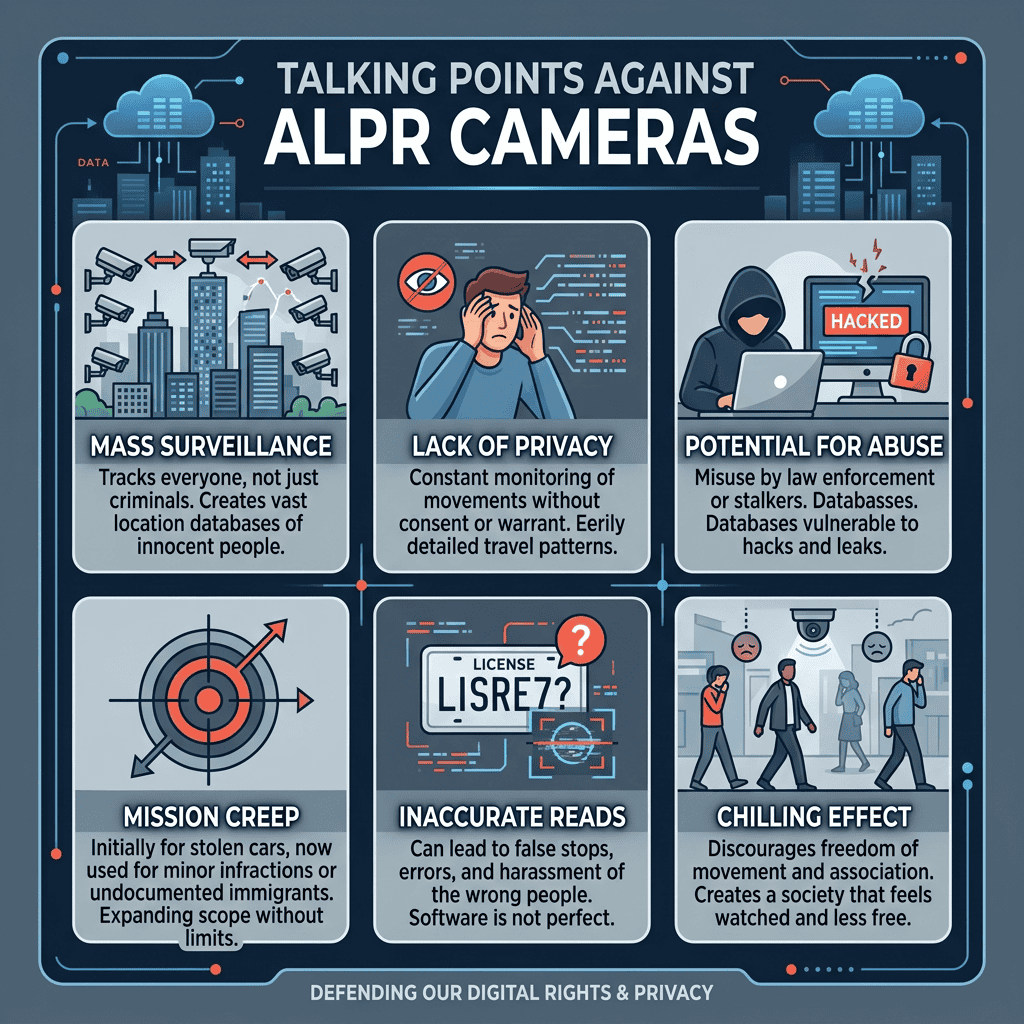

Talking Points Against Flock AI Cameras
Walk into any conversation, council meeting, or commissioner’s inbox with the evidence. Every point below is documented — use it, quote it, share it. (Every figure, sourced, in one place.)
1 It searches for people, not just plates
The pitch is license plates. That is not the whole product. New Hanover County’s own audit log records the other half, and it is the fact most commissioners have never been told:
- 470 “FreeForm” searches ran against this county’s camera network between April 2025 and May 2026. FreeForm lets an officer skip the plate and type a plain-English description instead.
- 456 described vehicles. Fourteen described human beings — clothing, build, what someone was standing near. (Our row-by-row breakdown.)
- Three of the fourteen typed a race, and in each case the identical search was re-run seconds later with the race removed: 15 seconds, 14 seconds, 13 seconds. We think that is Flock’s guardrail engaging. Flock says such attempts alert the searching agency’s own administrators. (The three pairs, with timestamps.)
- We cannot tell you who ran any of them. The County redacted the searching agency on all 2,980,082 rows.
- One FreeForm search from this log reached 2,109 camera networks at once. (The record.)
Somebody typed “2 young teenage black males” into a people-search against cameras this county pays for. Flock’s filter blocked that one; fifteen seconds later the same search with the race word removed was allowed. The County’s position is that residents are not entitled to know which agency ran it. (The searches, in full.)
2 The system flags cars before any officer suspects anyone
Hotlists and pattern tools run without a human typing anything. They are in this county’s records too:
- 4,955 “convoy” searches touched this county’s network — a paid feature that asks which vehicles habitually travel with a given car. (How convoy search works.)
- Down the road in Kure Beach, whose production names the searching agency, 19 convoy searches were run by the N.C. State Bureau of Investigation in three months. (Kure Beach’s audit, at the Internet Archive.)
- Flock’s Multi-State Insights alerts police when a vehicle is seen in more than one state, which the company’s own marketing ties to “human and narcotics trafficking.” Crossing a state line is now a signal. (ACLU · our explainer)
- A custom hotlist lets an officer add a plate that then trips an alert on every pass. Kure Beach’s event log shows 21 such entries created, updated or deleted in three months — in a town with four cameras.
The Fourth Amendment puts suspicion before surveillance. This reverses the order. (How hotlists and pattern flags work.)
3 You are paying about $219,000 — and it never went to a public vote
No referendum. No public hearing. No commissioner ran on it.
- The Sheriff’s Office holds Flock contract No. 25-0364, roughly $219,000. (The contract, in full.)
- The Board of Commissioners appropriates that money every year. Macon County’s board voted 5–0 on July 14, 2026 to stop appropriating theirs — it did not cancel a contract it did not hold; it ended the funding. (Agenda · WLOS)
- New Hanover’s contract also lets the County cancel at any time, without cause. (The clause, quoted.)
A commission holds the money. That is the whole mechanism. (The contract and the cost.)
4 The County will not say who searched
This is the question everything else runs through, and it is unanswered.
- The County produced the audit with the name of every searching agency blacked out — 2,980,082 rows of ***.
- Kure Beach released that same field without being asked twice. So did NC A&T State University Police, a sworn state law enforcement agency on the same vendor platform, in eleven days. (Both productions.)
- Buncombe County released it too.
- We have asked for one field — the agency name, not officers, not plates — since June 18, 2026. The County set its own deadline of July 6 for an update. It passed. (The correspondence.)
Ask your commissioner a single question: who searched our cameras, and why won’t we say? (The correspondence, in full.)
5 It is wrong often enough to put innocent people in handcuffs — and the vendor explained why
Errors here are structural, not occasional. Flock’s own communications chief described the mechanism this month:
- “It was asked, can you find this? And it did find that. It just didn’t say if there’s more here, then don’t do it.” — Joshua Thomas, Flock Safety, July 2026. The system does not distinguish a partial plate match from a full one. The officer receiving the alert cannot tell which he has. (The Drive, July 8, 2026)
- The Institute for Justice has catalogued 27 wrongful-stop cases since 2018 — innocent motorists pulled over, held at gunpoint, or jailed because the camera or the database was wrong. In nearly two-thirds, officers did not realise the error until after they had drawn their guns. These are machine failures. Point 7 counts a different 27: deliberate misuse.
- Settlements: $1.9 million (Aurora, CO — a mother and four children face-down on the pavement), $495,000 (San Francisco), $45,000 (Atherton, CA). (EFF) Detroit settled in 2025.
- Two North Carolina women were wrongly arrested after readers flagged the wrong car. (Charlotte · Fayetteville)
- In Oak Park, Illinois, oversight found a third or more of Flock-prompted stops ended with the driver released over data problems. The village ended its contract. (Sources and detail.)
A machine turned one truncated database entry into four squad cars around a journalist in Minnesota this month. (The North Carolina cases.)
6 Nobody audits any of this from outside
Every accountability claim runs through the audit log. Here is who checks it:
- N.C. Gen. Stat. § 20-183.31(a)(7) requires an agency’s ALPR policy to provide for annual auditing and reporting “to the head of the agency responsible for operating the system.” Not to a board. Not to a court. Not to the public. Once a year, to the boss.
- § 20-183.32(d) requires the system be updated from its source databases every 24 hours where updates are available — the provision that would clear a stale flag. No one external verifies it happens.
- Asked in June 2026 whether Flock had ever been independently audited, the Southern Pines police chief said he was unaware of any — and that his own agency had never audited the company. (Sandhills Sentinel)
- The only penalty in the statute for misuse is a Class 1 misdemeanour, and it reaches plate data only.
A system that watches everyone and is reviewed by no one is not oversight. It is paperwork. (Who watches the watchers.)
7 The people who hold the keys keep misusing them
This is not a hypothetical risk. It is a documented pattern, and it is accelerating:
- A Milwaukee officer ran 179 Flock searches on an ex-partner and her new partner. (Urban Milwaukee)
- Five former Albany, Georgia officers were arrested on 21 counts for misusing plate-reader data for personal, non-law-enforcement reasons. (Georgia Bureau of Investigation)
- In Georgia — Flock’s home state — more than a dozen officers across at least nine agencies were fired or charged in 2025 and 2026. (Richmond County · Cherokee County · Greene County · AJC)
- A Texas officer searched the network nationwide for a woman suspected of a self-managed abortion. (404 Media)
- A separate tally, and not to be confused with the wrongful-stop count in point 5: at least 27 documented cases of officers using plate readers deliberately — to track romantic interests, ex-partners, or personal targets. Nothing malfunctioned in any of them. (The full tally, case by case.)
The question is never whether the tool is misused. It is how long it takes anyone to notice. (The stalking cases.)
8 Federal agencies get in — through the side door
Flock committed in August 2025 that “federal users will not be added to Statewide or Nationwide lookup.” That commitment covered the lookup pools. It did not cover direct shares:
- Kure Beach shares its network directly with the FBI and the U.S. Postal Inspection Service. Its own records show the share running one way — the town gives, and receives nothing back.
- Those two agencies ran 31,476 searches of that town’s cameras in three months, well after Flock’s commitment. (The numbers, broken out.)
- Kure Beach also has Flock’s “Within Nationwide” discoverability switched on — the widest setting available — and shares with 554 organisations, 362 of them outside North Carolina. (The configuration screen, as produced.)
The safeguard is a setting. A four-camera beach town can change a setting. (Kure Beach’s records.)
9 It maps the pattern of your life
Plate data is not a list of cars. Assembled over months it is a record of where you go and who you are:
- The church you attend, the clinic you visit, the range you shoot at, the union hall, the recovery meeting, the lawyer’s office, the protest.
- In the SBI’s own pilot, Raleigh’s three state-road cameras recorded 14.8 million drivers and returned 956 “hits” — the report never says whether one produced an arrest. (The SBI report to the General Assembly.)
- WRAL obtained the internal ALPR policies of all 32 agencies in that pilot. Only Asheville and Raleigh police restrict using plate readers to surveil political rallies, religious gatherings or protests. The other thirty have no such language.
Gun owners: every trip to the range or the gun shop is logged, without a warrant and without a crime. (What it logs about gun owners.)
10 The law is moving — and the record here is bigger than the cases that permitted it
Courts are working this out now, and we will state it carefully:
- In Carpenter (2018) and again in Chatrie (2026), the Supreme Court has narrowed warrantless location tracking.
- In United States v. Porter (5th Cir., March 2026), a court held plate-reader use was not a search — distinguishing Carpenter partly because that town had “no more than ten LPR cameras.”
- New Hanover County has roughly 28, wired into a network searched 2.98 million times in sixteen months.
- Whether ten cameras and a nationwide network are the same constitutional question has not been decided on a record like ours.
We are not predicting an outcome. We are saying the ground is moving, and the County is standing on it. (ALPR in the courts.)
11 Flock is not the only thing watching Wilmington
Cancelling one contract does not end the inventory. Residents should know the whole of it:
- Wilmington PD runs a Fusus “STING Center” joining public and private cameras into one live feed.
- ShotSpotter acoustic sensors. Drones. ShadowDragon social-media monitoring. Store-lot cameras feeding the SBI.
- Onslow County runs Plate Ranger, a different vendor entirely — the same questions apply to all of them. (The inventory.)
The point is not one company. It is that nobody voted for any of it. (The full surveillance inventory.)
12 North Carolina towns have already said no — by vote, in public
This is not a fringe position. It is what neighbouring boards concluded once they read their own contracts:
- Macon County — commissioners voted 5–0 on July 14, 2026 to defund the Sheriff’s cameras, then unanimously to remove them. (WLOS)
- Hillsborough — unanimous cancellation, citing Flock’s data-sharing terms. (Town of Hillsborough)
- Pittsboro — voted 4–1 to terminate; cameras off by July 1. (WRAL · Chapelboro)
- Chatham County — the county board pulled its own cameras. (Hoodline · tracker)
- Boone paused expansion and forced a public transparency portal. (Watauga Democrat) Apex, Garner, Asheville, Southern Pines and Madison County are contested now. (The statewide tracker.)
Every one of those started where we are: a signed contract and a worried public. (The statewide tracker.)
Our goal is removal. Here is our floor.
We’re honest about the ask: the safest, cheapest, most constitutional outcome is to cancel the contract and take the cameras down. That’s what we’re asking the Board to do. But if the Board won’t cancel, “what would satisfy you?” deserves a real answer — so here it is. These are the minimum safeguards a responsible ALPR program would already have, drawn from the ACLU’s own recommendations and from North Carolina’s existing law:
- 1A public transparency portal. Flock hosts one for agencies as small as Franklinton; New Hanover’s has none. Publish camera counts, retention, sharing, and search totals.
- 2A warrant or court order for non-emergency searches of stored data — the judge the Fourth Amendment contemplates, not a database anyone can query.
- 3No out-of-state or nationwide sharing. Follow N.C. Gen. Stat. § 20-183.32 to the letter: local data, disclosed only on a written request for a legitimate law-enforcement purpose.
- 4Retention cut to the operational minimum — well under the 90-day cap — with automatic deletion.
- 5Independent, public annual audits that name the searching agencies and the stated reasons. Watch the watchers.
We say this plainly: interim safeguards can also entrench a system that shouldn’t exist. Half-measures are not victory. But a Board that refuses even these is telling you it wants the tracking without the accountability — and that is worth putting on the record.
Turn facts into pressure
Sign & share
Sign the petition opposing Flock and similar ALPR networks, then send it to a neighbor.
Talk to neighbors
Raise the privacy implications with neighbors and community organizations. Grab a flyer.
Demand accountability
Attend city council and county commission meetings and email your leaders to demand removal.
Privacy is not a luxury — it’s a right.
You’re not a suspect. So stop being tracked like one.
It takes one minute. Add your name, then tell your county commissioners to cancel the Flock contract.