
North Carolina Just Charged an Officer for Misusing Flock
For months, defenders of these cameras have told New Hanover residents that Flock abuse is someone else’s problem — a Georgia story, a headline from far away. On July 29, 2026, the North Carolina State Bureau of Investigation ended that argument. It charged a Charlotte-Mecklenburg police officer with illegally accessing a government computer to run an unauthorized plate search. His department owns no Flock cameras of its own. It did not need to. And when we checked the records we already hold, that same department had reached into other North Carolina agencies’ cameras — a rural campus, a beach town — more than four thousand six hundred times.
The charge is specific, and it comes from the state’s own investigators. On July 29, 2026 a Mecklenburg magistrate issued a warrant for the arrest of Charlotte-Mecklenburg Police Department officer Seth Daniel Elliott, on a charge sworn by the North Carolina State Bureau of Investigation (file 26CR369083-590). The offense is “Accessing Computers,” a misdemeanor under N.C. Gen. Stat. § 14-454(b). The charging language leaves little to interpretation: on June 16, 2026, the warrant alleges, Elliott “did without authorization access a computer and queried a North Carolina License Plate Registration through Flock Safety Inc. and CJ Leads” — the state’s Criminal Justice Law Enforcement Automated Data Services — for a non-law-enforcement purpose; WBTV reports the alleged purpose was providing information to the target of a drug investigation. He was arrested July 30, released on a $15,000 unsecured bond, and placed on unpaid administrative leave; he was hired in February 2024. (WBTV · the arrest warrant, home address redacted.)
A charge is an accusation, not a conviction. Seth Elliott is presumed innocent unless and until proven guilty. What follows is not about his guilt — it is about the system that made the alleged search possible, and how far it reaches.
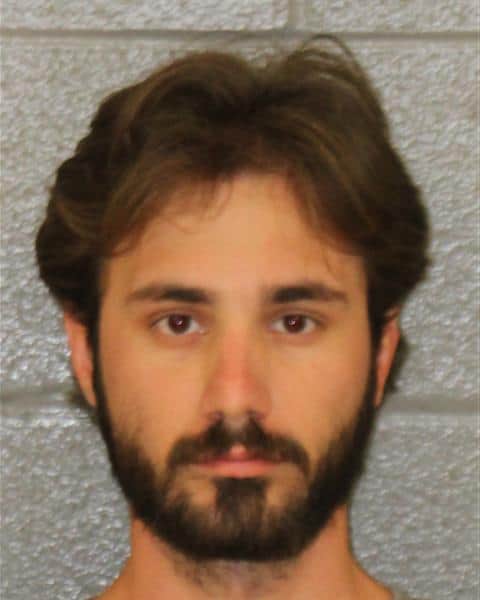
CMPD’s own chief did not soften it. “Misusing law enforcement technology or accessing confidential information for non-law enforcement purposes is a betrayal of the public’s trust and a violation of everything this profession stands for,” Chief Estella Patterson said. “We will not tolerate that kind of misconduct.”
A department with no cameras of its own
Here is the detail that should stop every New Hanover resident. In its own statement, CMPD said it does not own or operate any Flock cameras or devices. Instead, its officers hold a memorandum of understanding that lets them access the Flock devices of other agencies and entities — at no charge.
Read that again. A department with zero cameras can still search the plate-reader networks of departments that do have them, statewide and nationwide, for free, through a data-sharing agreement. The alleged misuse did not require owning a single camera. It required access — and access is exactly what the shared Flock network hands out. This is the whole architecture in one case: the danger is not just who buys cameras. It is everyone the network lets in.
We didn’t have to speculate — we checked our own records
DeFlockILM holds the network audits of several North Carolina Flock systems, obtained through public-records requests and published in full. A network audit logs every outside agency that searched a given system’s cameras. So we asked a simple question: did Charlotte-Mecklenburg PD search the North Carolina networks we already have?
It did — heavily. In every audit, the searcher is logged as “Charlotte Mecklenburg NC PD.” Across just the three systems we hold in machine-readable form, that one department ran:
| North Carolina network | Period we hold | CMPD searches |
|---|---|---|
| UNC Pembroke (Robeson County campus) | Apr 24 – Jul 24, 2026 | 2,431 |
| NC A&T State University (Greensboro) | Mar – May 2026 | 1,005 |
| Kure Beach (four-camera beach town) | Mar – May + Jul 1–22 | 1,215 |
| Total, three networks CMPD does not own | 4,651 | |
A Charlotte department, more than 200 miles from either coast, reached into a rural university’s cameras and a small beach town’s cameras thousands of times in a single quarter. We are still analyzing Carolina Beach’s network audit — it runs to hundreds of thousands of rows — and will update this figure when that count is complete.
What this proves, and what it doesn’t
We will be careful here, because the distinction matters. These 4,651 searches are not, in themselves, evidence of any crime. Most are presumably ordinary investigative queries, and the audits redact the individual searcher’s name — so we cannot say which CMPD officer ran any given search, and we make no claim that the officer charged this week ran any of them. What the records establish is narrower, and it is enough: the access is real, the reach is enormous, and the volume is routine. One department that owns no cameras touched three North Carolina networks 4,651 times through a sharing agreement — and this week, the SBI charged one of that department’s officers with abusing exactly this kind of access.
That is the answer to “trust us, we audit.” The audit is what caught this officer — after the fact, once. Every search above was equally invisible until someone went looking. The safeguard is not the network; it is the rare after-the-fact review, and it only works if someone runs it and someone else can see the result.
What the law requires — and what it doesn’t
This is a matter of statute, not opinion. North Carolina law does not require any law-enforcement agency to report ALPR abuse to anyone outside itself. The only reporting the statute mentions is N.C. Gen. Stat. § 20-183.31(a)(7), which asks each agency’s own policy to provide for auditing its system “at least annually” and reporting use and effectiveness “to the head of the agency.” Internal. Once a year. To the boss. No court, no oversight board, no public disclosure, and no notice to the SBI or the Attorney General when misuse is found. The statute’s only real consequence for abuse is § 20-183.33, which makes it a Class 1 misdemeanor — a penalty that arrives, if it arrives at all, only after a charge.
The state’s own program is built the same way. The SBI has run a statewide highway ALPR pilot since January 1, 2024, and the General Assembly made that program permanent in 2026 — not through House Bill 206, whose plate-reader section was stripped on June 17, but through the state budget, which authorized the SBI and NCDOT to place highway plate readers on state-owned land and became law. The reports that pilot owes the legislature cover usage: the written policy, the number of data requests, how much data was kept past 90 days. Not misuse. Nothing requires the SBI to tell lawmakers how many searches were improper — or that any abuse happened at all. And those reports come after the cameras are already live, not before.
Put it together and the CMPD case is not an exception to the system. It is the system. There is no tripwire, no mandatory disclosure, no real-time check — abuse becomes visible only when someone chooses to run an audit and someone else is willing to act on it. That is why an unauthorized search on June 16 was not charged until July 29, and it is why the overwhelming majority of searches — the 4,651 catalogued above included — will never be reviewed by anyone.
Why this lands in New Hanover
In the last two weeks, two agencies at the center of this fight gave residents the same reassurance — and their exact words share a hidden limit. Sheriff Ed McMahon told the County Commissioners, in the memo we published, that the Sheriff’s Office “does not use this technology to monitor the routine movements of law-abiding residents” and that it is “not a live surveillance system where Sheriff’s Office personnel continuously monitor the public.” Down the coast, Carolina Beach Police Chief C.V. Ward wrote that “access to this data is strictly limited to authorized law enforcement personnel” and that his department “does not monitor individuals or continuously track citizens.” (We took that statement apart here.)
Look at the subject of every one of those sentences. Each is a promise about the Sheriff’s Office, or Carolina Beach’s own officers. We don’t doubt either man about his own people — and that is exactly the problem. Neither can promise anything about the thousands of outside agencies that reach into their cameras through the shared network, and neither one audits them. Misuse does not require owning a camera; it requires access. New Hanover’s cameras sit on that same shared network, searched 2.98 million times in sixteen months, with the searching agency hidden on every row. McMahon can speak for his deputies. Ward can speak for his. Neither can speak for the Charlotte-Mecklenburg officer the SBI just charged — whose department owns no cameras at all, and who reached across the state through exactly the kind of sharing agreement that let CMPD search a small beach town’s cameras 1,215 times. The promise that an agency’s own people follow the rules is not an answer to the danger. It is a description of the blind spot this case walked straight through.
Check it yourself
The searches above come from the government’s own audit files, which we publish in full: UNC Pembroke, NC A&T, and Kure Beach. Search each for “Charlotte Mecklenburg NC PD” and count the rows yourself. The point of publishing the records is that you do not have to take our word for any of it.
The criminal charge is reported by WBTV and set out in the arrest warrant (file 26CR369083-590), a public record from NC eCourts that we publish with the defendant’s home address redacted; a charge is an accusation and the officer is presumed innocent. The search counts are DeFlockILM’s own tally of the Flock network-audit files produced to us by UNC Pembroke, North Carolina A&T, and the Town of Kure Beach, counting rows whose searching organization is logged as “Charlotte Mecklenburg NC PD.” Individual searcher names are redacted in those files; we do not attribute any search to any named individual, and we do not allege that any of these searches was improper. This article describes public records and is general information, not legal advice. If any figure here is wrong, write to mark@deflockilm.org and we will correct it in public. First published July 29, 2026.
You’re not a suspect. So stop being tracked like one.
It takes one minute. Add your name — then tell the officials who represent you to take the cameras down.