
Build (or Buy) a Flock Detector
The cameras built to catalog you won’t stop broadcasting their own location. Learn to listen — then add what you find to the public map.
Here’s the satisfying irony at the heart of DeFlock: the cameras built to catalog you are themselves easy to catalog — because they won’t stop talking. Every Flock unit chatters over Bluetooth (to its battery) and Wi-Fi (for setup and maintenance), broadcasting signals with recognizable fingerprints. Learn to listen, and a $15 gadget will beep every time you roll past one.
How the detection works
A Flock device emits Wi-Fi probe requests and beacon frames and Bluetooth advertisements that follow predictable patterns — including hardware MAC-address prefixes (OUIs) tied to its components. A passive radio that watches the 2.4 GHz band can match those patterns and flag a likely camera nearby. You’re not transmitting anything or interfering with the device — you’re just listening to what it already shouts into the air. (Hackaday.)
Build it: the “Flock You” project (~$15)
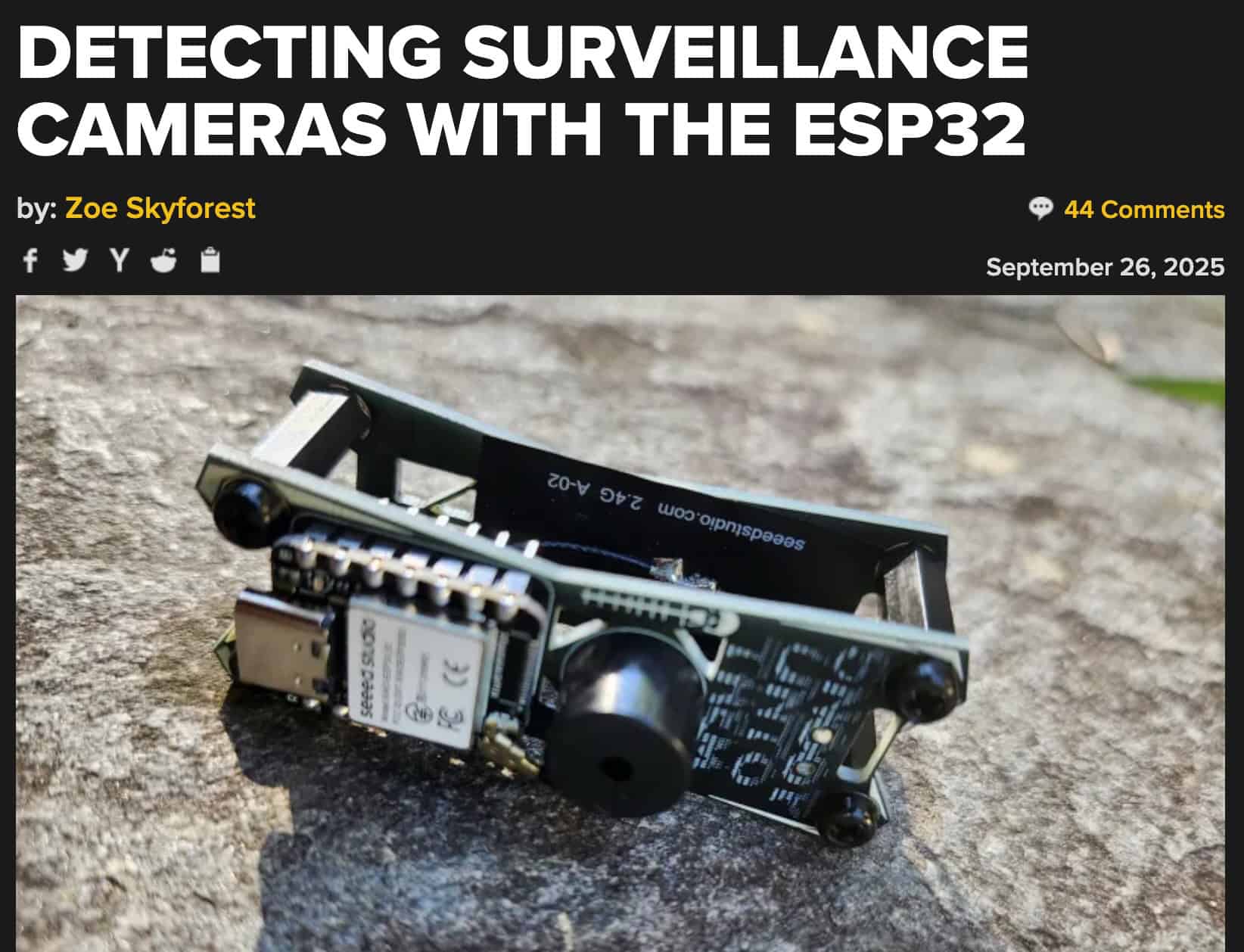
The open-source “Flock You” firmware runs on an ESP32 microcontroller. Flash it onto a Seeed Studio XIAO ESP32-S3 dev board — about $10–15 — and it becomes a passive scanner that buzzes when it detects a Flock signature. Several community forks exist for different boards and displays, and there’s pre-built “Oui-Spy” hardware from the project’s author if you’d rather not solder.
No hardware? Use your phone
You don’t strictly need a gadget. There’s a “Flock You” Android app that does similar Bluetooth/Wi-Fi sniffing from a phone, and the popular ESP32 Marauder firmware includes a “Flock Sniff” mode if you already own one. Any of these turns a casual drive into a mapping run.
The most important step: put it on the map
Detecting a camera is only half of it. The payoff is reporting it. Once you’ve confirmed a camera with your own eyes (use our field guide to spotting them), add its location to the DeFlock map — the volunteer-run global map that aggregates ALPR locations and feeds them into OpenStreetMap. Agencies redact where their cameras are; this crowdsourced map is the public’s only honest count. Every pin you drop makes the surveillance network a little more visible — which is the whole point.
They map us in secret. We map them in the open. Only one of those is a public service.
Passively listening for signals a device broadcasts in public, and mapping public infrastructure, is lawful. Transmitting to jam, spoof, or interfere with a camera is not — radio jamming is a federal crime. Detect and document; never disrupt.
You’re not a suspect. So stop being tracked like one.
It takes one minute. Add your name — then tell the officials who represent you to take the cameras down.