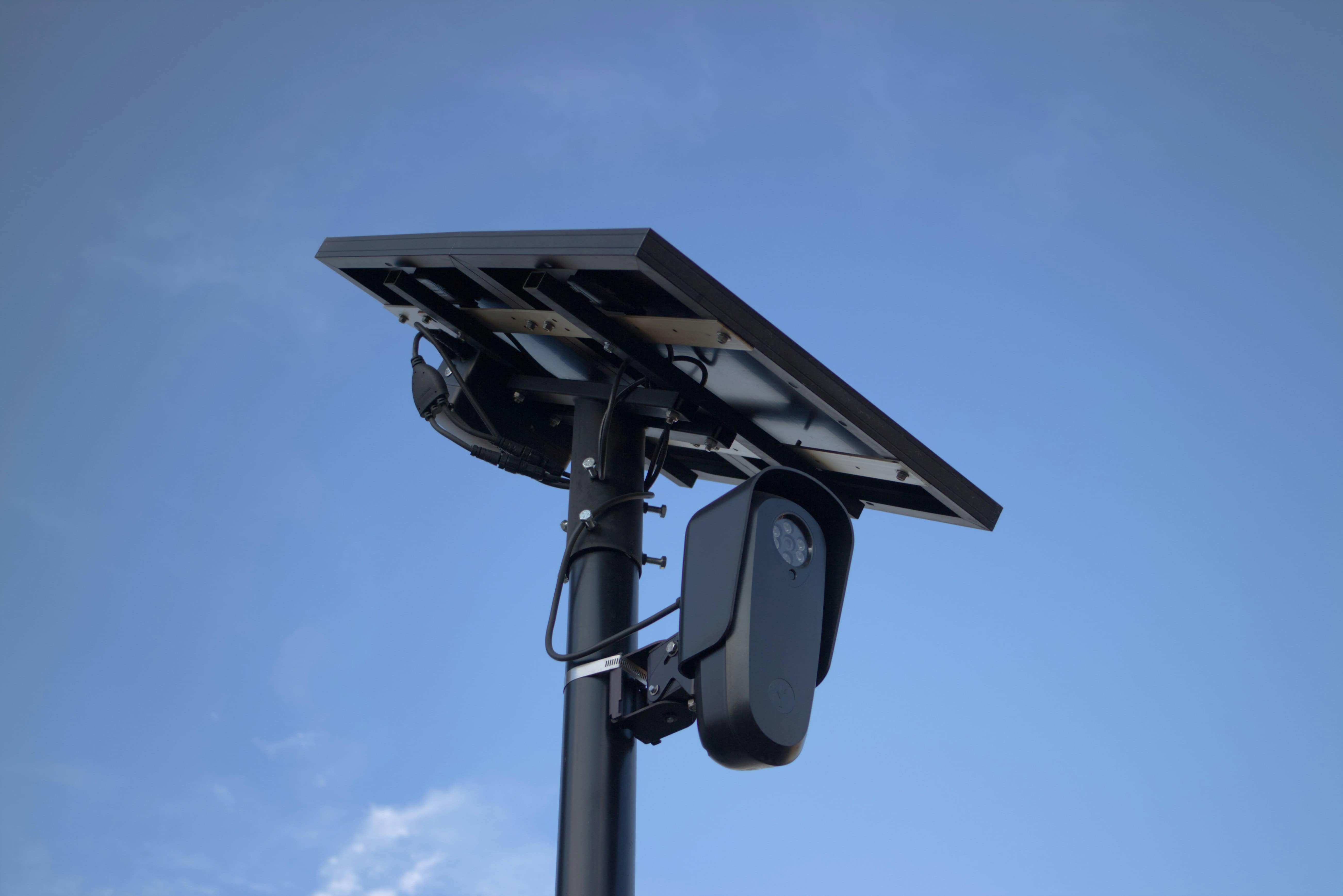

How a Flock Camera Actually Works
Strip away the marketing and it’s a cheap Android computer on a pole, running a neural net. Here’s the whole pipeline — and the rot inside it.
A Flock camera is a surprisingly ordinary piece of consumer electronics doing one relentless job. Here’s what’s actually in the box on that pole, and what happens in the second your car passes it.

Flock makes several products, and they don’t all work the same way. This teardown describes the Falcon — the fixed, solar-powered license-plate reader that blankets New Hanover County (its portable and compact cousins, Falcon Flex and Sparrow, are close kin). It is not the Condor, Flock’s pan-tilt-zoom camera that does stream live video — the type left exposed on the open internet — and it is not Raven, Flock’s audio/gunshot sensor, which is a microphone, not a camera. When we say “Flock camera” below, we mean the plate reader.
The box: solar, a cell modem, and a cheap Android brain
A Flock “Falcon” runs Android — specifically Android Things 8.1 on a Qualcomm OpenQ 624A module — paired with a lithium battery, a small solar panel, and a NimbeLink Skywire LTE modem for cellular data. There’s Wi-Fi and Bluetooth onboard plus a GPS antenna. No trenching, no wiring: it’s a self-contained, solar-powered, cellular computer that bolts to a pole and installs in hours. (teardown; Flock.)
The pipeline: segment, read, fingerprint
When a vehicle enters the frame, the camera grabs a burst of still images and runs computer vision on the device itself. First an image-segmentation step locates the license plate; then optical character recognition (OCR) reads the characters. But it doesn’t stop at the plate. The same models extract a “vehicle fingerprint”: make, model, color, body type, and distinguishing features like roof racks, bumper stickers, and damage. Flock says it can do this on cars moving up to 100 mph, at up to 75 feet, day or night.
What gets sent (and why it scales)
Critically, the Falcon does not stream live video back to a server — that’s the Condor’s job, and it would be expensive and bandwidth-heavy at this scale. Instead the plate reader sends still images plus the fingerprint metadata over the cellular modem to Flock’s cloud. That design is exactly why these things can blanket a county on solar power and a SIM card: the heavy lifting happens on the pole, and only compact data goes up.
The cloud is the actual product
Your plate, your car’s fingerprint, a timestamp, and a GPS location land in a database — and that database is networked nationally. Police can run searches across tens of thousands of other agencies’ cameras, and Flock has built tools (its “Nova” product) to fuse that with commercial data brokers and jump from a plate to a person. The camera is just the sensor. The searchable national record of where everyone drives is the thing being sold.
The part that’s not in the brochure: it’s leaky
For a system pointed at everyone, the security is alarming. Independent researchers have pulled root shells on Flock units, found them running Android builds with no security patches since around 2021, documented login credentials for sale on the dark web, and discovered roughly 60 cameras left wide open on the public internet — one streaming a children’s playground. (GainSec; our writeup.) A brittle, unpatched device, multiplied by thousands, aimed at you.
It isn’t magic. It’s a cheap Android computer running a neural net — and like any such system, it can be found, and it can be fooled.
One more thing — it announces itself
Because each unit uses Bluetooth to talk to its battery and Wi-Fi for setup, a Flock camera is constantly broadcasting recognizable radio signals. That’s the crack the counter-surveillance crowd pries open: you can build a cheap detector that listens for those signals and warns you a camera is near — which is how the public map gets built.
You’re not a suspect. So stop being tracked like one.
It takes one minute. Add your name — then tell the officials who represent you to take the cameras down.