
What the Police Actually See When They Run a Flock Search
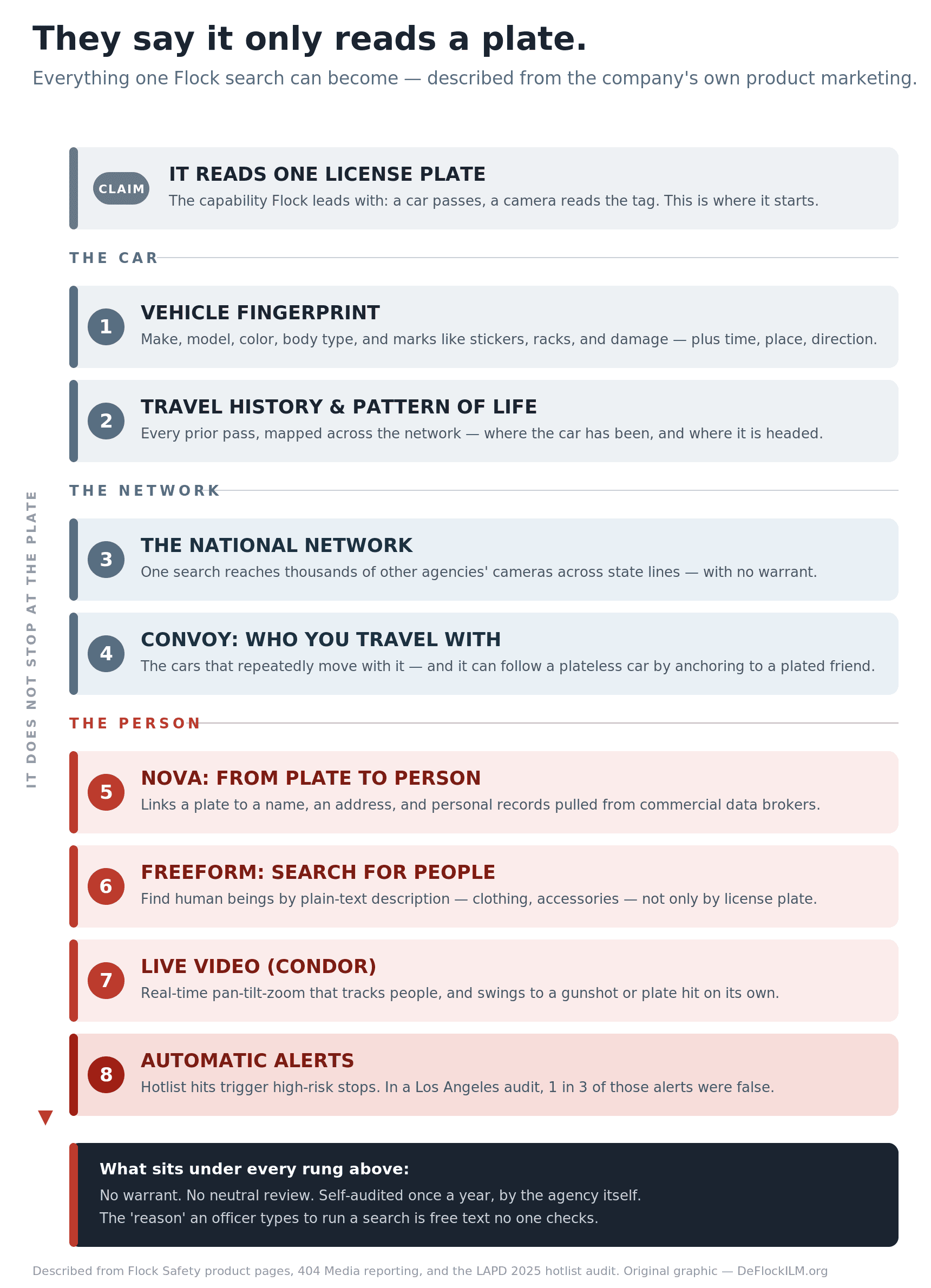
The most common defense of these cameras is that they “only read license plates.” So we set that claim next to the company’s own marketing. Every capability below is drawn from Flock Safety’s public product pages — the material the company shows the police departments it sells to. Read together, it describes a search tool that starts at a plate and does not stop there.
A plate reader that only logged plates would be a narrow thing. What Flock sells is not that. In the company’s own words, an officer at a keyboard can describe a vehicle in plain English, search cameras owned by agencies in other states, get pinged automatically when a car reappears, and — through Flock’s newest product — move “from license plate to person.” None of this is our characterization. It is what the pages read to the buyers.
What New Hanover’s own records show
None of this is hypothetical here. The Sheriff’s Office produced its Flock audit to us, and it logs 2,980,082 searches run against the county’s camera network over roughly sixteen and a half months — January 23, 2025 through June 5, 2026. Most are ordinary plate lookups. But the audit sorts every search by type, and the types run well past reading a plate:
- Convoy — 4,955 searches. The association tool that surfaces the vehicles moving with a target. Stated reasons include narcotics, fraud, and larceny cases — one marked “ApexPD assistance,” an agency near Raleigh, which shows the shared network in use.
- FreeForm — 470 searches. Plain-text description searches. Most describe vehicles (“black Porsche Macan with paper tags and bumper sticker”); 14 describe people (“white male wearing a black hat and a green shirt”) — the same people-search class as the racial-description query we documented separately.
- Visual, photo-match — 267 searches. Upload an image; the network finds the vehicle.
- Multi-geography — 9 searches. One query spanning multiple camera regions at once.
The hardware matches the software: the County’s Flock purchase includes eight Condor cameras — the live pan-tilt-zoom video units, not plate readers.
Two honest limits. The County redacted the searcher and agency on every line, so we can name the type of search but not who ran it — only that it ran against New Hanover’s network. And we found no record of Nova, Flock’s plate-to-identity tool, in this audit; we treat that one as a capability, not a documented local use. The counts trace to the audit in our records repository, and the scale of the network searches is broken down here.
What actually appears on the screen
Set aside the abstractions and picture the officer’s monitor. In Flock’s real-time platform, a single vehicle pulls up a card — not a line of text. Flock’s own demo interface shows it: a full photograph of the car in motion; a cropped, high-contrast close-up of the plate beside the software’s read of the number and state; the make, model, body type, and color the AI assigned; and any distinguishing marks it tagged — a roof rack, a dented panel, a bumper sticker, a trailer. Beside the image sits the telemetry — the date and time to the second, the camera’s location and the direction the car was traveling, and a map pin placing that pass against every other camera on the network. One car. One click. A dossier.
First, the plate is only the beginning
Each Flock camera does more than photograph a tag. Flock markets a “Vehicle Fingerprint” — the make, the type of vehicle, the color, and distinguishing features like bumper stickers, roof racks, and visible damage, all extracted from the image and made searchable. So even a car with no plate, a covered plate, or a plate the camera misreads still generates a describable, searchable record. The officer does not need your plate number. A description will do.
Then you type a sentence
Flock’s FreeForm product is built around this. Its tagline is “Type What You Know. Find What You Need.” The page tells officers to search in plain language — its own examples include “dark SUV with rear bumper damage” and, for a person, “man in blue shirt and cowboy hat.” The system then returns matches across enabled cameras. A Flock customer quoted on that page describes sorting through 6,000 camera hits down to a handful with one query. This is not a database you query with a warrant number. It is a search box.
The plate itself can be searched the same loose way. An officer does not need the whole tag — the system takes a full or partial plate, so a query for every car whose plate ends in a given three characters, inside a chosen time window and radius, returns a list. Fragmentary evidence is enough to start pulling records of who drove past.
And the search reaches past your town’s cameras
The reach is the part residents most often miss. FreeForm advertises the ability to “Search Beyond Your Own Cameras” — footage from participating agencies, campuses, businesses, and neighboring properties, “where sharing is enabled.” FlockOS, the company’s real-time platform, unifies “video, LPR, drones, CAD, and sensors in one real-time map” and advertises more than 4,800 connected agencies. That is the mechanism behind the millions of out-of-county searches our records show running against North Carolina networks: one officer, one search box, thousands of agencies’ cameras.
The system watches for you even when no one is searching
You do not have to be the subject of an active search to be flagged. Flock markets real-time alerts — FreeForm’s own line is “Get Alerts When Your Suspect Appears” — and hot lists that notify an agency the moment a listed plate is seen. Those hot lists can be wired to national databases such as NCIC — stolen vehicles, wanted persons, missing-person and AMBER alerts — or to an agency’s own custom watchlist of plates it wants to know about. It can also flag a car that repeats a route across multiple cameras. We covered how those flags and pattern alerts work separately. The point here is simpler: the network is not passive. It is configured to reach out.
Convoy: the search that finds who you drive with
One Flock tool earns its own line, because it does something a plate log alone cannot: it infers association. A search Flock calls Convoy takes an anchor vehicle — a suspect’s plate, or a car seen leaving a scene — and sifts the network’s background reads for other vehicles that kept turning up near it: the same cameras, within a short window of a minute or a few, across more than one location. It ranks those companion cars by how often they recurred and by the seconds separating them from the anchor, and it will tell the officer whether a given car was consistently leading or following. The shared route is drawn on the map; the two passes are shown side by side, plate to plate.
Two things about that are worth sitting with. First, it converts a record of cars into a map of relationships — who moves with whom — and proximity is not proof. A neighbor who shares your commute, a car that happens to take the same highway at the same hour, can surface as an “associate” of a target it has nothing to do with. Second, it defeats anonymity by proxy: a car with no plate, or a paper tag, can still be followed through the network by anchoring on a plated car it travels with. The absence of a plate is no longer the end of the trail. For a system defended as a way to find one specific stolen car, that is a long way from reading a plate.
The Condor cameras add live, moving video
New Hanover County did not buy only plate readers. It bought eight Condor cameras — Flock’s pan-tilt-zoom video platform. A Falcon plate reader takes a still of the back of a car. A Condor is a live HD feed an operator can control: pan, tilt, and zoom in real time on an intersection, a park, or a person — the company markets it for “overwatch,” including during traffic stops. Dual-lens units show a wide situational view and a zoomed telephoto view at once.
Its analytics run on people, not just cars. Flock’s “Guardian Mode” for the Condor “automatically detects and tracks people and vehicles” and zooms for “identifying details,” day or night, with no operator present. The system can be set to alert on behavior — someone lingering in a restricted area, a perimeter crossed, a crowd forming — and its natural-language search runs against stored video, so “individual carrying a dark backpack” or “white van parked at the curb after 2 a.m.” returns timestamped clips instead of hours of footage to scrub. A plate reader photographs the back of a car. A Condor follows a person across a parking lot.
And the cameras do not work alone. In the platform’s design, a hit on one sensor cues the others: when an adjacent Falcon flags a wanted plate, or a Raven audio sensor registers a possible gunshot, a nearby Condor can swing, zoom, and lock onto that spot on its own — putting video on a location before any officer arrives. The FlockOS dashboard ties it together on one screen: a live video window with pan-and-zoom overlays, a dark-mode map of the jurisdiction with officer positions and color-coded camera pins, a scrolling sidebar of gunshot, hotlist, and camera alerts, and a “nearby cameras” panel that lets an operator jump to the next feed and follow a car’s direction of travel. We wrote about the Condor purchase in detail.
And the newest product turns a plate into a name
In May 2025, 404 Media reported, from leaked internal materials, that Flock was building a tool called Nova to supplement plate data with personal information drawn from data brokers, public records, and — per the reporting and Flock employees quoted in it — in some configurations, hacked data. The stated goal, in the leak, was to “jump from LPR to person.” Nova is now on Flock’s public product menu. We are describing reporting on documents we have not independently verified, and Flock has disputed characterizations of its data sources; in our reading, the direction is nonetheless plain — the plate is a starting point for identity, not the end of the record.
What Flock says it does not do
Fairness cuts both ways, so here is the company’s position. Flock states that FreeForm “does not use facial recognition or biometric person recognition,” that people searches on video rely on “observable, non-biometric” features like clothing, and that people search does not run on the plate-reading cameras at all. Flock also markets moderation tools, permission controls, and audit logs as safeguards. We take the company at its word on what the software is designed to do. Our concern is not the demo. It is that a description-based, cross-jurisdiction, alert-driven search network — with a free-text “reason” field that, in the audits produced to us, no neutral party reviews — already reaches far past “we only read plates,” even accepting every safeguard exactly as advertised.
And an alert is not proof
The system’s confidence is not the same as accuracy, and the gap lands on drivers. When the Los Angeles Police Department audited its Flock hotlist alerts across August and September 2025, 161 of 498 — roughly one in three — were false: the car was not in fact stolen or wanted. The error usually lives in the underlying law-enforcement database rather than the camera, but that distinction means little to the person on the receiving end, because a stolen-vehicle hit is worked as a high-risk stop — backup summoned, sometimes a driver ordered out at gunpoint. The LAPD is letting its Flock contract expire. What these misfires do to innocent people, we covered here.
The company’s own account keeps changing
Sort out the hardware and one last thing comes into focus. The plate readers on poles — Falcon and Sparrow — capture still images, a burst of photos per car, not a live stream; the Condor is the video camera. That distinction is real, and we hold to it. But Flock itself has blurred it. For more than a year the company marketed a free software update that would let its existing plate readers stream live video, and its CEO told Forbes that officers could open the nearest cameras and see “what’s happening right now.” Then, after Los Angeles dropped the company in July 2026, that same CEO told a television station the technology is just “a static picture of a car… it’s actually not that complicated.” Flock says it has since discontinued the live-video feature for law enforcement. When the company that makes the product cannot keep its own description steady, residents are right to ask for the records rather than the reassurance.
The honest summary
Put the marketing back together and the picture is not a plate scanner. It is a searchable, describable, cross-agency record of vehicles and, on the video side, people — queryable in plain English, shareable across thousands of agencies, wired to send alerts, and, through Nova, linkable to identity. A resident told “it only reads plates” is being told about one feature on a much larger screen. The screen is the thing to look at. Flock will show it to a police department that asks. Residents deserve the same look.
Your county commissioners or town council hold the lever that ends Flock where you live. They meet regularly — find the next date, and the sign-up to speak is on this site.
Sources & method. Product descriptions and quoted phrases are drawn from Flock Safety’s own public product pages for FreeForm, FlockOS, the Condor video cameras, and Flock Nova, accessed July 2026. The Nova reporting is from 404 Media (Joseph Cox, May 2025); we describe that reporting and note Flock’s dispute of it. The one-in-three false-alert figure is from the LAPD’s August–September 2025 hotlist audit (161 of 498 alerts), reported by 404 Media and ABC7. The CEO’s statements about live video, and Flock’s discontinuation of the LPR video feature, are reported by 404 Media. Search-volume figures reference audit logs produced to us and archived in our NC Records Repository. This post is commentary on public marketing materials and reporting; characterizations are ours and are general information, not legal advice. DeFlockILM is a citizen effort on ALPR and privacy in the Wilmington area.
You’re not a suspect. So stop being tracked like one.
It takes one minute. Add your name — then tell the officials who represent you to take the cameras down.