
What Is a Panopticon? The 234-Year-Old Prison Design Behind the Flock Camera Debate
A panopticon is a design that makes people behave as if they are always being watched. Here is what the word means, where it came from, and why it keeps surfacing in the fight over Flock license plate cameras.
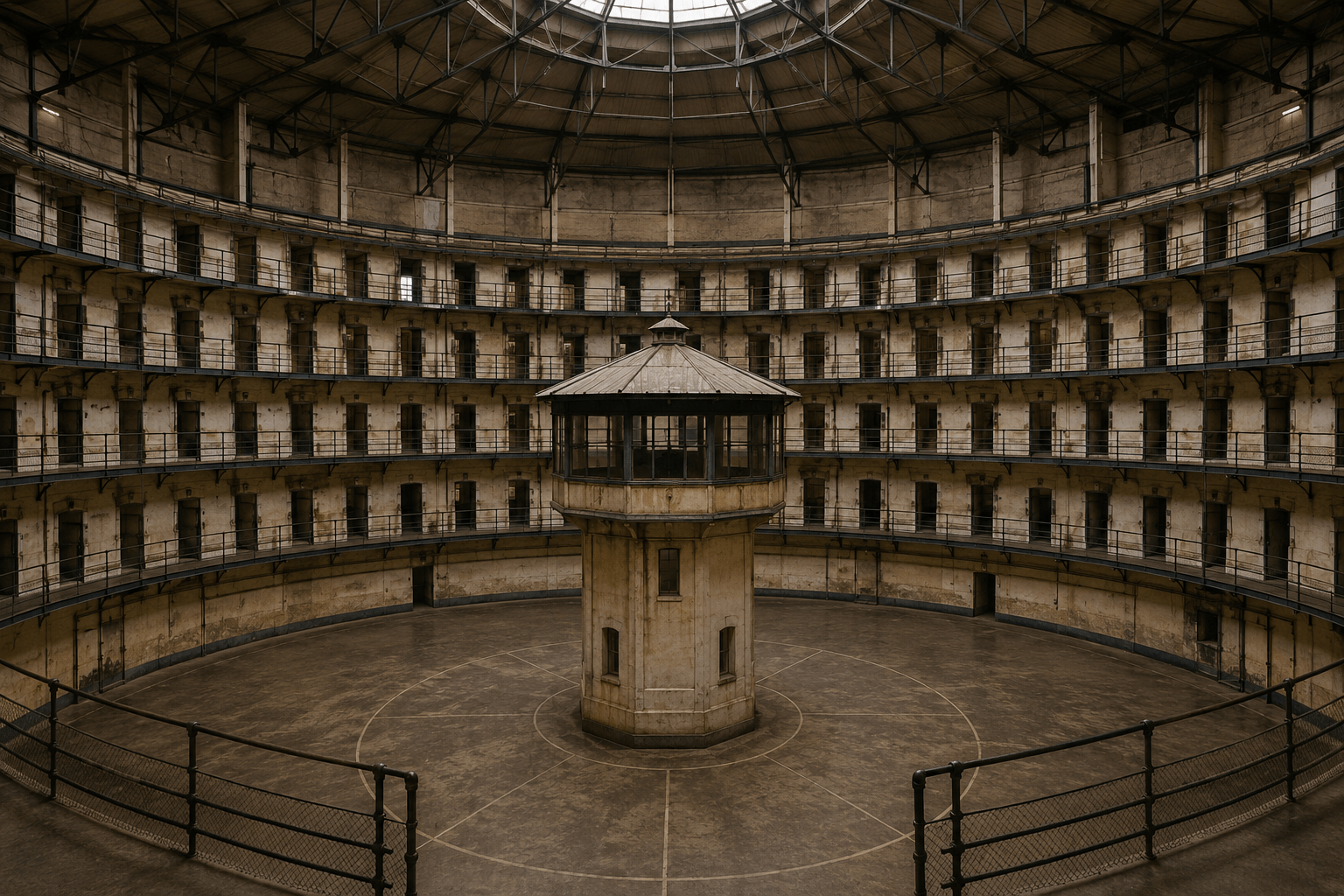
A panopticon is a structure built so that everyone inside can be watched at any moment, and no one inside can tell whether they are being watched right now. The watching does not have to be constant. It only has to be possible. That uncertainty is the whole design — people who cannot rule out being observed start managing their own behavior, and the system runs itself.
The word gets used a lot in the argument over Flock Safety cameras, usually by people who oppose them. If you had to look it up, that is a fair reaction, and it is worth understanding before you decide whether the comparison holds. This article explains where the idea came from, what it actually claims, where it fits an automated license plate reader network, and — just as important — where it does not.
Pronunciation: pan-OP-ti-kon. From the Greek pan- (“all”) and optikos (“of sight”). All-seeing.
Where the word comes from
Jeremy Bentham, the English philosopher and legal reformer, sketched the idea in a series of letters written while visiting his brother Samuel in Russia in the late 1780s — adapting Samuel’s “central inspection principle” from factory management — and published it in 1791 as Panopticon; or, The Inspection-House.
The layout was simple. Cells ring the outer wall of a circular building, each one backlit so its occupant appears in silhouette. An inspector sits in a central tower, screened by blinds and angled partitions. The inspector can see into every cell. No one in a cell can see into the tower.
The result is asymmetry. The prisoner is always potentially visible; the inspector is never verifiably present. Bentham understood exactly what that asymmetry bought him. He called it a “new mode of obtaining power of mind over mind, in a quantity hitherto without example.” The point was not to catch people. It was to change how they act by making observation permanently plausible.
Bentham spent years and much of his own money trying to get one built in Britain, and failed. He bought a site on the Thames for it; Tate Britain stands there now. No prison was ever built to his full specification, though later institutions borrowed pieces of the plan — Millbank in London, opened 1821, and Presidio Modelo in Cuba, built between 1926 and 1931. The design’s real career was as an idea.
Foucault: the tower does not need a guard
In Discipline and Punish (French, 1975; English, 1977), Michel Foucault took Bentham’s floor plan and turned it into an argument about modern life. His claim was narrow and useful: the panopticon works even when the tower is empty. Once you cannot verify whether you are being watched, you supply the discipline yourself. Foucault called it “a generalizable model of functioning” — a way of describing power in schools, hospitals, workplaces, and eventually anywhere records are kept.
That is the version of the word people are reaching for when they apply it to cameras. They are not saying a police officer is watching you drive to work. They are saying it no longer matters whether anyone is.
The three conditions
Strip the metaphor down and a panopticon needs three things. It is worth testing any surveillance system against all three rather than invoking the word as a verdict.
- Asymmetry. The watched are visible to the watcher. The watcher is not visible to the watched.
- Uncertainty. Those inside cannot determine when observation is actually occurring.
- Inescapability. The architecture, not the operator’s diligence, is what makes the coverage total.
How an ALPR network measures up
An automated license plate reader is a fixed camera that photographs every vehicle passing it, reads the plate, and writes a record: plate number, time, location, direction of travel, and a set of vehicle characteristics the industry calls a “vehicle fingerprint” — make, body type, color, and distinguishing features such as roof racks, damage, or bumper stickers. Those records go into a searchable database that participating agencies can query.
Flock Safety is the dominant vendor. Reporting from Stateline in August 2026 put the network at more than 120,000 cameras across 49 states and more than 6,000 communities, and The Record has reported it capturing roughly 20 billion license plate records per month. Figures move as the company grows, so any number here is a snapshot with a date attached — not a fixed fact.
| Condition | Bentham’s building | An ALPR network |
|---|---|---|
| Asymmetry | Inmates are lit; the tower is screened. | Vehicles are photographed; the search logs are not public, and in New Hanover County the names of searching agencies are redacted. |
| Uncertainty | No way to tell if the inspector is present. | No way to tell which cameras are active, who has queried your plate, or why. |
| Inescapability | Guaranteed by the circular wall. | Guaranteed by camera placement at entrances, arterials, and neighborhood chokepoints, plus network sharing across thousands of agencies. |
By that test the comparison is not rhetorical excess. It holds on the mechanics.
Where the comparison breaks — and why that cuts both ways
The honest version: Bentham’s prisoners were convicted, confined, and told. The tower was the most visible object in their world. The design announced itself, because announcement was the mechanism.
A Flock camera does not announce itself. Most drivers have no idea where the cameras are, that a record exists, how long it is kept, or that an agency two states away can search it. Camera locations in New Hanover County have not been disclosed.
That difference is usually offered as a defense — nobody is being made to feel watched, so there is no panoptic pressure. Read it the other way and it is worse, not better. Bentham’s design at least gave the watched party the information needed to understand their situation. A network that collects without notice produces the record without the awareness, which means the behavioral effects arrive later — when someone learns their movements were searchable all along, or when a neighbor’s were.
A second real difference: Bentham’s inspector had to look. An ALPR system logs whether anyone looks or not. The tower now writes everything down and waits.
What changed in August 2026
Two developments made the panopticon comparison harder to wave off, and both are recent enough that most coverage of Flock predates them.
Flock narrowed its default retention. On August 14, 2026, the company announced a package of changes: a recommended default retention of seven days instead of thirty, an “Evidence Mode” to preserve specific records for active cases, offense filtering to limit which agencies can search what, required case codes on all searches by year end, and automatic suspension of users flagged for abnormal activity. These are meaningful. They are also, in the main, recommendations and defaults — communities choose their own retention, and existing customers can keep the policies they have. A default is not a limit.
WIRED reported a tool that searches for people, not plates. On August 20, 2026, WIRED described “OS Investigate,” internally codenamed Nightshift, reconstructed from more than 450 files exposed through Flock’s own login portal. Rather than starting with a plate, an officer starts with a place and a time frame, and the system surfaces which vehicles appear there most often — then links those vehicles to case files, 911 dispatch data, and commercial identity databases to produce names, addresses, relatives, and associates. Of the prompts WIRED examined, fourteen need no plate, name, or physical description at all. Flock said the tool is in development with select partners and that its capabilities may change before release; it did not dispute the described functionality.
That is the panopticon completing itself. Bentham’s inspector chose a cell and looked. This chooses the population that fits a pattern and builds the file. The company’s longstanding public assurance has been that its technology cannot identify or track individuals; a tool that starts from a location and returns a person’s relatives is difficult to square with that.
The case for the cameras
The argument for ALPR deployment is not frivolous, and any case against them that skips it is not worth much.
Investigative speed. A plate read places a specific vehicle at a specific place and time. In homicides, abductions, hit-and-runs, and stolen vehicle recoveries, that is exactly the kind of evidence investigators otherwise spend days assembling from door-knocks and private security footage.
Objectivity over discretion. New Hanover County Sheriff Ed McMahon has said the system “doesn’t use facial recognition, isn’t used for traffic enforcement and isn’t a live surveillance system,” and that plate readers “provide investigators with timely, objective information.” The underlying claim is worth stating plainly: a camera that reads every plate does not choose which drivers to notice, and a lead generated by a database query is not a pretextual stop.
It is used, and used often. Public records reported by WECT show the Sheriff’s Office ran roughly 6,000 searches between June 1 and the record date, with categories including narcotics, homicide, burglary, DUI, hit-and-run, and missing persons. Whatever else is true, this is not equipment sitting idle.
A serious opponent should concede all three points and argue the question that remains: what does the same architecture cost, and who controls it?
Where the argument breaks
The misuse record is documented, not hypothetical. Stateline’s August 2026 reporting counted nearly 50 officers nationally charged with or accused of using plate reader systems to track romantic partners or family members. Six employees in Savannah, Georgia were fired for personal searches. In Wisconsin, a woman was pulled over at gunpoint because of an outdated alert.
The Texas abortion search. In May 2025, a Johnson County, Texas sheriff’s investigator ran two nationwide Flock searches — one across 17,684 cameras, one across 83,345 cameras in 6,809 networks — with the audit-log reason recorded as “had an abortion, search for female.” The agency publicly characterized it as a welfare check. Court records later obtained by the Electronic Frontier Foundation showed a death investigation in which investigators asked prosecutors about charging the woman and were told they could not. Whatever your view of abortion, the mechanism is the point: one deputy, one query, a nationwide movement history, and a stated reason that did not match the file.
Local data does not stay local. New Hanover County’s leased cameras sit on a $219,000 contract, and the county’s system can reach thousands of networks that share data. When the county was asked which outside agencies had searched its data, officials said those records must be obtained from Flock. Public-records analysis published by DeFlockILM found the network searched roughly 2.98 million times over about sixteen months — and, in the logs of five neighboring agencies that did not redact requester names, roughly 90% of searches originated out of state. A local vote authorizes a local camera. It does not authorize the audience.
False positives land on real people. Two North Carolina cases show the failure mode, and both involved plate reader systems other than Flock — the technology is not the variable; the workflow is. In Fayetteville, Jacqueline McNeill’s white Nissan Versa was flagged by a Rekor system as matching a vehicle near a shooting. She was handcuffed in a parking lot while preparing for her goddaughter’s funeral and questioned for about four hours, while her car visibly lacked the damage on the suspect vehicle. The city settled for $60,000 in 2022 without admitting wrongdoing; no officer was disciplined. In Charlotte, police entered Jasmine Horne’s plate into their ALPR system while looking for a different woman with a similar name wanted for attempted murder. At least ten cars responded to her grandmother’s house in June 2021 and an officer approached with his gun drawn. She was handcuffed and released within fifteen minutes, and settled for $10,000 in July 2023. A misread character or a stale database entry is a clerical error until it arrives as a felony stop.
The law is genuinely unsettled — and it moved this summer
This is the part where advocacy pieces most often overstate. There is no settled national rule that warrantless ALPR networks are unconstitutional. There is a live and shifting fight.
United States v. Jones (2012). Attaching a GPS tracker to a vehicle is a search. Five justices signaled, in concurrences, that long-term aggregate location tracking raises constitutional problems even without a physical trespass.
Carpenter v. United States (2018). Obtaining historical cell-site location records requires a warrant. The Court held that handing data to a third party does not automatically strip Fourth Amendment protection when the data reveals “the privacies of life.”
Schmidt v. Norfolk (E.D. Va., January 27, 2026). The district court ruled that Norfolk’s 176 Flock cameras did not violate the Fourth Amendment, reasoning that discrete photographs at separate locations are not a search and the system cannot reconstruct a person’s whole movements. The plaintiffs, represented by the Institute for Justice, appealed to the Fourth Circuit (No. 26-1227) — the federal appeals court whose rulings bind North Carolina. As of mid-2026 the case was fully briefed with no oral argument scheduled and no decision issued.
Chatrie v. United States (June 29, 2026). The Supreme Court held 6–3 that a geofence request — asking a company for every device near a location during a window of time — is a Fourth Amendment search requiring a warrant. Justice Kagan wrote that a person “is not to be viewed as sharing private information with third parties” merely by “doing the ordinary things cell-phone users do.” (Our full breakdown of the ruling and what it means for Flock.)
Note the sequence. Schmidt was decided five months before Chatrie. The district court’s core move — treating a narrow, retrospective, place-and-time query as categorically different from tracking — is the move Chatrie declined to accept in the phone context. Whether the Fourth Circuit reads it that way is unknown. Flock’s position is that plate readers capture point-in-time images of vehicles in public view; law professor Andrew Guthrie Ferguson counters that the distinction collapses once plate data is joined to the other databases police query alongside it — an argument that OS Investigate makes concrete. Anyone telling you this question is resolved, in either direction, is ahead of the record. (Attorneys can go deeper in our Flock ALPR litigation resource.)
Wilmington’s version of the question
New Hanover County leases its Flock cameras under a $219,000 contract. Locations are undisclosed. Search logs redact the requesting agency. The county can reach thousands of outside networks, and outside agencies can reach it. (The town-by-town picture is in our Flock in North Carolina tracker.)
On August 17, 2026, dozens of residents spoke at a County Commissioners hearing. None spoke in favor. A vote is expected in September.
The question in front of the commissioners is not whether investigators find plate readers useful. They do. It is whether a tool that useful should operate with undisclosed placement, redacted requester logs, retention set by vendor default, and access extending to thousands of agencies that answer to no one in this county.
What would actually change the answer
The panopticon comparison is about architecture, which means it can be answered architecturally. A network with these constraints would be a materially different thing:
- A warrant or court order for any query that assembles historical movement across multiple locations or dates.
- Retention set in the contract, not by vendor default, and short enough to serve active investigations rather than build a history.
- Published camera locations. Deterrence is one of the stated benefits; secrecy about placement gives that up while keeping the collection.
- Unredacted, publicly posted search logs — agency, date, stated reason, case number — with real penalties for a stated reason that does not match the file.
- No out-of-state or federal sharing without a specific, documented local authorization.
- A sunset clause requiring an affirmative public vote to renew, with published outcome data attached.
If those conditions are unacceptable to the vendor or the agency, that itself answers a question about what the system is for. (Our talking points put these into language you can use at a podium.)
The bottom line
Bentham’s insight was that visibility does the work of walls. He was proposing it as a reform — cheaper, more humane than what came before, and he meant it.
What he could not have designed was a tower that costs a few hundred dollars a month per camera, sits at the entrance to a subdivision, remembers on its own, and can be looked through by an agency in another state whose name your county will not print. That is not a metaphor stretched to fit. That is the mechanism, running as designed, on a street you use every day.
The word is worth knowing. The vote in September is worth showing up for.
Frequently asked questions
What does panopticon mean?
A panopticon is a design — originally for a prison — in which everyone inside can be observed at any time and no one inside can tell when observation is actually happening. The uncertainty is the point: it produces self-regulation without requiring constant watching.
How do you pronounce panopticon?
pan-OP-ti-kon. From the Greek for “all-seeing.”
Who invented the panopticon?
Jeremy Bentham, an English philosopher and legal reformer, who sketched it in letters in the late 1780s and published Panopticon; or, The Inspection-House in 1791.
Was a panopticon ever built?
Not in Bentham’s lifetime. Later prisons adopted parts of the design, including Millbank in London (1821) and Presidio Modelo in Cuba (1926–1931).
What is a digital panopticon?
A system that produces the same effect through data rather than architecture — the possibility of observation is permanent, the fact of it is unverifiable, and the coverage comes from the design rather than from anyone’s effort.
Are Flock cameras a panopticon?
They meet the structural conditions: those photographed cannot see the search logs, cannot tell which cameras are active or who has queried their plate, and cannot route around a network placed at neighborhood entry points. They differ from Bentham’s design in that most drivers do not know the cameras are there at all — which removes the announcement, not the collection.
How long does Flock keep license plate data?
It depends on the community’s contract. Flock’s default was 30 days; on August 14, 2026 the company announced a recommended default of 7 days, with communities free to choose their own retention and existing customers free to keep current policies.
Is warrantless license plate reader surveillance legal?
Unsettled. A federal district court upheld Norfolk’s system in January 2026; that ruling is on appeal to the Fourth Circuit. In June 2026 the Supreme Court held in Chatrie v. United States that geofence location searches require a warrant, which privacy litigators argue undermines the reasoning courts have used to approve ALPR networks.
Sources
Stateline, “Flock Safety tightens safeguards as states, cities question surveillance network” (Aug 14, 2026) · The Record, “License plate cameras may be next target after Supreme Court reins in location tracking” · WIRED, “Flock’s new AI tool can find people by how they drive” (Aug 20, 2026) · Courthouse News, “Judge holds Norfolk’s license plate reader use constitutional” · Institute for Justice, Schmidt v. City of Norfolk case materials · Electronic Frontier Foundation, “Flock Safety and Texas Sheriff Claimed License Plate Search Was for a Missing Person. It Was an Abortion Investigation.” (Oct 2025) · WECT, “Records detail how Flock system is used in New Hanover County” (Aug 4, 2026) · Port City Daily, “Get the flock out of our lives” (Aug 18, 2026) · The News & Observer / Charlotte Observer, “NC police errors with license plate cameras brought wrongful arrests” · UCL Bentham Project, “The Panopticon” · Jeremy Bentham, Panopticon; or, The Inspection-House (1791) · Michel Foucault, Discipline and Punish (1975; Eng. 1977).
You’re not a suspect. So stop being tracked like one.
It takes one minute. Add your name — then tell the officials who represent you to take the cameras down.