
We Support Law Enforcement — the Kind That Keeps Its Oath
We support law enforcement — the kind that swears an oath to the Constitution and keeps it, follows the ethics of the profession, tells the truth, and treats the people it serves as citizens with rights, not suspects who have already done something wrong. Those are not our standards. They are the profession’s own.

Let us say plainly what we are for, because it is the heart of this campaign and it is easy to miss under the records requests and the camera counts.
We support the officer who took an oath and means it. We support the deputy who treats the person in the driver’s seat as a neighbor first. We support the chief who releases the audit before anyone asks. We support the sheriff who says, in public, “here is exactly what we do with your data, and here is who can see it.” That officer, that deputy, that chief, that sheriff — they are not our opponents. They are the reason this work matters. And every standard we hold the plate-reader network to is a standard the law-enforcement profession wrote for itself.
The sheriff we all picture is a North Carolinian
When Americans imagine a good lawman, a great many of us picture one from right here: Sheriff Andy Taylor of Mayberry — the character that Mount Airy’s own Andy Griffith turned into the country’s idea of a decent sheriff. It is worth asking why that image has lasted more than sixty years, because the answer is essentially a list of the virtues the profession’s own codes describe.

The character endures because he embodied what the codes only describe. He solved problems with patience and common sense rather than force — he famously carried no gun — he insisted on doing what’s right, and he treated the town drifter, the mayor, and the lawbreaker with the same respect, turning mistakes into lessons rather than just punishment.
And above all, Andy had humility. He deflected the praise and shared the credit — with his family, his friends, even his bumbling deputy. That last virtue is the one that matters most here, and it is precisely what mass surveillance can erode. A humble officer assumes he might be wrong, and welcomes the check that would prove it — the warrant, the audit the public can actually read, the vote taken in the open. A surveillance network assumes the reverse: that the watcher needs no check, and that everyone else is the one to be watched. Mayberry was fiction; the standard it set was not. It is the same standard the Oath of Honor and the Code of Ethics put in writing — and it is the one we are asking our own sheriffs and chiefs to keep.
The oath is to the Constitution — not to a database
North Carolina’s constitutional oath requires public officers — municipal police among them, under Article VI, Section 7 and G.S. § 160A-284 — to support and maintain the Constitution and laws of the United States, and the Constitution and laws of North Carolina not inconsistent therewith. The IACP Law Enforcement Oath of Honor puts the same commitment in the officer’s own voice: “On my honor, I will never betray my badge, my integrity, my character, or the public trust… I will always uphold the constitution and community I serve.” (IACP)
Let us be precise about the law, because precision is part of the point. The constitutional line for large, networked plate-reader databases has not yet been finally drawn. According to a September 2026 survey by UNC School of Government professor Jeff Welty, no court had held that Flock’s ALPR use itself violates the Fourth Amendment. But the concern is serious, not theoretical, and it rests on real doctrine that binds North Carolina. In Carpenter v. United States (2018), the U.S. Supreme Court held that the government’s acquisition of historical cell-site location records was a Fourth Amendment search, emphasizing the privacy of “an all-encompassing record” of “the whole of” a person’s movements. And the en banc Fourth Circuit — the federal court over North Carolina — held that warrantless access to the data from Baltimore’s persistent aerial-surveillance program (an aerial camera system, not ALPR) was a search in Leaders of a Beautiful Struggle v. Baltimore Police Department (2021). Whether a given plate-reader network crosses that line is a fact question courts are still confronting — it turns on camera density, retention, search tools, and cross-agency sharing, and whether the system can reconstruct a person’s movements over time. A network that records and stores where tens of thousands of innocent drivers go, and lets officers query those movements later without a warrant, is moving toward that line — which is a reason for democratic safeguards now, not after a system has grown too pervasive to undo. We do not doubt the good faith of officers who use these tools. We are saying the oath is older and higher than any vendor’s dashboard. (The North Carolina constitutional case.)
The Code of Ethics: from “protect the innocent against deception” to “respect the privacy of people and communities”
For generations, the IACP’s 1957 Law Enforcement Code of Ethics told officers their fundamental duty was “to protect the innocent against deception, the weak against oppression… and to respect the Constitutional rights of all persons to liberty, equality, and justice.” In 2024, the IACP modernized the Code — and on the very issue at the center of this debate, the current version is more direct still: “I will uphold the Constitution and honor the rights of all… I will respect the privacy of people and communities that I serve.” (1957 Code · 2024 Policing Code of Ethics)
Read those commitments together and you have much of our argument. To honor the rights of all — and to respect their privacy — is to treat the person you have no reason to suspect as a citizen with rights, not a file to be pulled later. And protect the innocent against deception is a standard worth keeping. Consider the Reidsville man told in his own driveway, “I have you on camera… I have enough to arrest you right now,” over a plate read that turned out to be the wrong car. Whatever the officer believed in that moment, the result for an innocent citizen was the same: a confident accusation the evidence did not support, which he had to disprove with a fast-food receipt. (The documented case.) That is exactly why systems matter even when officers act in good faith — and why we cannot accept a tool that makes such confident, unverified accusations easy.
There is a postscript here, and it belongs to the police, not to us. On September 10, 2026, Reidsville Police Chief Ray Gibson announced the department had stopped using Flock cameras and would not renew its contract — calling them a valuable investigative tool, but citing community concerns about privacy, data collection, and appropriate use, and the need to keep the public’s confidence. That is not anti-police. That is police leadership putting public trust back in the equation. (FOX8 · WHQR)
“Honest in thought and deed” — which is why the vendor’s claims matter too
The same Code commits every officer to being “honest in thought and deed in both personal and official life.” Honesty is not only a rule for the traffic stop; it is a test for the whole program. When the company that runs the cameras told the public it had “no federal contracts” while federal agencies held access, and when a public transparency portal shows a fraction of the searches the real audit records, the honesty the profession demands of its own officers is being undercut by the tool they were sold. (What the record shows.) Keep two things separate here. One is the vendor — the private company whose sales claims and dashboards should be held to the same honesty the profession demands of its officers. The other is the agency — the local sheriff or chief, whose own choices about retention, sharing, and public disclosure are the ones residents get to weigh. An officer can keep his oath faithfully and still be sold a system built on claims that don’t survive the records. Holding the company honest is not an attack on the badge; it is a defense of it.
Policing by consent: “the police are the public and the public are the police”
Modern policing also rests on a tradition commonly associated with Sir Robert Peel and the founding of London’s Metropolitan Police in 1829 — the idea of policing by consent. (Historians debate whether Peel himself wrote the familiar “principles”; the ideas endure regardless.) Its most-quoted line: “The police are the public and the public are the police.” Another holds that police power depends on “public approval… and on their ability to secure and maintain public respect.” Consent depends on transparency about what powers police hold and how they use them. A dragnet the public never voted on, run through contracts signed without a public hearing, audited only in-house, with the searching agency’s name redacted from the record, is the opposite — not because the officers are bad, but because the public was never asked. Restoring the ask — a public hearing, a recorded vote, an audit the public can actually read — is how a program earns that consent. (FBI Law Enforcement Bulletin)
Building trust and legitimacy — the profession’s own modern standard
The President’s Task Force on 21st Century Policing made its very first pillar “Building Trust and Legitimacy,” and built it on procedural justice: treating people with dignity and respect, giving them a voice, being neutral and transparent in decisions, and conveying trustworthy motives. It urged a guardian mindset over a warrior one. (Final Report)
The Task Force treated trust and legitimacy as foundational to effective policing, and transparency as one of the practices necessary to build them. An agency that publishes its network audit — who searched, and why — is doing exactly that. An agency that redacts the searcher’s name from a three-million-row log is doing the opposite, and it is trust, not the camera, that pays the price. When we ask for the audits, we are asking agencies to meet a standard their own profession set for building public trust.
This is not theoretical — some agencies here are already doing it right
We hold up the local examples that meet the standard, because they prove it can be met. Wrightsville Beach ran an early audit of its own new system, caught a discrepancy in an officer’s access, and referred the matter to the SBI and the District Attorney — exactly the kind of independent accountability we say these systems require. (A former officer was later indicted; that charge is an allegation the courts have yet to resolve. The case.) Western Carolina University’s police, through counsel, produced their full Flock audit — native files and all — and their officers annotated it candidly; the record showed a small, contained, properly used deployment, and one officer even explained on the record that a flagged search was a login test he mislabeled. That is what nothing-to-hide looks like, and we said so. And in Franklin County, Sheriff Kevin White did exactly what this argument asks: he ordered an audit of his own Flock system, found a detective using it to track a private citizen’s every movement, fired her, referred the matter to the District Attorney, and indefinitely suspended the county’s Flock cameras, equipment, and servers. “Just because a tool can be useful doesn’t mean it can’t be dangerous,” he told the public — “I will never allow it to come at the cost of your privacy and constitutional rights.” A sheriff who audits himself, acts on what he finds, and turns the system off is the guardian ideal in practice. (the case) These are the professionals keeping the oath. Crediting them is not a rhetorical trick; it is the point. The standard is reachable, because some are reaching it.
A sheriff said it to Congress
If any of this sounds like advocates telling police their business, listen instead to a sheriff. At the same September 23 Senate hearing on Flock, Pinal County (Arizona) Sheriff Ross Teeple testified — invited because he had terminated his county’s Flock contract over Fourth Amendment and citizen-privacy concerns. He did not soften it. Flock’s AI-driven networks, he warned, are capable of violating Fourth Amendment rights and of building an “AI-driven surveillance state” that logs the movements of innocent Americans without a warrant. He accused the company of dishonesty — his constituents were told the cameras used no AI, only for the company to later say otherwise. And he framed the constitutional question as plainly as any lawyer could: “If my deputies need a search warrant to put a physical tracker on a vehicle, where is the line for camera systems that build an identical, AI-driven map of a citizen’s life?” Traditional plate readers, he allowed, are a legitimate tool for finding stolen cars and missing people; Flock, he said, had “way overreached” past that into broad surveillance. His counsel to lawmakers: don’t wait on the Supreme Court — act. (Cronkite News · AZFamily · Pinal County SO)
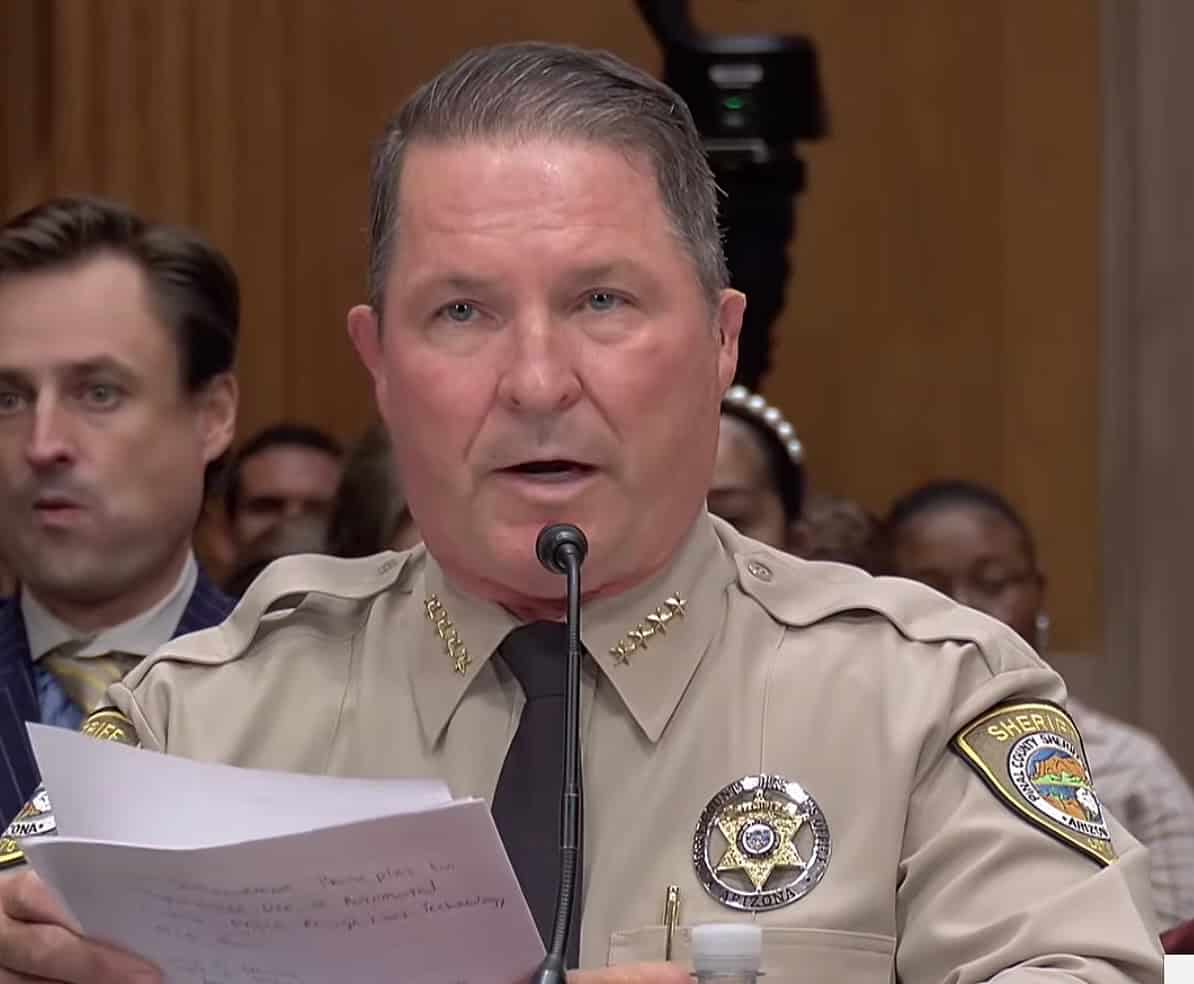
The sheriff’s question echoes United States v. Jones (2012), where the Supreme Court held that physically attaching a GPS device to a car to monitor it is a Fourth Amendment search. The unresolved question — his, and ours — is whether a network of fixed cameras becomes constitutionally comparable when it lets the government reconstruct the same movements over time without ever touching the car. It is a question that carries added weight coming from a sheriff, testifying before Congress.
No list of uses answers the objection
Defenders of these systems will point to the good a camera can do and invite you to weigh it against the risks. We do not accept that framing, because it concedes the thing that is actually wrong. The objection to mass plate-reader surveillance is not that it never helps. It is how it works: the system treats every driver as a subject to be recorded, stored, and searched later — including the overwhelming majority who have done nothing wrong. A free country does not begin from the premise that everyone is a suspect and keep a standing record of where they go on the chance it proves useful someday. That is the line the presumption of innocence draws, and no catalog of uses moves it. A tool that can only deliver its benefits by first treating all of us as suspects is not one a constitutional republic should hand its government — and on that, we go further than even Sheriff Teeple. The point is not to balance the surveillance better. It is that a government of a free people does not watch them all to begin with.
So here is what “We support law enforcement” means
It means we support the officer who upholds the Constitution he swore to, not the database that asks him to set it aside. It means we support the deputy who protects the innocent against deception, and never practices it. It means we support the chief who earns consent through transparency, and the sheriff who releases the audit because the public’s trust is worth more than the convenience of secrecy. It means we support the profession’s own guardian ideal — citizens with rights, not suspects in waiting.
Good policing does not require blind trust. Good policing earns it. That means warrants when the Constitution requires them. It means audits outsiders can actually evaluate. It means honest answers about who can search the data. And before government builds a system capable of reconstructing the movements of ordinary people, it means asking the people whose movements will be recorded.
We support officers who catch criminals. We support deputies who find missing people. We support chiefs and sheriffs who keep their communities safe. And precisely because we support them, we expect the technology used in their name to live up to the principles attached to the badge. Turning off warrantless mass surveillance is not asking law enforcement to abandon its mission. It is asking government to remember the limits that make legitimate policing different from simply holding the power to watch. That is not anti-police. It is pro-constitutional policing — and it is the most pro-law-enforcement thing we know how to say.
References
- International Association of Chiefs of Police, Law Enforcement Oath of Honor.
- International Association of Chiefs of Police, Law Enforcement Code of Ethics (1957 text) and the updated 2024 Policing Code of Ethics.
- The tradition of “policing by consent” commonly associated with Sir Robert Peel (1829); on the disputed authorship, see FBI Law Enforcement Bulletin.
- President’s Task Force on 21st Century Policing, Final Report (2015), Pillar One: Building Trust and Legitimacy.
- Carpenter v. United States, 585 U.S. 296 (2018); United States v. Jones, 565 U.S. 400 (2012); Leaders of a Beautiful Struggle v. Baltimore Police Department, 2 F.4th 330 (4th Cir. 2021, en banc). On the unsettled state of ALPR-specific Fourth Amendment law, see UNC School of Government (Sept. 2026).
- Sheriff Ross Teeple testimony and Reidsville PD discontinuation, Sept. 2026 (Cronkite News; FOX8).
The local cases referenced above — the Reidsville stop, the Wrightsville Beach and Western Carolina productions, and the vendor’s public claims — are documented and linked throughout DeFlockILM.org.
You’re not a suspect. So stop being tracked like one.
It takes one minute. Add your name — then tell the officials who represent you to take the cameras down.