
The Cameras Belong to Lowe’s. The Government Has the Key.
A protest at the South College Road Lowe’s today is not our action. Our position is narrower — and we believe it is stronger.
- Fight for the Future is protesting at the S. College Road Lowe’s today at 10:00 a.m. It is not our event.
- Lowe’s has the right to record its own parking lot. We have never disputed that.
- In September 2025, the State Bureau of Investigation asked Lowe’s for access to those cameras. Lowe’s approved it, across three states.
- Lowe’s policy allows it to retain plate records for as long as 90 days, and to disclose them on a law-enforcement request — no warrant required.
- We are asking Lowe’s for five things it could do this week, starting with telling customers and requiring legal process.
- We are not telling anyone where to shop. We are saying people deserve to know before they park.
What is happening today
Fight for the Future has organized a demonstration at the Lowe’s at 5110 S. College Road, Wilmington, NC 28412, today, Wednesday, August 19, 2026, at 10:00 a.m. The organizers are asking Lowe’s to end its contract with Flock Safety.
DeFlockILM did not organize this event, and our position is our own. We have said publicly that private companies like Lowe’s have the right to record their customers. We have also said that Lowe’s should tell those customers they are being recorded — and should tell them their information is shared with law enforcement voluntarily, without a warrant.
We are posting this because Wilmington residents should know it is happening. Attend, or don’t. Decide for yourself.
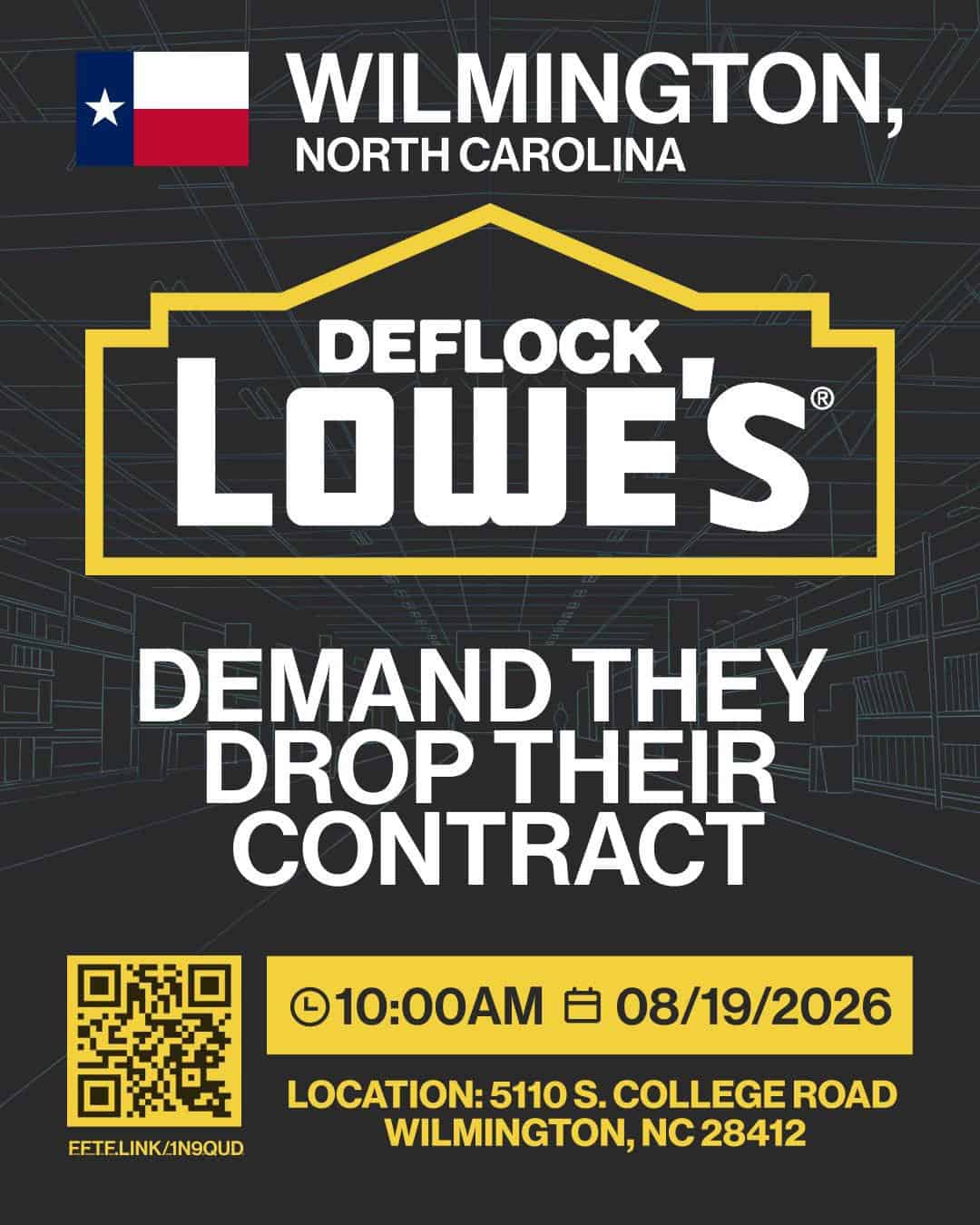
Where we stand
Lowe’s owns its parking lots. A private business may record its own property. That is its right, and we have said so publicly and consistently. We are not asking anyone to boycott Lowe’s, and we are not asking Lowe’s to stop protecting its stores from theft.
Our objection is to what happens after the camera captures the plate.
In August 2025, State Bureau of Investigation Director Chip Hawley asked Lowe’s for access to its Flock cameras. According to records reported by WRAL and The News & Observer, a Lowe’s senior director of investigations approved the request — including expanded search areas — and by September, SBI had access to cameras at Lowe’s stores in North Carolina, South Carolina, and Virginia.
The records describe a request from a state agency and a company’s voluntary approval. Not a warrant. Not a court order. And so far as we can determine, no public announcement to customers — Lowe’s privacy policy contains no commitment to notify anyone, and the arrangement became known through reporters’ records requests, not through Lowe’s.
That is not a private company protecting its property. That is a government agency acquiring the movement histories of ordinary shoppers, and a private company deciding to hand them over.
Lowe’s made a decision
Lowe’s was not served with process. Lowe’s was asked, and Lowe’s said yes.
The company’s Privacy and Security Statement, last updated March 11, 2026, sets out the standard in full:
“We only disclose your personal information if required by law or legal process, or when we believe doing so will help protect the safety, property, or rights of individuals or Lowe’s.”
It then lists examples. Two of them sit side by side:
“A search warrant, other judicial order, or valid legal process.”
“Responding to a request from state or local law enforcement.”
Read it carefully. Lowe’s has written itself two separate pathways: one requiring compulsory legal process, and one requiring nothing but a request and the company’s own judgment. A request is not legal process. Lowe’s built the second path, and in September 2025 the SBI walked down it.
One fair objection deserves an answer. Privacy policies routinely include broad law-enforcement language to cover genuine emergencies — an active shooter, a missing child. No one disputes that a store should hand over footage in those moments, and we would not ask it to hesitate. But Lowe’s policy already covers that ground separately, listing “protecting the health or safety of individuals” and “addressing crimes committed on Lowe’s property” as their own categories. The emergency case is accounted for. What the request clause authorized here was not an emergency. It was a standing channel, opened in September 2025.
Two more details from the policy matter.
This is not just a live theft alert. Lowe’s says it retains ALPR data “typically no more than 90 days (though shorter in certain states),” longer for an active investigation or legal obligation. A camera that flags a stolen truck in real time does not need three months of history. Retention is what makes retrospective searching possible — the ability to ask not “who is here now” but “where was this car in June.”
Someone is responsible. Lowe’s names its Vice President of Asset Protection as the official custodian of this data. This is not an abstract corporate policy. There is a person with a desk who can change it.
And a competitor drew the line Lowe’s has not. Home Depot states publicly, on its own corporate site: “We do not grant access to our license plate readers to federal law enforcement.” We take no view on the rest of Home Depot’s practices. We note only that a major retailer can set a boundary and say so in writing. Lowe’s has set none, and has not answered the reporters, legislators, or shareholders who have asked.
The question Chatrie opens
We want to be careful here, because this is the part most likely to be overstated — including by people on our side.
For fifty years, the rule was that anything you handed to a business became the business’s records, and the business could give them to police without a warrant, because you had surrendered any expectation of privacy. Your bank statements. The numbers you dialed. That rule is called the third-party doctrine, and it is why so much of this is lawful.
The Supreme Court has now twice cut into it. In Carpenter in 2018, and again in Chatrie this June, the Court held that some information is different in kind — so revealing, and so unavoidably generated by ordinary life, that you keep a constitutional interest in it even though a company holds it. Justice Kagan wrote that this data is “the automatic price of conventional cell-phone usage.” You did not consent to surveillance by owning a phone.
Driving is the automatic price of living in New Hanover County. There is no bus to the Lowe’s on College Road for most of the people who shop there.
That raises a question Chatrie makes much harder to dismiss: if customers keep a Fourth Amendment interest in sufficiently revealing location data despite a company holding it, can a retailer’s consent alone authorize the government to search aggregated records of where those customers have traveled?
The Supreme Court has not answered that question for license plate data. We will not pretend it has. Chatrie concerned cell-phone location history, not parking lots. Courts remain divided on whether ALPR records trigger Carpenter at all, and defendants raising the argument have more often lost than won. Massachusetts’ highest court held in 2020 that a few cameras on two bridges invaded no reasonable expectation of privacy — while accepting that a sufficiently extensive network would.
One more point of accuracy, because it cuts against the easy version of this story: Chatrie held that obtaining the data was a search. It did not hold that the search was unconstitutional. The Court sent the warrant, probable cause, and particularity questions back to the lower courts.
So this is an emerging constitutional argument, not settled law. We think it is the better argument. A court will decide that, not us.
The principle underneath the argument is an old one. A hotel clerk cannot consent to a search of a guest’s room. A landlord cannot consent to a search of a tenant’s home. Holding the keys is not the same as holding the right. Those cases involved rooms, not parking lots, and courts treat the two differently — we offer them as the principle at stake, not as controlling precedent.
And the other half requires no court at all. Whatever the Fourth Amendment ultimately demands of the SBI, nothing required Lowe’s to say yes to a request. Declining to hand over the key is a business decision, available today.
What the SBI says
The public-safety argument deserves to be stated at full strength, not caricatured.
The SBI says this access supports legitimate investigations — organized retail theft and human trafficking — and points to results: stolen vehicles recovered, merchandise worth millions returned, a missing woman located. Those are real outcomes, and the agents pursuing them are not acting in bad faith.
That explains why law enforcement wants the tool. It does not answer the narrower question in front of us.
Nothing about organized retail theft requires standing access. An agent investigating a specific crime can identify the store, the date, and the vehicle, and seek authorization to search for it. The difference between “we have an open channel into every Lowe’s in three states” and “we asked a judge about this car” is not the difference between solving crimes and not solving them. It is the difference between a system with a check in it and one without.
We are not saying never search it. We are saying show cause and get authorization.
How we got here
- August 6, 2025 — 404 Media, working from records obtained by the Electronic Frontier Foundation, reports that Home Depot and Lowe’s share Flock camera data with law enforcement. A single Texas sheriff’s office could reach cameras at 173 Lowe’s locations nationwide. EFF’s Dave Maass: “Do customers know that these stores are collecting their data and sharing indiscriminately? Probably not.”
- August–September 2025 — SBI Director Chip Hawley requests access to Lowe’s Flock cameras. A Lowe’s senior director of investigations approves it, including expanded search areas, across three states.
- April 2026 — More than forty-five organizations write to Lowe’s asking it to end its Flock contract. Lowe’s does not respond.
- April–May 2026 — The AFL-CIO Reserve Fund files Proposal 6 in Lowe’s proxy statement, asking the company to report on privacy risks to customers from sharing sensitive data with third parties. The proposal cites concern that license plate data “may be used by law enforcement in ways that potentially could violate the civil liberties and data privacy expectations of our Company’s customers.” The Lowe’s board recommends a vote against it.
- May 26, 2026 — Connecticut’s Senate and House leaders send Lowe’s and Home Depot eight questions — among them, whether the companies require a judicial warrant before sharing ALPR data, and whether out-of-state agencies can access it. Those are, almost word for word, the questions we are asking. Legislators in another state arrived at them independently.
- June 8, 2026 — The News & Observer reports that the SBI “has had the ability to keep a watchful eye over customers at Lowe’s stores across the state.”
- June 29, 2026 — The Supreme Court decides Chatrie v. United States, 6–3. Justice Kagan, for the majority: the government’s acquisition of stored location data is a Fourth Amendment search. The resemblance to Carpenter, she wrote, “practically leap[s] off the page.”
Lowe’s is not unusual. That is the problem.
Some of the most consequential surveillance systems in this country were not built by the government. They were built by companies and made available to the state, which is how they escape the limits that would apply if the state built them directly.
Amazon’s Ring built a police portal for doorbell video. Data brokers sell location records to federal agencies. Google fielded thousands of geofence demands a year. And in 2025, a data broker owned by Delta, United, American and other carriers was found to have sold passenger flight records to Customs and Border Protection and ICE — under a contract asking the government not to reveal where the data came from.
We raise this not to excuse Lowe’s, but because of what happened next.
Pressure has worked. Repeatedly.
- The airlines stopped. After the flight-record sales became public, the airline-owned broker shut the program down. No court ordered it. Customers found out.
- Google closed the door. Facing years of litigation and scrutiny over geofence demands, Google moved location history onto users’ own devices, largely ending the practice.
- Flock retreated. After reporting revealed plans to build a people-search tool using hacked data, Flock dropped it. This month, facing continued scrutiny, Flock rolled out new auditing controls on police use.
- Ring reversed — then reversed back. Ring ended its police video-request tool in 2024 under public pressure. In 2025 it brought the capability back through partnerships with Axon and Flock.
That last one is the lesson. A press statement can be withdrawn. A policy can be quietly edited back. What we are asking Lowe’s for is not a gesture. It is a change to the document.
What others said at the podium
Some speakers at Monday’s Board of Commissioners meeting reached for historical analogies.
Our concern is simpler, and it requires no analogy at all: surveillance infrastructure outlasts the officials, policies, and purposes that originally justified it. You are not building it for the government you have. You are building it for the one you get.
One speaker described mass surveillance in Britain. The factual core is worth knowing, and the government’s own numbers are more persuasive than any rhetoric. Britain’s National ANPR Service receives more than 80 million plate reads a day — the Home Office’s own data-protection assessment cites figures exceeding 100 million — and retains those records for 12 months. No single vote created that. It arrived one reasonable-sounding installation at a time.
Questions nobody has answered
These are the questions we would ask if Lowe’s or the SBI were answering. They are on the record now, and any reporter is welcome to them.
- How many SBI employees hold access to Lowe’s cameras, and how many searches have they run?
- How far back can an agent search?
- Are searches logged, and does Lowe’s audit them?
- Can an agent in North Carolina query cameras at Lowe’s stores in South Carolina and Virginia?
- Can search results be shared with other agencies, including federal ones?
- Has Lowe’s ever declined a search request?
- Does Lowe’s receive notice each time an agent searches its cameras?
- Does Lowe’s receive any alert, hot-list entry, or record about a driver beyond the plate itself?
Lowe’s did not respond to Fast Company in April, did not respond to The American Prospect in May, and has not publicly answered Connecticut’s eight questions.
What we ask Lowe’s to do
We are not asking Lowe’s to remove its cameras. We are asking for five changes it could make this week, without legislation, litigation, or anyone’s permission:
- Require legal process. Strike the clause permitting disclosure on a law-enforcement request. Require a warrant, court order, or valid legal process for any search not tied to a documented incident at that store.
- End standing access. No agency should hold a continuous, open channel into a Lowe’s parking lot.
- Post notice. Signage at every store entrance disclosing that plates are captured.
- Report. Publish annually how many searches ran against Lowe’s cameras, by which agencies, and on what basis.
- Shorten retention, and disclose federal access. Ninety days is a long memory for a parking lot. And say plainly whether federal agencies have access — as Home Depot has.
Two things can be true
Lowe’s has the right to record its own property. We have said so from the beginning and we say it again here.
Lowe’s has also granted a state law-enforcement agency standing access to its cameras across three states, without a warrant and without telling anyone. Both statements are true. Holding them together is not a contradiction. It is the difference between a company exercising its rights and a company lending those rights to the government.
We are not telling anyone where to shop. We are saying customers deserve to know what happens in the parking lot before they park in it. A person who knows can decide what to do with that knowledge — including deciding it does not bother them. That is their call. It is not Lowe’s call to make for them by saying nothing.
At minimum, tell people. Then let them choose.
This is also a New Hanover County question
Our work here has always been about Contract 25-0364 and the roughly 2.98 million searches run through this county’s Flock system in sixteen months. On August 17, the Board of Commissioners heard public comment. Dozens spoke. Not one spoke in favor.
The Lowe’s story is the same problem wearing a different hat. A camera goes up for one stated purpose. Access to the data goes somewhere else. The people recorded are not asked, and there is no way to opt out of driving to the store.
Warrant. Notice. Limits. That has never depended on who owns the pole.
Sources
- NC law enforcement may track your next visit to a home-improvement store — WRAL, June 2026
- Next time you go to a Lowe’s store in NC, ask yourself who might be watching — News & Observer, June 8, 2026
- Lowe’s Privacy and Security Statement, updated March 11, 2026
- Immigration Activity in Our Parking Lots — The Home Depot
- Home Depot and Lowe’s Share Data From Hundreds of AI Cameras With Cops — 404 Media, August 6, 2025
- Lowe’s Companies, Inc. 2026 Proxy Statement (Proposal 6) — SEC
- Senate, House Leaders Press Lowe’s, Home Depot on License Plate Readers — Connecticut Senate Democrats
- Lowe’s faces pressure to cut ties with Flock Safety — Fast Company, April 23, 2026
- Home Depot and Lowe’s Downplay Customer Surveillance Threats — The American Prospect, May 21, 2026
- Court rules that law enforcement’s use of a “geofence warrant” was a “search” — SCOTUSblog, June 2026
- Automated License Plate Reader (ALPR) — Cornell Legal Information Institute
- National ANPR Service Data Protection Impact Assessment — GOV.UK
- Airlines Will Shut Down Program That Sold Your Flight Records to Government — 404 Media, November 2025
- Amazon Ring cameras push deeper into policing with Flock Safety, Axon deals — CNBC, October 2025
- Flock rolls out new police auditing and accountability controls — CNN, August 13, 2026
- DeFlock Lowe’s Home Improvement — Fight for the Future
This page is general information about North Carolina and federal law, not legal advice, and creates no attorney-client relationship. For advice about a specific situation, consult a licensed North Carolina attorney.
DeFlockILM.org is a citizen-led, volunteer effort. We don’t solicit donations; no one is paid, and no one profits.
You’re not a suspect. So stop being tracked like one.
It takes one minute. Add your name — then tell the officials who represent you to take the cameras down.