
Brunswick Hit Pause on License-Plate Readers. The Meeting Revealed a Much Bigger Surveillance System.
The Board voted 5–0 to pause new license-plate-reader purchases for 30 days. Then the meeting revealed how much bigger the county’s surveillance system already is — and how little of it was ever put to a public vote.

On Monday evening, the Brunswick County Board of Commissioners pressed pause on Flock. On a motion by Commissioner Frank Williams, the Board voted 5–0 to halt procurement of any new automated license plate reader (ALPR) equipment for 30 days, and to send staff, legal, and communications — together with the Sheriff’s Office — back to the table to answer the public’s questions.
That is progress, and the residents who showed up and spoke earned it. But a pause is not a decision. The next 30 days are where this gets decided. So here is what the Board revealed, what it got right, and where the record needs correcting — because the commissioners will make a better decision, and the public a better judgment, from facts than from talking points.
What the Board actually did
The motion evolved during the debate. It began as a “pause plus a committee.” It ended as a 30-day pause on new ALPR purchases plus a direction for staff, legal, and communications to work with the Sheriff’s Office and report back — after several commissioners objected to “death by committee.” The vote was unanimous.
One structural detail deserves attention, because it decides how much the public will see. The Board did not just decline a committee — it chose staff on purpose. As one commissioner put it: “I’d even be willing to let staff, legal, and communications work it out and come back to us with something. That way you wouldn’t have a committee; you’d have staff working with the Sheriff’s Office.” That choice has a consequence most residents won’t catch. Under North Carolina’s open-meetings law, a committee of two or more commissioners with an advisory function is a “public body” (G.S. 143-318.10(b)) — it must meet in the open, keep minutes that are public records, and post notice. A working group of staff and the Sheriff’s Office is not. By routing the review to staff rather than a committee, the Board placed it outside the open-meetings framework entirely: no open session, no minutes, no public comment — the review can surface only as a finished “message” the public never watched being written. That may not have been the intent, but it is the effect. The remedy is simple and we are asking for it: whatever the review’s form, the county should produce the review’s full record under the Public Records Act and hold a real public hearing with a recorded vote before it decides — not present a communications product as a settled conclusion.
What the meeting revealed
Three things came out on the dais that residents had not been told before.
Every Sheriff’s Office vehicle carries an in-car plate reader. Commissioner Williams, reading the contract again, said the agreement signed November 17, 2025 puts a reader in every Sheriff’s vehicle — mobile ALPR, on top of the fixed cameras across the county — and added: “I don’t think staff knew that the vehicles had [these] cameras in them until this week.” One clarification the Board never made: Williams called them “Flock” cameras, but the contract at issue is an Axon agreement, and to our knowledge the in-car readers are Axon’s, not Flock’s. That may sound like a technicality. It is not. If commissioners who approved a multimillion-dollar surveillance contract cannot say whose cameras sit in their own deputies’ cars, it proves the very point Commissioner Sykes pressed all night — the stated purpose never quite matches what was actually bought.
A second surveillance system nobody voted on. Finance Officer Aaron Smith confirmed a purchase order for “Airship AI.” He described it as roughly a dozen pole-mounted cameras — typically on power-line poles — with cloud storage, meant to feed into the county’s Axon system, and noted it is “mostly used by the FBI on a national level.”
So what is Airship AI? It is not a camera brand. Airship AI Holdings (Nasdaq: AISP) is an artificial-intelligence video-surveillance and data-analytics company. Its platform, “Acropolis,” is built for government and law enforcement — its own announced customers include the U.S. Department of Justice and the Department of Defense — and the company markets it as software that centralizes feeds from many cameras and sensors and delivers “predictive analysis of events before they occur.” In plain terms: this is the kind of AI surveillance platform federal agencies use, and it was added to Brunswick County’s toolkit under the purchasing policy — without a separate public board vote, because the price “didn’t rise to that level.” That is the same pattern residents are fighting in New Hanover, where eight “Condor” cameras were bought inside a larger contract and never separately approved.
A commissioner raised an undisclosed vendor connection to a former Sheriff. Commissioner Pat Sykes told the Board that a software item it approved last month is sold by a company that employs former Sheriff Ingram, and that the connection was not disclosed to the Board. We have not independently confirmed the company, Ingram’s role, or whether any disclosure was required — so we report it as her on-record allegation, and as a transparency question the county should answer plainly.
The program itself is a ~$4 million, five-year, 150-plus-page Axon agreement that covers far more than plate readers.
Update — Sept. 24, 2026. Reporting after the meeting sharpened the inventory problem: Brunswick pays Flock for eight cameras but has fifteen in use, because Flock failed to remove seven cameras from private property as planned — so the county is operating nearly twice the hardware its contract covers. (Port City Daily.)
The commissioner who brought Flock now says he needs more information
Brunswick’s Flock program did not appear out of nowhere. On January 18, 2024, Commissioner Randy Thompson signed the county’s Flock contract himself, as Chairman of the Board. His signature is on the document.
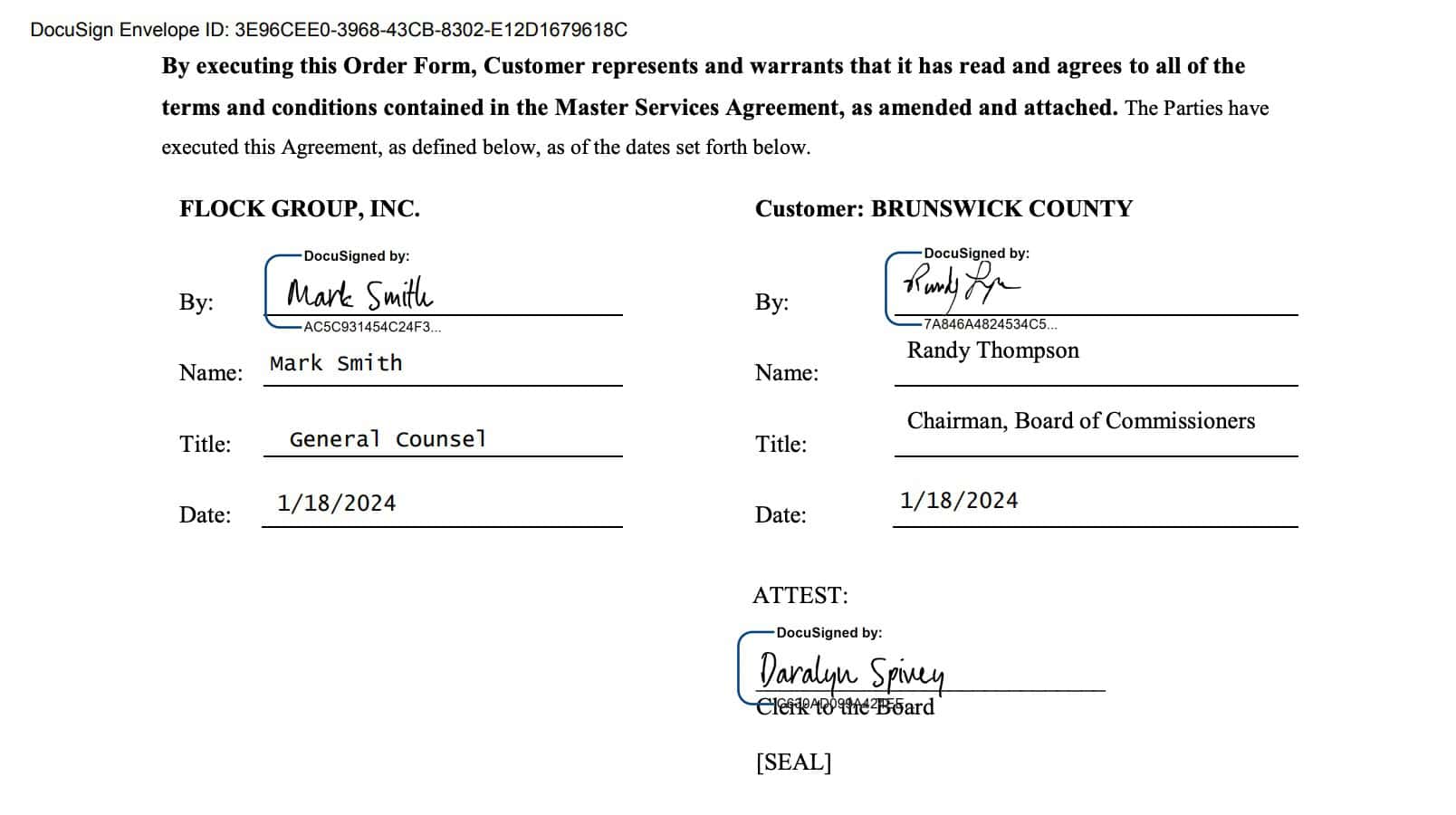
Yet on September 20, 2026 — the day before this meeting — Commissioner Thompson posted his “current position on Flock Cameras” publicly. In his own words:
“We are still in the process of receiving data from the Sheriff’s Office to review. The data requested at this point has been slow in providing a clear understanding of the use and location of the units… We may not need the Flock System, which I will determine after the data review. As for misuse, if you didn’t have it there would be no misuse. I disagree with spending additional tax dollars on policing the police.”
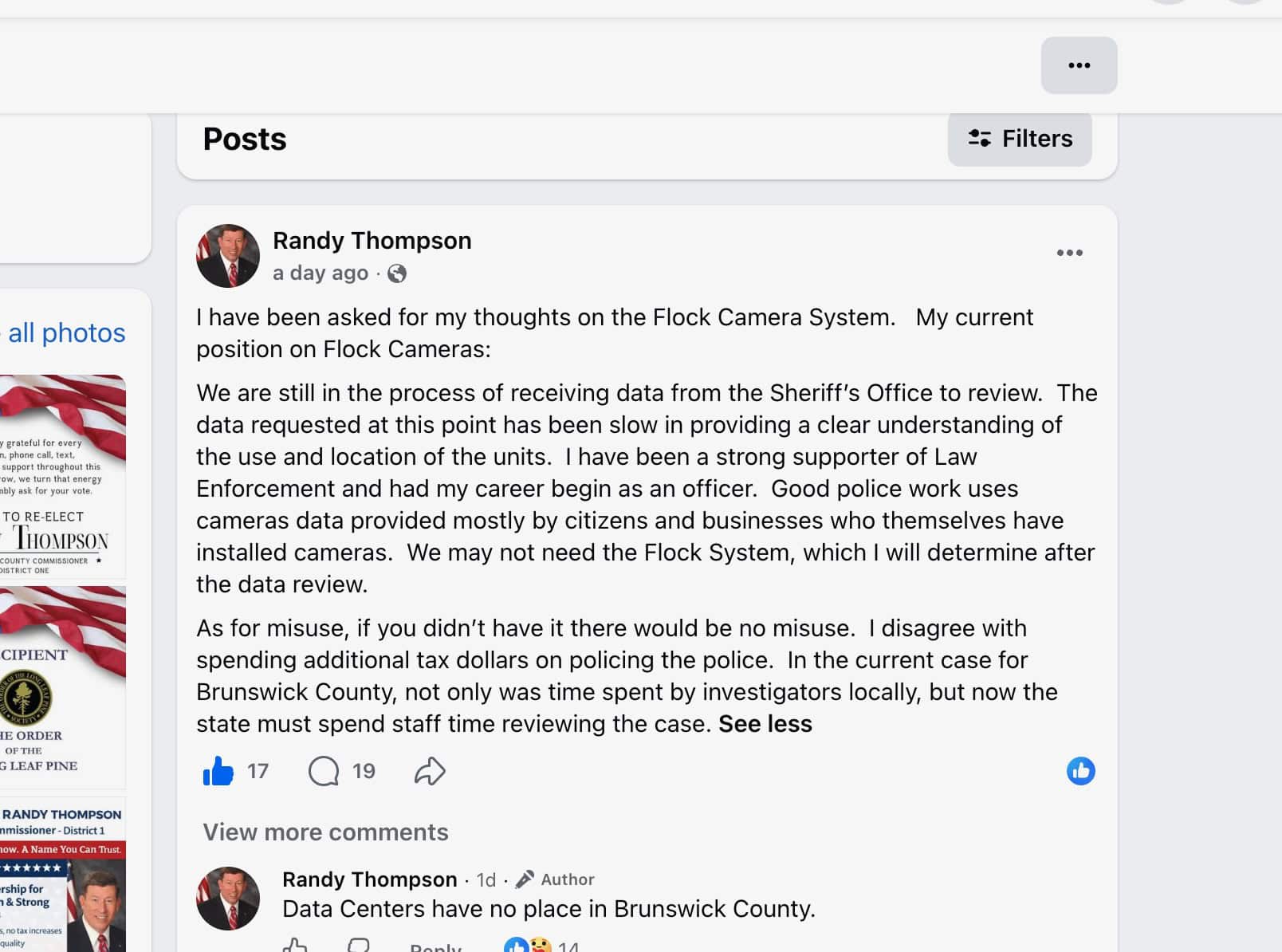
Read that carefully, because it says more than he may have intended. The commissioner who signed this contract now reports that his own Sheriff’s Office has been “slow” in giving him “a clear understanding of the use and location of the units” — an admission that even the man who put his name on the deal cannot get a straight account of what it does or where the cameras are. He concedes the county “may not need the Flock System.” And he rejects “spending additional tax dollars on policing the police” — which is to say he opposes the one thing this program most lacks: independent oversight.
Those positions are hard to square with having signed the contract in the first place. If the program needs this much study now — if even its own signer cannot get clear answers about it — then it needed that study before the county committed.
A word on timing. The Board set a 30-day clock for staff to report back — but it set no date for an actual vote on the contract’s future. A report is not a decision. With commissioners on the November ballot, an open-ended “review” is exactly how a politically difficult vote slides past an election. That is not idle speculation: a commissioner warned on the dais that this must not “go the way of the fire committee” and still be unresolved “three years from now.” The public should hold the Board to a date — a real vote, before the year is out.
What it looked like: managing the message
Watching the full discussion, we came away with a distinct impression — and we offer it as exactly that, an impression. The Board’s energy seemed aimed less at finding out whether this program should exist than at easing the pressure it is under. The words the commissioners reached for again and again were “educate,” “the message,” “the media,” and “divided.” The review they created would lean on the county’s and Sheriff’s communications officers as much as on anyone auditing the technology itself. Commissioner Williams put the goal plainly: come back with “a good message to send out,” because “the message out there is dividing folks.”
Educating the public is a worthy thing. But it is not the same as digging in to find the truth. A board that is genuinely investigating treats contested claims as open questions. This board, more often, treated them as settled — most tellingly the assurance that “the audit worked.” We do not believe it did, for the reasons in the next section.
Where the record needs correcting
Commissioners on both sides said things that deserve a factual reply. We are not questioning anyone’s good faith — we are completing the record.
Claim: “It’s a snapshot in time. It doesn’t track you.” (Commissioner Cooke) The record shows otherwise. Flock does not take one picture and forget it. Each camera creates a time- and location-stamped record of every vehicle it sees, and authorized users can search those stored records to find where a queried vehicle was observed during the retention window. That is a searchable movement history, not a single snapshot — and the searches we examined from February 2025 used 30-day look-backs to reconstruct where a vehicle had been seen by cameras over the prior month. (What it shows is only as complete as the network’s camera coverage — but within that coverage, it is a record you can query by plate.)
Claim: “It’s just a license plate reader.” (Chairman Forte) Commissioner Sykes was right to push back. Flock’s own product — marketed as “Vehicle Fingerprint” — captures make, model, color, and distinguishing features like decals and damage, not merely the plate. “Just a license plate reader” understates what it does.
Claim: “There’s no expectation of privacy on your license plate.” (Chairman Forte / Commissioner Cooke) True of a single glimpse — and incomplete as a matter of law. Supreme Court precedent does not establish that an ALPR search is unconstitutional. But it does undercut the simpler idea that information loses all Fourth Amendment protection merely because each movement happens in public. In United States v. Jones (2012), several Justices wrote separately to warn that prolonged GPS monitoring of a vehicle raises constitutional concerns even though any single moment of the drive is observable on a public street; in Carpenter v. United States (2018), the Court held that obtaining an extensive historical record of a person’s movements — there, through cell-site location data — is a Fourth Amendment search. A single plate on a public road is not the issue. Whether a fixed ALPR network becomes comprehensive enough to cross that line is exactly the question now on appeal in Schmidt v. City of Norfolk, discussed next.
Claim: “Every court reviewed it and said it’s constitutional… look at Schmidt v. City of Norfolk.” (Commissioner Cooke) Here is the fuller picture, because the case he named is considerably less definitive than his description suggested. Schmidt v. City of Norfolk is a lawsuit brought by the Institute for Justice to stop a Flock ALPR network — 176 cameras in Norfolk, Virginia — as a Fourth Amendment violation. It is not a case defending Flock. It is true that in January 2026 a federal district court granted summary judgment to the City, reasoning the program was not a “search” because it had gaps and captured only what is visible on public roads. But even that court acknowledged that ALPR surveillance could, at some point, become intrusive enough to raise constitutional problems — it simply found that Norfolk’s network had not yet crossed that line. And that is not the end of the story: the plaintiffs appealed, and the case is now pending before the U.S. Court of Appeals for the Fourth Circuit (No. 26-1227) — the court whose rulings bind North Carolina’s own federal courts — with civil-liberties groups across the spectrum, from the ACLU and EFF to the Cato Institute, urging reversal. The question is unsettled, and the Fourth Circuit’s eventual ruling could reshape the legal landscape for North Carolina’s own federal courts.
Further reading — the cases, and why “you have no privacy in public” is not the whole story: ALPR Cameras in the Courts · “No Privacy in Public”? · The Chatrie geofence case · The Norfolk lawsuit · North Carolina’s Constitution and ALPR.
Claim: “The audit caught the misuse and it was dealt with swiftly. The guardrails worked.” (Chairman Forte) An audit is a rear-view mirror. It can only find misuse after the access has already happened. And Commissioner Sykes asked the question the Board never answered: “Who’s watching the Sheriff’s Office?” North Carolina law does require auditing: an ALPR agency’s written policy must provide for annual or more frequent auditing of the system’s use and effectiveness (Article 3D of Chapter 20, G.S. § 20-183.31). But the statute requires those results to be reported only to the head of the agency that operates the system — it does not require an outside or independent auditor. (Separately, state law generally caps retention of captured plate data at 90 days under § 20-183.32.) But the statute’s floor keeps that review inside the operating agency: state law does not require the audit to be performed by any independent, outside entity. “The audit worked” and “no one outside is required to check it” cannot both be reassuring at once.
To be fair to the other side: Commissioner Cooke is right that the federal district court in Schmidt upheld Norfolk’s particular deployment — a judgment now on appeal — and Chairman Forte is right that a stolen car or a wanted person can be flagged by an ALPR. Those points are real. They are also not a reason to skip the review the Board just voted for.
And that is the deeper problem. A board that is genuinely searching for the truth hears from both sides — proponents and opponents — and holds its conclusion until it has. Several times on the dais, Commissioner Cooke told the room, “I’ve already done the research on all these,” and rested his position on it. But the research, as the record above shows, misstated the very case he named and overstated a body of law that is unsettled and on appeal. When members of a board arrive already certain — and certain on incorrect information — the 30-day “review” they just ordered is not truly open. The residents who filled that room, on both sides, deserve a board that is still willing to be persuaded by the facts.
What one Sunday afternoon says about “the audit worked”
We can be specific about why we doubt that reassurance. On Sunday, February 9, 2025, between 12:58 and 1:16 PM, a single Brunswick County Sheriff’s Office account ran a burst of Flock searches on four vehicles. Every search gave its reason simply as “Law enforcement.” None carried a case number. Each one pulled a 30-day history of where the vehicle had been. At least two of the four are privately registered vehicles, titled to local residents. We found no publicly available record establishing why any of them was searched.
We know this not because Brunswick disclosed it, but because Flock’s national network logged those searches in the public records of police departments in Virginia and Illinois. Volunteers reconstructed the session from other states’ released records; the files are archived publicly. We are not naming the account or the vehicles — the people whose plates were run appear to be the subjects of these searches, and they are entitled to their privacy.
Here is the point for Brunswick. That was more than nineteen months ago. If private citizens sifting through scattered out-of-state records could surface a no-case-number search session from February 2025, what does the Sheriff’s own audit — the one commissioners were told “worked” — show inside its own complete system, and how quickly does it act? We do not know whether these February 2025 searches have any connection to the misuse matter later referred to the SBI, and we do not claim they do. That uncertainty is precisely the point: it is exactly why the underlying audit history matters, and exactly what an internal, after-the-fact review — with no independent eyes on it — is poorly built to answer.
And the “one bad apple” framing is itself contested — on the record. At a September 8 meeting, when Sheriff Chism said the office had caught “one” instance of misuse, Commissioner Sykes cut in: “You had more than one. I am not even going to go there.” The Sheriff’s Office later told WWAY it “has not identified any other BCSO employee who has misused the Flock system.” Those two accounts cannot both be complete. When an elected commissioner says, on the dais, that there is more than one — and the agency that runs and audits the cameras says there is only one — the public is owed an independent accounting, not the agency’s word for it.
The question that should drive the next 30 days
Commissioner Sykes asked for proof that deputies were trained; the Sheriff’s attorney said they were, but no documentation was produced. She asked who audits the searches; the answer was the Sheriff’s own office. She asked why the “purpose” stated in an agenda item so often does not match what the contract actually authorizes. Those are not anti-police questions. They are the questions a board asks before it spends four million dollars and puts a camera in every deputy’s car.
And there is our own request. DeFlockILM asked the Brunswick County Sheriff’s Office for its Flock records — including the network audit that would show who has searched county cameras, when, and why — on June 29, 2026. The office produced part of the file in August, but nearly three months later, that audit has still not been produced. When the agency that runs the searches will not show the public who ran them, “trust us, we audit ourselves” rings hollow.
Two more questions belong out loud, in public. The public still has not been told the rank of the employee who left over the Flock matter, and the county has not said whether any public money — a separation agreement, severance, or an early-retirement payment — was spent in connection with it. There is rumor circulating on both points, and some outlets have reported details we are not going to repeat, because the way to replace rumor with truth is not to amplify it — it is to make the county confirm or deny it, on the record.
The questions that actually decide this
The five questions below are the ones the county can answer with documents. But underneath them sit three the commissioners have never put to the public — and these are the ones that decide whether Brunswick keeps this system at all:
- Should the county keep treating every resident as a suspect — logging where innocent people drive, day after day — instead of honoring the presumption this country is built on: innocent until proven guilty?
- Should taxpayers keep funding a national surveillance network that lets out-of-state law enforcement reach into Brunswick’s cameras — with no local accountability, and no one here checking why?
- Should the county have these systems at all?
Those are not questions for staff, or for a committee, or for the county’s communications officers. They belong to the public — in a real public hearing, on the record. Residents are entitled to that hearing before the county spends another dollar or keeps another camera. And they are entitled to it precisely because the commissioners have already stated their positions in public — positions that, as the record above shows, rest on incorrect facts. A board that has made up its mind on bad information owes the people it represents the chance to correct it, out loud, before it decides.
Five questions Brunswick must answer in the next 30 days
- How many ALPR-capable devices does Brunswick County operate — by vendor and type — and can the county produce one complete inventory?
- When did commissioners learn that Sheriff’s Office vehicles carry in-car plate readers?
- Who authorized the Airship AI purchase, how much did it cost, what account paid for it, and why was a board vote not required?
- Exactly when was the alleged Flock misuse discovered, when was it referred internally, and when was the SBI contacted — and was any public money spent to resolve it?
- Will the county release its audits, require a case number for every search, and adopt independent, outside review — and set a date for a public vote on the contract’s future?
The next evening meeting is Monday, October 19, 2026, at 6:00 PM — Commissioners’ Chambers, David R. Sandifer Administration Building, 30 Government Center Drive NE, Bolivia. Public comment is open. Tell the Board to finish the job with a public vote to end the contract — and don’t let it get buried under a committee. Two minutes at the podium is enough, and a full room is its own message. Bring a neighbor, and wear red.
This post is news analysis and commentary on statements made in a public meeting. Quotations are drawn from the meeting audio and lightly cleaned for readability; a full transcript is available. Our legal characterizations are our own opinion and are not legal advice.
You’re not a suspect. So stop being tracked like one.
It takes one minute. Add your name — then tell the officials who represent you to take the cameras down.