
What Happened Inside Brunswick County’s Flock System Before the Public Was Told?
Brunswick County has run a license-plate surveillance network for years with no pre-September 2026 written policy located in the records reviewed — though state law requires one. These are the records, and the questions they leave for the County Commissioners.
What this article does — and does not — claim
Nothing in this article asserts that Lt. Daniel Little, or any other officer or operator named here, improperly used the Flock system, violated any policy, or committed any crime. The names that appear below come from public records — Brunswick County’s own Flock event log — and from a publicly available dataset. An audit “review” flag, or a third-party “anomaly” flag, marks activity worth examining; it is not a finding of wrongdoing, and legitimate, active investigations can produce the very same patterns. Any investigation referenced here rests with the North Carolina SBI and the District Attorney, who alone determine whether any law was broken. We report what the public records show, and raise questions the public and its elected representatives are entitled to ask.
This is a story told in dates. Each one comes from a document — a contract, a state report, a personnel record, or the Sheriff’s own system logs. Put in order, they raise a simple question of transparency: when a surveillance system runs for years with no written policy in the records, and 145 Audit Assistance review items are archived on a single day, how is the public supposed to know what happened?
Twenty-one days
- Aug 11, 2026 — an “Internal Affairs Division” role appears in the Flock system.
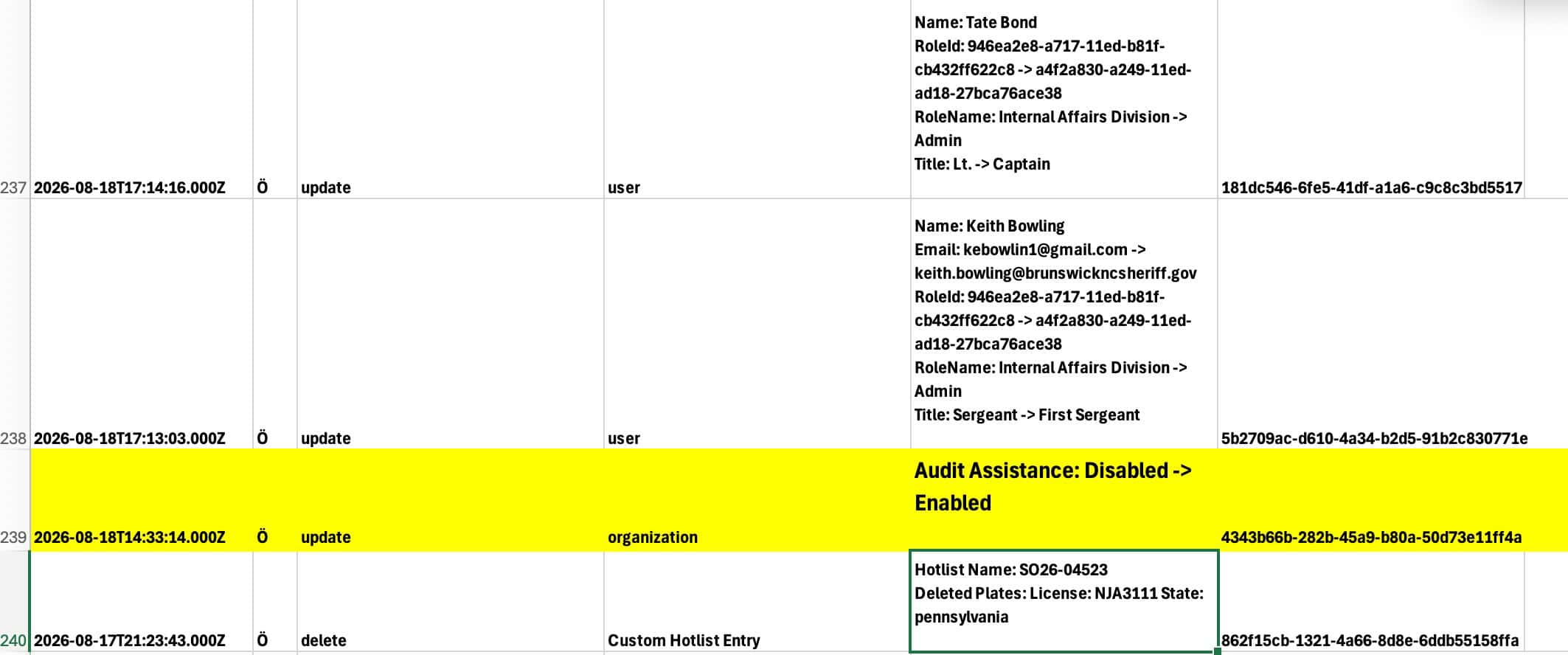
- Aug 18 — Flock’s “Audit Assistance” is switched on in the agency’s system (10:33 a.m. ET); Lt. Daniel Little’s Flock account is deleted the same day (7:02 p.m. ET).
- Aug 19 — a Sheriff’s Office attorney is added to the system, and searches are changed to require a stated reason.
- Aug 31 — all 145 Audit Assistance “Needs Review” items — flagging 17 different employees — are archived in a single day.
- Sep 1 — the Sheriff announces the investigation; policy E-07 bears this date; the transparency portal launches.
None of these events proves misconduct. Together they establish a sequence Brunswick County residents have not yet had explained.
Years of cameras. No earlier policy located in the records.
Brunswick County Sheriff’s Office’s presence in the Flock system can be traced to February 7, 2023 — the start of the agency’s data range on the public Have I Been Flocked dataset, matched to the day by a role identifier in the Sheriff’s own event log. That establishes presence in the system, not necessarily that cameras were collecting data that day. The paid contract we have a copy of for eight cameras did not take effect until January 18, 2024 — roughly eleven months later — so the gap is unexplained. For most of that first year, the governing agreement is not something we can identify in the record at all.
More striking: when the North Carolina SBI reported to the Legislature on the ALPR pilot in April 2026, it attached the written ALPR policies of the participating agencies. Sixteen agencies’ policies are in that appendix. Brunswick County’s is not. Omission from the appendix is not itself proof that no policy existed — one could have gone unsubmitted, been filed elsewhere, or fallen outside the pilot’s scope — but, together with E-07 naming no predecessor, it leaves the question for BCSO to resolve by producing any earlier policy.
📄 Read the NC SBI ALPR Pilot Program Report to the Legislature (Apr 7, 2026) — see the participating-agency list and the policy appendix; Brunswick County’s policy is absent. (Internet Archive)
What state law requires.
North Carolina’s ALPR statute is explicit: an agency must adopt a written policy governing use before the system is operational, and that policy must address supervisory oversight and annual (or more frequent) auditing and reporting (N.C. Gen. Stat. § 20-183.31(a)). The law puts the policy first — before the searching, not after it. The statute requires those audits and reports to go to the head of the agency operating the system; it does not itself require them to be made public. The open question is whether BCSO performed the required reviews, what they found, and what records can lawfully be disclosed. (N.C. Gen. Stat. § 20-183.31)
In the records the Brunswick County Sheriff’s Office has published, the Flock event log first shows an “Internal Affairs Division” role on August 11, 2026 — years into the program, and days before the public first heard of a problem. The records reviewed for this report do not identify an earlier Flock-based oversight role, or document how supervisory review was structured before then.
The vendor’s audit tool switches on — and flags appear.
The most serious finding concerns these 145 searches that Flock’s own audit system marked “Needs Review.” A flag generally means a search looked like it might not meet the rules. Flock describes Audit Assistance as a tool that surfaces atypical search patterns for administrators to review, and the system requires a case number and offense type for every search (Flock Safety; TechCrunch, Aug. 2026). A copy of the tool’s output released by another agency — the Dunwoody, Georgia Police Department, through a public-records request — shows the categories it flags, among them “Single-User Plate Searches,” “Searches Beyond 30 Day Timeframe,” and “Repeated Narrow Timeframes”: the pattern of one user repeatedly searching, or tracking, a single plate. Flock’s own interface cautions that these items are “for administrators’ informational purposes and do not reflect any findings or conclusions by Flock or your agency.” Flock told TechCrunch the same — it is a rules-based “data tool,” not AI, and “a flag does not mean that it is definitely abuse — it only means it warrants further investigation” (TechCrunch, Aug. 13, 2026). Each flag is supposed to be checked by a supervisor, who decides whether the search was proper. That supervisory review is exactly the oversight state law requires the policy to provide (N.C. Gen. Stat. § 20-183.31(a)).

Yet the records show this audit function was off for almost the entire period they cover. The event log runs from January 1 through August 31, 2026, and within it Flock’s “Audit Assistance” is switched from Disabled to Enabled only once — on August 18, 2026. Flock had made the tool available months earlier: it launched Audit Assistance in April 2026 (announced April 14) and offered it to every agency at no cost, with more than a third of agencies adopting it voluntarily (Flock Safety; TechCrunch, Aug. 13, 2026). Brunswick County left it switched off until August 18, nearly four months later. So, at least as far as the system is concerned, no automated audits were being run until August 18. Once on, the tool flagged 145 “Needs Review” items in thirteen days, across 17 different Sheriff’s Office employees (one account alone drew 65).
Then, on August 31, 2026 — the day before BCSO’s “Automated License Plate Readers” policy (E-07) took effect — every one of the 145 flags was marked “Archived” between 9:55 a.m. and 4:10 p.m. That is one flag closed, on average, every 2.6 minutes, for searches run by 17 different employees. What “Archived” means — each one individually reviewed and resolved, or simply closed in bulk — is not established by the records, which record no reviewer name, no written justification, and no “approved” or “resolved” outcome for any of the 145 — only the status change to “Archived.” The records also show only when each flag was closed — all on August 31 — not when it was raised. The flag-creation dates exist in Flock’s system; they have not been produced. Nor has BCSO produced its Audit Assistance report itself: when another agency released that report, each flagged item carried the type of anomaly, the number of searches involved, the date of the latest activity, and space for reviewer notes — none of which appear in the records Brunswick County produced.
We identify the operators below only by initials. Their full names were released by Sheriff Chism’s office in the publicly produced Flock event log; we have chosen not to republish them here. A review flag means “worth a look,” not wrongdoing — a high count can reflect legitimate, active casework. We draw no conclusion about any operator; we simply report what the County’s records and a public dataset show.
Audit “Needs Review” flags per operator (145 total)
145 “Needs Review” items by operator (shown by initials), from BCSO’s Flock event log. Operators in red also appear on Have I Been Flocked’s anomaly index.
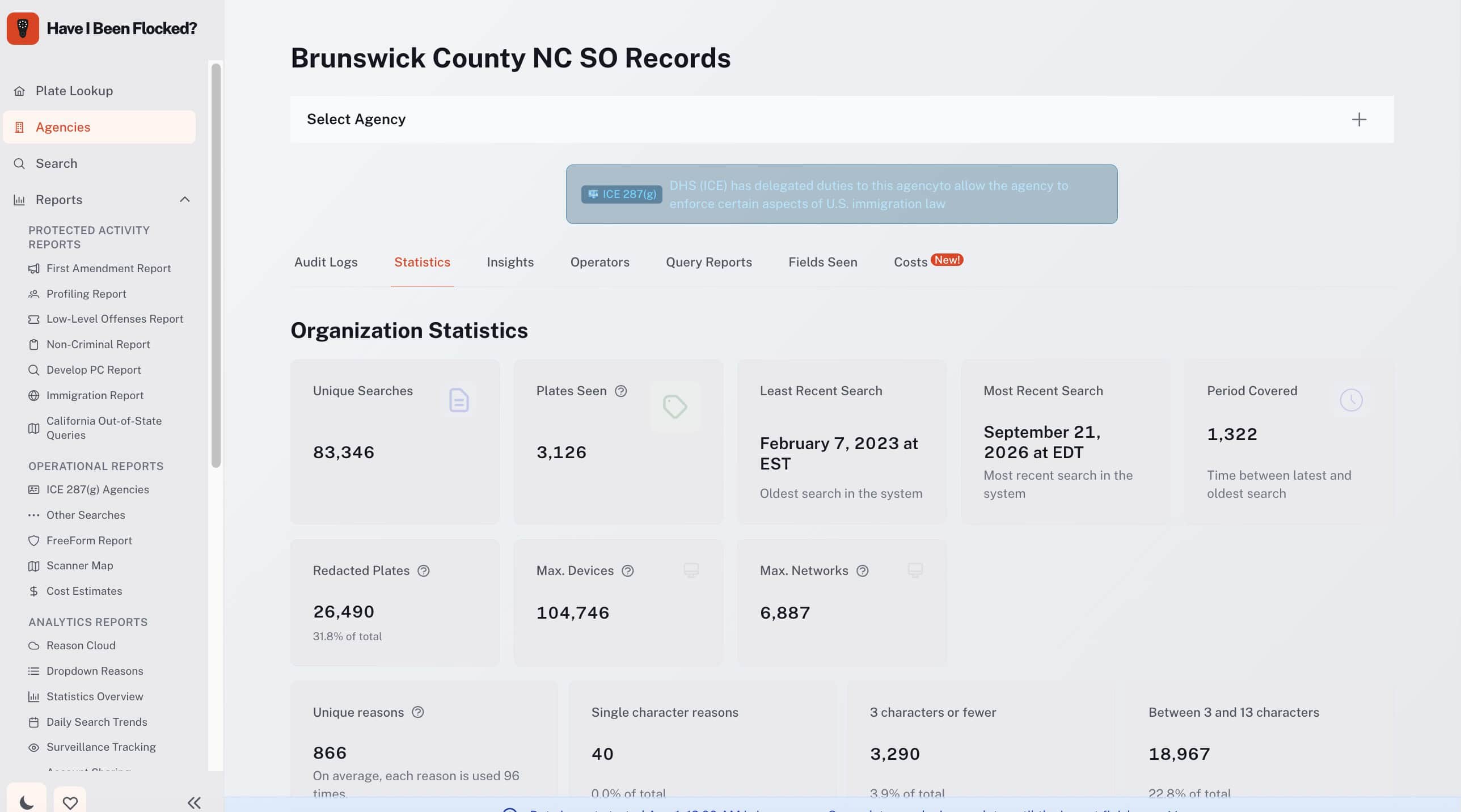
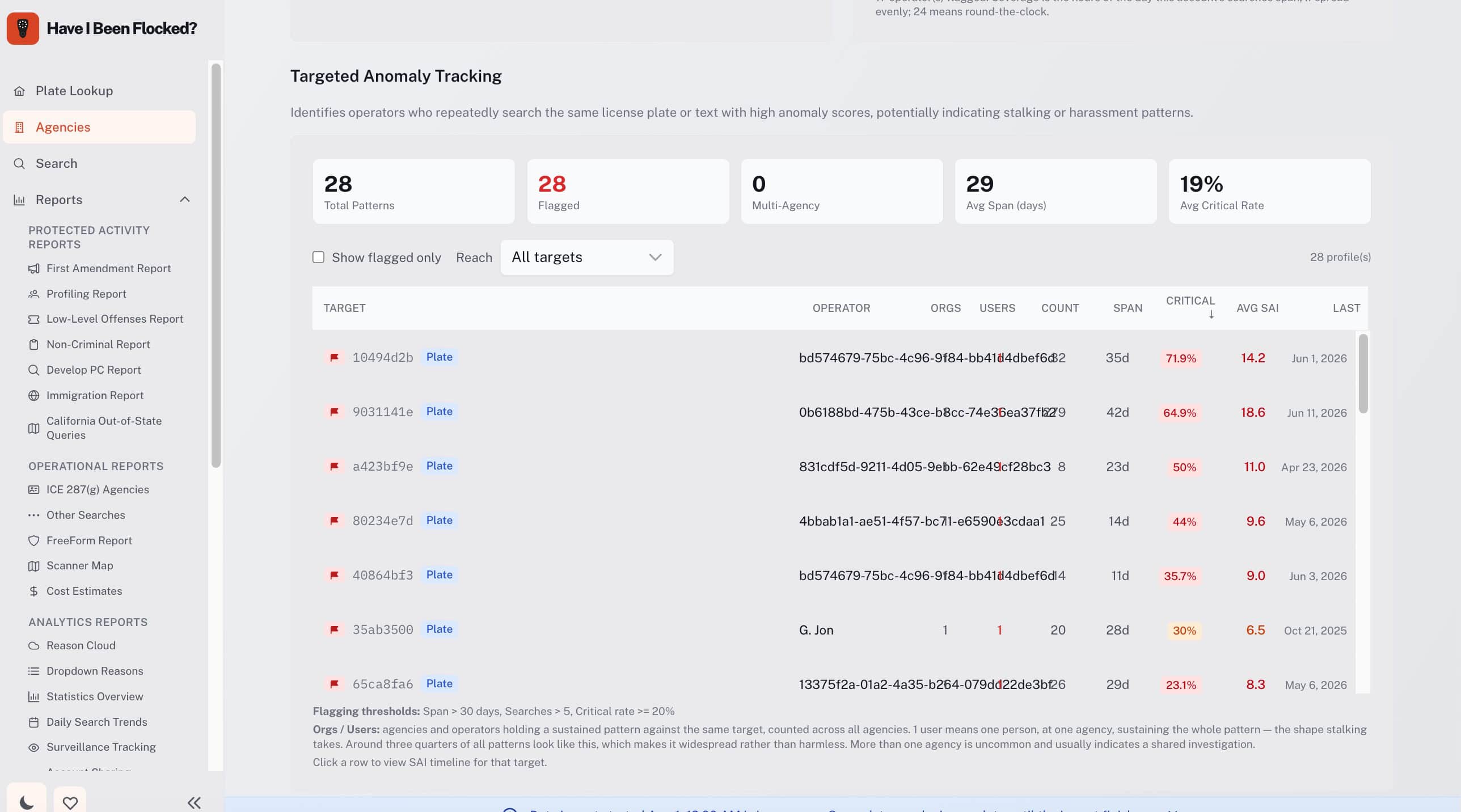
Independently, Have I Been Flocked — a public, open-source project that analyzes agencies’ ALPR audit and transparency data to surface unusual search patterns — catalogued the same agency’s activity (83,346 searches by 96 operators) and flagged a set of repeat-search patterns. Three of the operators it flagged — G.J., J.D., and C.S. — also appear in Brunswick County’s own Audit Assistance review list, with 65, 8, and 2 review items respectively. BCSO’s own event log and an outside project’s analysis of ALPR data name an overlapping set of accounts (the two analyses may draw in part on related underlying data).
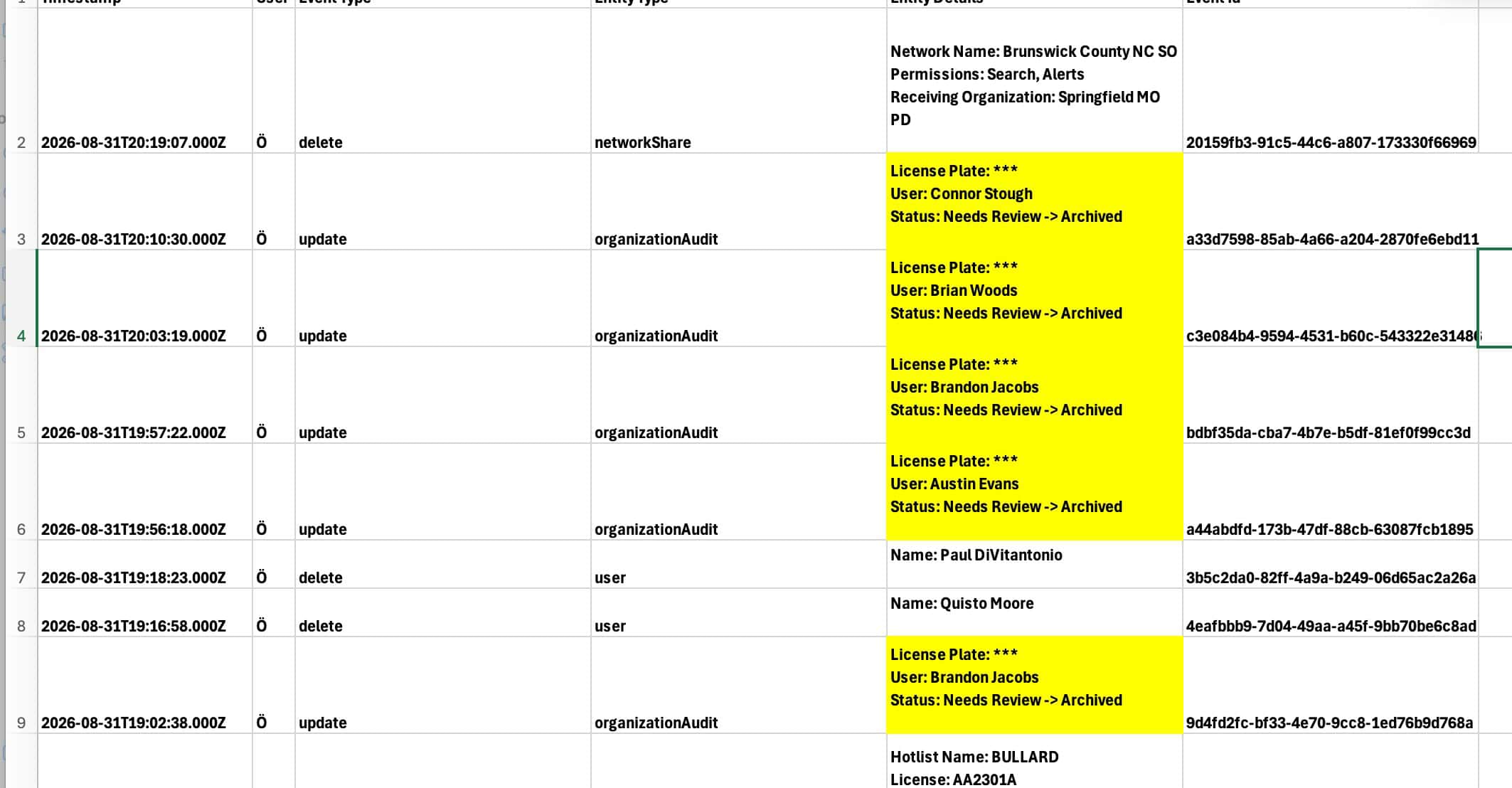
Every single one of the 145 Audit Assistance review items — flagging 17 different Sheriff’s Office employees — was switched from “Needs Review” to “Archived” on August 31, 2026, the day before the Sheriff told the public that an audit had found a problem. The records reviewed for this report do not show who reviewed them or what any reviewer concluded.
Importantly, these 145 review items cannot be identified, from the records reviewed, as the “routine audit” the Sheriff said flagged the employee. Local reporting (Port City Daily, Sept. 1) stated the matter had been referred to the SBI in early August — weeks before the August 31 archiving — though we have not independently verified that referral date. The relationship, if any, between the 145 items and the employee investigation is unclear.
There is more that does not line up. At the Board of Commissioners’ meeting on September 21, 2026, it was stated that the misuse was caught by an audit and dealt with the next day — yet Lt. Daniel Little, the only employee who is publicly known to have left the agency in that timeframe, does not appear anywhere among the 17 flagged accounts. And the 145 “Needs Review” items that flagged those 17 employees were not resolved one at a time over the days that followed; all 145 were cleared on August 31 with the same “Archived” switch.
That raises questions the records cannot answer on their own: Were these 145 items given a genuine, individual review — or simply closed in bulk? Who reviewed them? And was the single separated employee really the only person who may have used Flock improperly, when Audit Assistance had just flagged 17?
Independent experts have raised exactly this concern about Audit Assistance. The ACLU’s Chad Marlow has written that without knowing how many officers are misusing the system, “we cannot conclude if Flock and its auditing tools are catching 95% of violators or 5%,” and that until the tool is independently evaluated “we don’t know if [it] is a real security measure or just window dressing.” The Electronic Frontier Foundation’s Cooper Quintin put the oversight problem plainly: if “whoever [the tool] reports to is the same police agency that is doing the abuse, it’s just a fig leaf” (TechCrunch, Aug. 13, 2026). In Brunswick County, the tool reported to the Sheriff’s Office — and the Sheriff’s Office closed all 145 flags itself.
An exit, an SBI referral, and no public detail.
On September 1, 2026, the Sheriff announced in a video statement that an employee had “resigned” amid an SBI investigation into Flock misuse — flagged, he said, by a “routine audit.” The Sheriff publicly described the employee as having resigned and did not name them. The Investigative Watchdog account first identified the officer as Lt. Daniel Little; the county roster corroborates his rank and tenure, and the Sheriff’s own event log shows his Flock account was deleted on August 18. His separation has been reported as a retirement effective September 1 — with a salary and a leave/longevity payout. The event log records the deletion but does not state the reason, or whether the account’s search history was preserved.
The public was given a conclusion — one employee, handled — without the record behind it. A week later, on September 8, a sitting commissioner said on the record that she believed the misuse might involve more than one employee.
🔗 WECT: “Brunswick Co. Sheriff’s Office employee resigns amid investigation into Flock system misuse” (Sep 1, 2026) (wect.com)
The full sequence, in order.
Each entry is drawn from a primary source, named beneath it.
Brunswick County Sheriff’s Office’s Flock records begin. Two independent sources fix the date: the third-party dataset Have I Been Flocked lists the agency’s data range as starting Feb 7, 2023, and the Flock event log’s original “BCSO” role identifier decodes to the same day.
A two-year Flock Safety Agreement for eight license-plate cameras is executed — roughly eleven months after use began. Signed for the County by Board Chairman Randy Thompson.
The NC SBI’s ALPR Pilot Program Report to the Legislature lists BCSO as a participating agency. Its appendix of participating agencies’ written ALPR policies contains sixteen agencies’ policies. Brunswick’s is not among them.
In a single thirty-minute session, BCSO builds out a division-role structure in Flock and renames its catch-all role “Internal Affairs Division” — the first Internal Affairs role to appear in the system.
Lt. Daniel Little’s Flock account is deleted. Reports confirm this was his last day worked; his separation is later reported as a retirement effective Sep 1, 2026.
Attorney Glenn Emery is added as a user in the Flock system.
Every one of the 145 “Needs Review” items generated by Flock’s Audit Assistance tool is marked “Archived” on this single date — the day before the public announcement.
The Sheriff announces in a video statement that an employee “resigned” amid an SBI investigation into Flock misuse flagged by a “routine audit.” General Order E-07 carries a revision date of this same day and names no prior policy it amends or rescinds. The Transparency Portal goes live.
At the County Commissioners’ meeting, Commissioner Pat Sykes suggests the misuse may involve more than one employee. The same night, New Hanover County votes to cancel its Flock contract.
Sheriff Chism makes a public statement on the agency’s use of Flock amid mounting community questions.
The officer’s separation has been reported as a retirement effective Sep 1, 2026 — not the “resignation” described publicly — with a salary and a leave/longevity payout.
How two other NC agencies handled it.
Two other North Carolina agencies faced similar allegations in 2026. Here is what each disclosed.
Brunswick County SO
- Employee not named.
- Publicly described as a resignation; later reporting described it as a retirement with a payout.
- Scope beyond one employee not addressed.
- 145 audit flags archived in one day; none reported publicly.
- Cameras kept running.
- Status at disclosure: SBI referral; employee had separated.
Franklin County SO
- Sheriff Kevin White named the detective publicly.
- Fired the detective (Sep 25, 2026).
- Stated the system was used to track a private citizen.
- Referred to the District Attorney.
- Shut the cameras off indefinitely.
- Status at disclosure: detective fired; referred to the DA.
Mooresville PD
- Named and charged its officer.
- Police alleged 31 unauthorized searches.
- Publicly stated it was reviewing 10 more possible cases.
- Added a case-number requirement for every search.
- Kept the public informed as it went.
- Status at disclosure: officer charged; further cases under review.
These jurisdictions differed in the facts known, charges filed, camera ownership, and personnel-law constraints at the time each spoke. This compares what each agency chose to make public — not the merits of the underlying cases.
🔗 WRAL: “Franklin County detective fired for misuse of Flock Camera system” (Sep 25, 2026) (wral.com)
🔗 See the Mooresville case, with coverage, on our NC Flock Misuse Tracker (deflockilm.org)
The policy, dated the day of the announcement.
General Order E-07, BCSO’s written ALPR policy, carries a revision date of September 1, 2026 — the same day the Sheriff announced the investigation and the public portal launched — and names no prior policy it amends or rescinds. (The “Twenty-one days” box above lays out the full sequence of August changes.)
We have found no evidence, in the records reviewed for this report, of a BCSO plate-reader policy predating September 1, 2026: the SBI’s April report does not include a Brunswick policy among the participating-agency policies, and E-07 identifies no policy it amends or rescinds. That is not proof none existed. If an earlier policy did exist, Brunswick County can resolve the question by producing it.


Separately, Brunswick County’s Flock configuration grants live-video permissions to more than a hundred agencies outside North Carolina — even though the Sheriff’s Office says it does not use Flock’s live-video cameras. We examine that finding in a companion report: Brunswick County’s Flock network shares live-video access with agencies in more than 20 states.
Flock told agencies to be transparent. Brunswick County wasn’t.
In August 2026, a leaked Flock coaching guide — “How to Speak to City Councils About Public Safety Technology,” reported by 404 Media — urged agencies to get ahead of scrutiny: brief officials early, “share policies proactively,” and “demonstrate oversight rather than simply promising it.” Its chapter on accountability tells agencies to “show safeguards rather than simply describe them,” and says the ability to “demonstrate who searched what, when they searched it, and why they searched it allows agencies to answer those questions with facts rather than assurances.” The guide even holds up as a model an agency that found an audit configuration problem and “initiated a full review … and shared its findings directly with elected officials,” rather than waiting for the issue to surface publicly.
Brunswick County did close to the opposite. Its written ALPR policy bears the very date it announced the matter; it switched the audit tool on only the day the account at the center of the matter was deleted; and it has not produced the records that would show who reviewed the 145 flags, when, or why — the same “who searched what, when, and why” Flock says an accountable agency should be able to demonstrate. DeFlockILM’s public-records requests — including a request for the unredacted network audit and a request for the Sheriff’s Office’s written ALPR policy, filed before BCSO issued E-07 on September 1 — remain unanswered.
Questions the Commissioners could ask.
Nothing here accuses any individual of a crime. These are the questions the records leave open — the ones the Brunswick County Commissioners are well placed to put to the Sheriff’s Office:
An invitation to correct the record.
This report is built entirely on public records and public datasets, each cited below. If Brunswick County, the Sheriff’s Office, or its counsel believes any fact stated here is inaccurate or incomplete, we invite them to tell us — we will correct the record promptly and publish their response in full. The questions raised here — among them the August 31 archiving of the 145 review items, the absence of a written policy before September 2026, and the out-of-state video sharing — remain open, and we welcome answers. Reporters and readers who want to authenticate the underlying records can download the full source set, with integrity hashes, at the Internet Archive.
Acknowledgment.
The Investigative Watchdog account first surfaced the identification of Lt. Daniel Little and several of the lines of inquiry this report develops. We independently verified each factual claim here against the underlying public records before publishing.
Methodology and limits
This report draws on BCSO’s Flock event-log and monthly network-audit exports (covering January–August 2026), the offense-type audit export (January–June 2026), the executed Flock Safety Agreement (effective January 18, 2024), BCSO General Order E-07, the NC SBI’s April 7, 2026 pilot-program report, the public Have I Been Flocked dataset, and local reporting. Counts reflect rows in the files produced to us and may not capture records withheld, omitted, or kept in other systems. We received the event log as an export and cannot independently verify that it is the complete, unaltered original; a produced export can be filtered, and we cannot rule out that events were omitted or removed before release. We make no claim that this occurred — only that the complete native records from Flock would resolve it. “Shared access” and video figures refer to permission entries listed in the export, not proof that an outside agency viewed or downloaded video. “Archived” refers to the status recorded in the export; the records provided do not state why each item received that status, who archived it, or what any reviewer concluded. “Traffic Infraction” is the label recorded in the offense-type export, not a verified description of how each search was used. Verify it yourself: every primary-source file, a SHA-256 integrity manifest, and a script that reproduces each figure are posted for independent review at the Internet Archive — https://archive.org/details/deflockilm-bcso-flock-evidence-2026.
Sources
- Brunswick County SO Flock event log [1-1-26 – 8-31-26] and monthly Network-Audit exports.
- Fully executed BCSO Flock Safety Agreement (effective Jan 18, 2024).
- NC SBI ALPR Pilot Program Report to the Legislature, Apr 7, 2026 (participating-agency list and policy appendix). archive.org
- N.C. Gen. Stat. § 20-183.31 (ALPR policy / audit requirements).
- Brunswick County personnel separation details (retirement date, salary, payout), as publicly reported (N.C. Gen. Stat. § 153A-98(b)).
- BCSO General Order E-07 (rev. 09/01/2026).
- WECT, “Brunswick Co. Sheriff’s Office employee resigns amid investigation into Flock system misuse,” Sep 1, 2026.
- Port City Daily, “Brunswick County paying for 8 Flock cameras but have 15 in use,” Sep 24, 2026.
- Have I Been Flocked — Brunswick County NC SO agency page.
- WRAL, “Franklin County detective fired for misuse of Flock Camera system,” Sep 25, 2026.
- ABC / national coverage of the Mooresville PD Flock matter, 2026.
- 404 Media, “‘Own the Narrative’: Leaked Flock Guide Shows How It Teaches Cops to Promote Its Tech,” Aug. 3, 2026. 404media.co
You’re not a suspect. So stop being tracked like one.
It takes one minute. Add your name — then tell the officials who represent you to take the cameras down.